The yellow-throated miner is easily told apart from its close relatives by one simple feature: a clean white rump that flashes clearly in flight, unlike the continuous grey back of the noisy and black-eared miners.
This medium-sized, grey honeyeater is endemic to Australia and holds a Least Concern status. It ranges across much of the continent's drier woodlands and scrublands, and its bold, noisy social life makes it one of the more conspicuous birds of the Australian bush.
Identification and Appearance
The clean white rump is the single best field mark for distinguishing the yellow-throated miner from the noisy and black-eared miners, which both show a continuous grey back and rump instead.
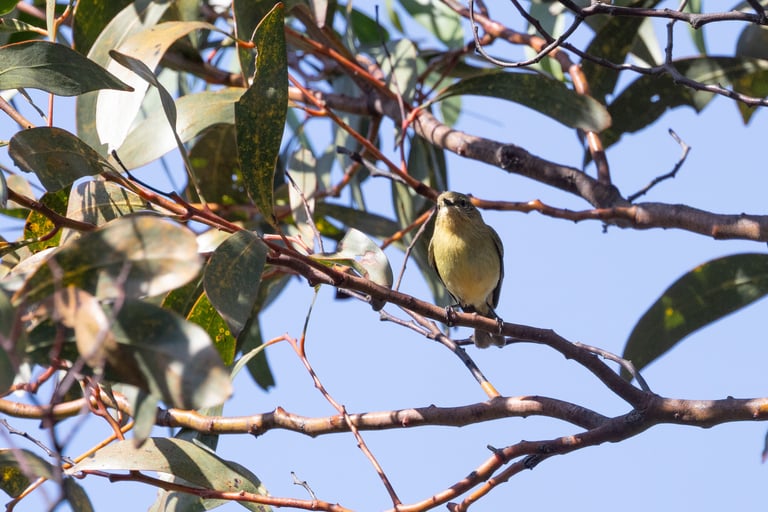
This is a medium-sized honeyeater measuring 22 to 28 centimeters in length, with a wing length of 12 to 13.8 centimeters and a bill around 25 millimeters long. Adults weigh between 50 and 61 grams. The dorsal surface is dark grey with medium grey patterning, while the underside is light grey to white with light grey scalloping across the chest. A black patch surrounds the eye, framed by bright yellow bare skin and a yellow bill; the iris is brown, and the legs are yellow as well.
Fledglings have soft, undefined light grey chests lacking the adult's scalloped pattern, while immature birds retain brownish juvenile wing and tail feathers that can be checked in the hand. The amount of yellow highlighting above and below the bill, on the forehead, and on the throat varies among individuals.
Compared to the noisy miner, which shows white rather than yellow above the bill and little to no yellow on the forehead or neck, the yellow-throated miner is noticeably yellower-faced. It differs from the black-eared miner in that its lower jaw feathering is paler than its throat, the reverse of the pattern in pure black-eared miners; hybrids between the two show a range of intermediate rump and jaw shades. Subspecies vary slightly too, with M. f. obscura darker overall and M. f. lutea showing more yellow.
Distribution and Habitat
The yellow-throated miner has the widest distribution of any Manorina species, occurring across most of Australia except the region east of the Great Dividing Range, Cape York Peninsula, the far northeastern Northern Territory, and small patches of the driest central deserts.
Five subspecies divide this range: M. f. wayensis spans the middle of Western Australia through to western Queensland, M. f. flavigula covers most of Queensland and extends south through New South Wales and inland Victoria, M. f. lutea occupies northern Western Australia and the Northern Territory, M. f. obscura is restricted to southwestern Western Australia, and M. f. melvillenis occurs in the far north of the Northern Territory.
The species favors arid and semi-arid woodlands and scrublands, including acacia, eucalyptus, mallee, and casuarina, though it also extends into temperate, subtropical, and tropical areas. It has a strong affinity for edge habitats and disturbed ground, readily colonizing regrowth, roadsides, and land next to cleared paddocks. While it prefers some tree cover and is rarely found in dense mature mallee, it will venture further into open pasture than the noisy miner does.
Observation records show numbers rising through the Australian winter and spring months and peaking around September, suggesting greater presence in the landscape during that period, though these counts reflect where the species has been recorded rather than its actual abundance.

Behavior and Lifestyle
Yellow-throated miners live in complex communal groups of up to 50 birds, though they are more often seen in smaller parties of a dozen or fewer, and sometimes in pairs or alone. Group size tends to grow during the non-breeding season, likely reflecting local movements rather than true migration, since the species is largely sedentary with no known migratory pattern, even as some populations shift locally throughout the year.
The species is highly watchful and often the first to sound an alarm when a predator approaches, using calls that are higher-pitched than but readily recognizable as those of other miners. This vigilance extends into notably aggressive behavior toward other birds, especially smaller insectivores and honeyeaters, and colonies have been observed monopolizing patches of remnant roadside vegetation, cutting off movement corridors for smaller species.
Despite this aggression, the species has been found sharing territory with grey and pied butcherbirds, even nesting nearby, possibly because the miners' constant vigilance benefits both species' nest defense. It has also been seen feeding peacefully alongside mixed flocks of other honeyeaters, including noisy miners, white-plumed honeyeaters, friarbirds, and blue-faced honeyeaters.
Diet and Nutrition
Yellow-throated miners feed actively and noisily, usually in small groups of five to ten birds, foraging mainly in the canopy where they probe flowers for nectar and glean leaves and bark for spiders and insects, though they glean less than other miner species.
The diet is varied, combining invertebrates, nectar, and occasional fruit, with studies finding insect-to-nectar ratios ranging from about 65 to 70. Birds also forage on the ground, probing among herbs, leaf litter, and stones for invertebrates, and they catch insects in flight using a sally-stall maneuver roughly 6% of the time, relying on wing-powered foraging more than other Manorina species.
Chicks are fed almost exclusively insects until fledging, after which they begin exploring flowers for nectar themselves.
Nesting and Breeding
Breeding in yellow-throated miners is typically cooperative and colonial, though isolated pairs also nest, generally with lower success since pair attempts without helpers fail more often. Breeding can occur throughout the year but peaks from August through October, with multiple clutches common in a season.
The nest is a sturdy cup or bowl built into a forked branch with good cover, woven from twigs and grasses and lined thickly with soft material, often wool. Females lay a clutch of typically three or four pink-buff eggs spotted toward the larger end, occasionally two or as many as five. Incubation, usually done by the female alone though males may help during strong wind, lasts 15 to 16 days.
Once hatched, chicks are fed by both parents and any available helpers, with as many as seven birds recorded attending a single nest. Nests are sometimes parasitized by pallid cuckoos, with parasitism rates reaching as high as 12% in some records, and also by common koels.
Fun Facts
- The yellow-throated miner can hybridize with both the noisy miner and the endangered black-eared miner, but hybridization with the black-eared miner is rare compared to how often it interbreeds with its noisy cousin despite broad range overlap.
- Before mature mallee clearing in the mid-twentieth century, yellow-throated miners rarely encountered black-eared miners, which prefer thick, undisturbed mallee; clearing opened new habitat that let the yellow-throated miner expand and begin hybridizing with them.
- Genetic analysis shows that before 1950 the two species had distinct appearances, but today a continuum of intermediate forms exists due to this hybridization, prompting culls of yellow-throated miners in reserves protecting genetically distinct black-eared miner populations.
Photos
Photographs from via iNaturalist, licensed under CC0 1.0. and by Mark Clarke via iNaturalist, licensed under CC BY 4.0., credited on each photo.
Ecology and classification
Classification
- Phylum
- Chordata
- Class
- Aves
- Order
- Passeriformes
- Family
- Meliphagidae
- Genus
- Manorina
- Species
- Manorina flavigula