Marchantia polymorpha is found on every continent except Antarctica, making it one of the most widely distributed plants on Earth.
Known as common liverwort or umbrella liverwort, it belongs to the class Marchantiopsida within the phylum Marchantiophyta, the true liverworts, and sits in the order Marchantiales and family Marchantiaceae. As a large thalloid liverwort, it lacks the roots, stems and leaves of flowering plants, instead growing as a flattened, ribbon-like body called a thallus. The species is highly variable and includes several recognized subspecies.
That variability, combined with its near-global range and unusual biology, has made it a familiar subject in botany classrooms and gardens alike, even where it turns up uninvited.
Identification and Appearance
The most useful field mark is the pattern of polygonal markings covering the upper surface of the thallus, a mosaic visible even without magnification. The plant grows as a rosette of flattened, strap-like thalli that branch by repeated forking rather than producing true leaves or stems.
Thalli reach up to 10 centimeters in length and up to 2 centimeters in width. They are typically green, though older growth can fade to brown or take on a purplish tint.
The underside of each thallus is covered in numerous root-like rhizoids, thread-like structures that anchor the plant to soil or rock rather than absorb water and nutrients the way true roots do.
Under magnification, the internal anatomy offers another distinguishing trait shared across the Marchantiopsida: complex oil bodies confined to specialized cells, where they fill nearly the entire interior of the cell.
Distribution and Habitat
Marchantia polymorpha subsp. ruderalis has a circumpolar boreo-arctic cosmopolitan distribution, occurring worldwide on every continent except Antarctica. The species as a whole ranges from tropical forests to arctic tundra.
It grows on a wide variety of sites, including cliffs, closed forests, alpine heathlands, peat bogs, minerotropic fens, springs, swamps, grasslands and tundra. It favors moist or wet mineral soil, particularly in recently burned areas, and grows best in subcalcareous soil around pH 6.0 under full sunlight. Most varieties need consistently moist substrate, but Marchantia polymorpha var. aquatica is semi-aquatic and often invades marshes and small ponds without a stable water table.
The species readily colonizes human-made settings too, turning up in gardens, on paths and in greenhouses, where it is often treated as a horticultural weed. It can spread inadvertently through the nursery trade when infested plant liners are grown in one region and shipped to retail locations elsewhere. Remarkably, it has also established itself in caves lit only by artificial light, including Niagara Cave and Crystal Cave in Wisconsin, where it has even been observed producing gemmae.
Monthly observation counts rise sharply through spring and peak in July, with a secondary high in August, before tapering off toward winter. Since these figures reflect presence records rather than actual population size, they should be read only as a rough hint of when the species is most visible or actively surveyed, likely tied to its growing season.

Growth and Form
Marchantia polymorpha follows the alternation of generations typical of liverworts, cycling between a haploid gametophyte and a diploid sporophyte stage. The leafy, photosynthetic thallus that people generally notice is the gametophyte, the dominant and long-lived phase of the plant.
The gametophyte produces haploid gametes, an egg and a sperm, which fuse to form a diploid zygote. That zygote develops into a sporophyte, which in turn produces haploid spores through meiosis, restarting the cycle as those spores germinate into new gametophytes.
Reproduction and Life Cycle
Sexual reproduction relies on umbrella-shaped structures called gametangiophores, which rise on stalks above the thallus. In female plants, these are archegoniophores, topped with star-like rays that bear archegonia, the organs producing the ova. Male plants instead produce antheridiophores, topped by a flattened disc containing antheridia that generate sperm.
The species also reproduces asexually through gemmae, lentil-shaped propagules produced within small gemma cups on the thallus surface. Water droplets splash the gemmae free, and each one can grow into a new plant, allowing a single colony to expand into a significant patch without any sexual reproduction at all.
Ecology and Relationships
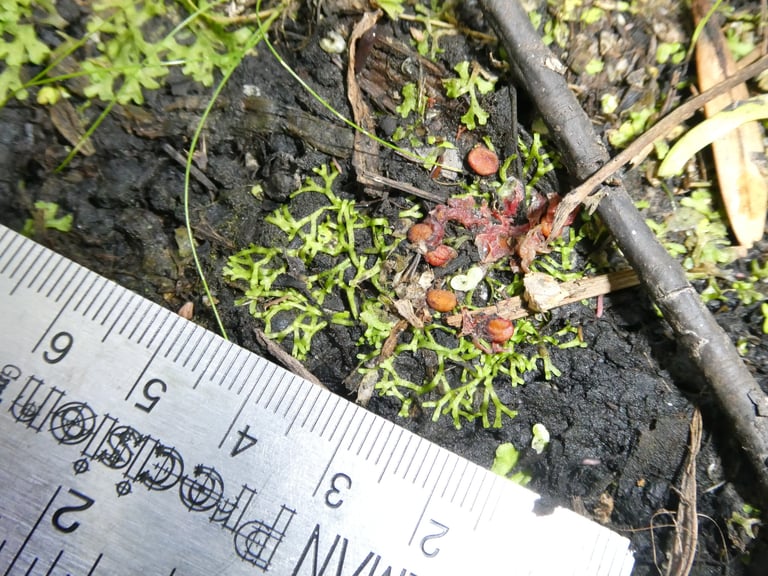
Marchantia polymorpha is often the first vegetation to reappear after a severe wildfire. Exposed mineral soil and elevated lime concentrations left behind by intense fires create favorable conditions for its gametophytes to establish, and the liverwort then grows rapidly, sometimes blanketing the entire burned site. This early cover helps prevent the soil erosion that can otherwise cause lasting environmental damage after severe fires.
As it spreads, the species renews humus in the scorched soil and gradually improves soil quality until conditions favor the return of other plants. Once that recovery is underway, it loses out to species better suited to stable conditions. In a USDA study in northeastern Minnesota, it dominated the burned landscape for three years before being replaced by lichen after five; in New Jersey, a similar fire saw it cover the ground for two to three years before local shrubs and forbs took over. A comparable succession was documented in Alaska.
In northern North America, it is commonly found alongside other post-fire colonizers such as willows, blueberries, fireweed, bluejoint reedgrass, sheathed cottonsedge, fire moss and various other mosses, forming part of a broader community of early recovery species.
Uses and Human Relationships
Historically, Marchantia polymorpha was believed to treat liver ailments, an idea rooted in the doctrine of signatures, the old notion that a plant's shape reveals its medicinal use, since the liverwort's form was thought to resemble an animal liver.
More concretely, the species produces a range of antifungal bis[bibenzyl] dihydrostilbenoid compounds, including plagiochin E, 13,13'-O-isopropylidenericcardin D, riccardin H, marchantin E, neomarchantin A, marchantin A and marchantin B. These compounds give it genuine fungicidal activity, which has been used successfully in treating fungal infections of the skin and nails.
Fun Facts
- Fossil spores resembling those of liverworts suggest some of the earliest land plants may have looked something like Marchantia polymorpha, though this hints at kinship rather than proving direct descent.
- The species can grow in total natural darkness, using only artificial light, and has been documented producing gemmae inside Niagara Cave and Crystal Cave in Wisconsin.
- Because it is so widespread and easy to observe, Marchantia polymorpha is frequently used as the representative liverwort in biology textbooks.
- Its species name, polymorpha, reflects just how variable its appearance can be, spanning several recognized subspecies and varieties.
Ecology
Habitat
- Wetland
- Forest
- Tundra
- Disturbed Ground