Floating crystalwort forms dense, tangled mats on the surface of still water, a trait that has made it a favorite among aquarium keepers who use it as shelter for young fish fry, especially in live-bearing tanks.
This is a liverwort, a member of the ancient plant division Marchantiophyta, placed in the genus Riccia within the family Ricciaceae. It grows floating on ponds and other still freshwater, often forming thick mats on and just beneath the surface.
What makes it worth a closer look is how differently it can behave depending on where it grows: left undisturbed it spreads into a soft green carpet, but in the wrong company it can just as easily be crowded out or vanish entirely.
Identification and Appearance
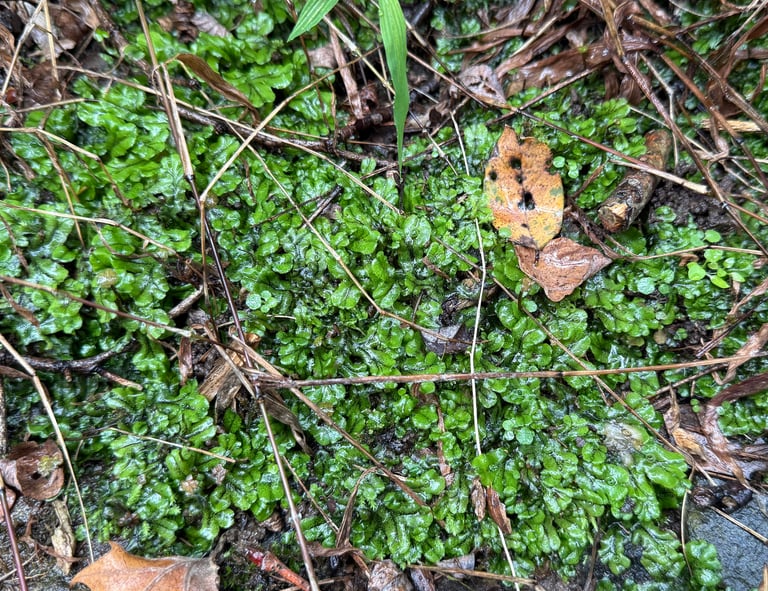
The clearest way to recognize Riccia fluitans is by what it lacks: there are no distinct leaves, stems, or roots. Instead, the plant consists of narrow, repeatedly forked, ribbon-like green strands called thalli, which branch out and interlace to form loose, tangled floating masses.
Color is a uniform bright to medium green across the thallus, without the reddish or brown tints seen in some related liverworts. The forked branching pattern gives each strand a fine, almost feathery outline when viewed closely, and this branching repeats at small, regular intervals along the plant's length.
Because the whole plant is thallus rather than differentiated leaf and stem tissue, it looks the same from base to tip, with no obvious front, back, or growth point visible to the naked eye. It floats freely rather than rooting into substrate, which alone distinguishes it from most other aquatic plants sold or found alongside it.
Distribution and Habitat
Riccia fluitans is a floating species of still or slow freshwater, most often found in ponds, where it drifts on the surface or forms mats that extend just below it. It does not root into the bottom, so its presence tracks open, calm water rather than any particular soil or substrate type.
Monthly observation records show a pronounced rise through late spring into summer, climbing from a low of around 242 sightings in February to a peak near 3,670 in July, before falling back sharply by October and November. This pattern suggests the plant, or at least reports of it, is far more conspicuous during the warmer months, likely reflecting more active growth and easier detection when mats are dense and visible at the surface.
These figures come from occurrence records and reflect where and when the species has been observed, not its abundance or the full extent of its range, so the summer peak should be read as a seasonal visibility pattern rather than proof of a population surge.

Fun Facts
- The species name fluitans comes from Latin for "floating," a direct reference to its free-floating habit on the water surface.
- In aquariums, floating crystalwort is prized as a nursery habitat: its tangled mats give newly hatched fry places to hide from adult fish.
- It does not compete well with duckweed, which spreads across the water surface fast enough to crowd Riccia fluitans out.
- Hair algae can just as easily overtake it, smothering the delicate thalli and outcompeting it for light and space.
Ecology
Habitat
- Wetland
- Freshwater