The masked tityra wears a striking bare patch of rosy red skin around its bill and eyes, giving it the look of a bird in a mask. It is a medium-sized passerine in the family Cotingidae, found across an enormous range spanning Mexico, every Central American country, and most of northern and central mainland South America except the Guianas.
The IUCN lists the masked tityra as Least Concern, and its huge range and large population back that assessment. Beyond its unusual face, the species stands out for its varied, almost insect-like vocal repertoire and its habit of nesting in old woodpecker holes.
Identification and Appearance
The bare rosy red skin running from the bill to and around the eye is the masked tityra's most distinctive feature, present in both sexes but framed differently depending on sex. Adults measure 20 to 24 centimeters long and weigh between 77 and 88 grams.
Adult males of the nominate subspecies have a black forecrown that wraps behind and under the red facial skin, pale grayish-white upperparts with a pearly gray cast, mostly black wings with grayish-white tertials, and a grayish-white tail marked with a wide black band near the tip. Their throat and underparts are whitish.
Females share the same bare red facial skin but lack any black on the head; their head is a smokier gray, their upperparts darker gray with brown streaks and smudges, and their throat and underparts a dingy pale gray. Both sexes have a reddish brown to brick-red iris, a slightly hooked rosy red bill tipped in black, and blackish legs and feet.
Nine subspecies vary subtly in shade and pattern: T. s. nigriceps is whiter overall with more black on the face and a wider tail band, T. s. deses is paler overall, and T. s. fortis resembles the nominate but has a longer bill, among other regional differences.
Distribution and Habitat
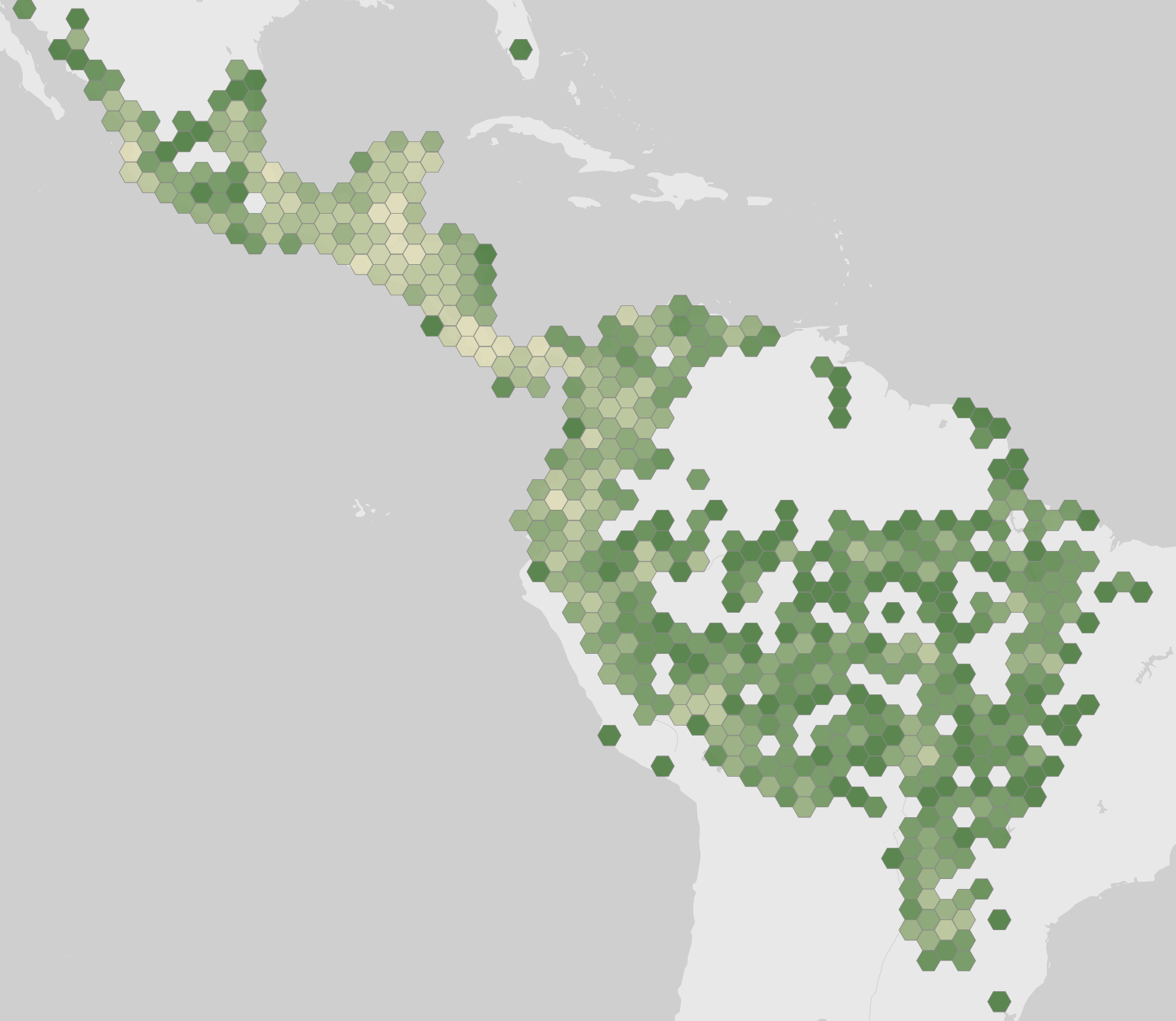
The masked tityra occupies an enormous range, from northwestern Mexico through every Central American country and into northern and central mainland South America as far as Paraguay and possibly northeastern Argentina, covering roughly 6,820,000 square kilometers. It favors forested but somewhat open landscapes: canopy, clearings and edges of lowland and montane evergreen forest, secondary forest, semi-open woodland, savanna with scattered trees, and plantations such as coffee farms.
Elevation limits shift regionally, reaching up to 2,500 meters in western Mexico and northern Central America but only 1,100 meters in Ecuador. The species is a year-round resident essentially everywhere it occurs, though one individual turned up in southern Texas in early 1989 after a severe freeze pushed it north of its normal Mexican range.
Behavior and Lifestyle
The masked tityra lives alone, in pairs, or in small, loosely scattered flocks, coming together in small, mostly male groups during the breeding season. It perches and forages within the forest's mid-story to canopy, an insessorial lifestyle built around staying in the trees rather than on the ground.
Pairs defend their nesting territory but likely do not defend feeding areas, suggesting territoriality is tied specifically to reproduction rather than year-round resource control. As a sedentary species, it stays put through the year across nearly its entire range, with wandering individuals like the Texas bird in 1989 being notable exceptions tied to extreme weather.
Communication
The masked tityra has an unusually varied vocal repertoire, much of it buzzy and insect-like rather than typically birdlike. Calls include a staccato, nasal zzzu rrk or zzr zzzrt, a croaking rr-rr-rrk, and a dry, grunting, almost pig-like querp or kuert, sometimes doubled.
It also produces a longer, more rhythmic two-pitched series, ghe-rák-gherik, along with quieter rruk, rruk or eg-eg calls and a snorted gaaaa. Males additionally use a visual display, running back and forth along a branch while drooping their wings and croaking, to court females.
Diet and Feeding Habits
Fruit makes up most of the masked tityra's diet, supplemented with invertebrates and occasionally small lizards. It forages alone, in pairs, or in small groups, mostly from the forest's mid-story up into the canopy, and does not join mixed-species feeding flocks.
Its feeding technique centers on perching in the open and gleaning food while stationary or while hopping along a branch. It sometimes takes food with a short sally from its perch, occasionally including a brief hover, rather than pursuing prey in sustained flight.
Nesting and Breeding
Breeding season timing shifts by region: May in Guatemala, March through July in Costa Rica, and January through May in Colombia. Courtship involves males running back and forth on a branch, drooping their wings and croaking to attract a female.
The species nests in tree cavities, often an old woodpecker hole, lined with a bed of dead leaves, twigs, and other plant fibers. Most nests sit between about 12 and 30 meters above the ground, though some have been found as low as 3.4 meters.
The female lays a clutch of two to three eggs and incubates alone for about 18 to 21 days. Once hatched, the young fledge after roughly 20 to 30 days, with both parents provisioning the nestlings during that time.
Conservation and Threats
The IUCN classifies the masked tityra as Least Concern, reflecting its extremely large range and an estimated population of at least five million mature individuals, even though that population is believed to be decreasing. No immediate threats have been identified for the species.
It is described as fairly common to common across most of its range, including northern Central America, Costa Rica, Colombia, Venezuela, and Brazil, fairly common in Ecuador, and the most common and widespread tityra in Peru. It occurs in many national parks and other protected areas, and much of its suitable habitat remains in relatively pristine condition across its large range.
Fun Facts
- The genus name Tityra comes from "Tityri," the name the Ancient Greeks gave to satyrs and other mythological companions of Pan and Bacchus.
- The genus Tityra was introduced in 1816 by French ornithologist Louis Pierre Vieillot, with the black-tailed tityra designated as its type species.
- Tityras, including this species, were once classified within the tyrant flycatcher family Tyrannidae before being reassigned, along with becards and a few other species, to the family Tityridae.
Photos
Photographs from via iNaturalist, licensed under CC0 1.0., by Roger A. Morales-Flores via iNaturalist, licensed under CC BY 4.0., by avocat via iNaturalist, licensed under CC BY 4.0., by Nicolas Olejnik via iNaturalist, licensed under CC BY 4.0., by Javier Hernandez via iNaturalist, licensed under CC BY 4.0., by Conrado Pável de Oliveira via iNaturalist, licensed under CC BY 4.0., by Viktor via iNaturalist, licensed under CC BY 4.0., by Theo Rickert via iNaturalist, licensed under CC BY 4.0., and by Sebastián de Jesús Herrera Buenfil via iNaturalist, licensed under CC BY 4.0., credited on each photo.
Ecology and classification
Classification
- Phylum
- Chordata
- Class
- Aves
- Order
- Passeriformes
- Family
- Cotingidae
- Genus
- Tityra
- Species
- Tityra semifasciata
Sources
- GBIF Species names and classification
- iNaturalist Photos
- Wikidata Common names and conservation status
- Wikipedia Summary extract
- Encyclopedia of Life Habitat, diet and behavior traits
- AVONET Bird mass, habitat, migration, diet and range size