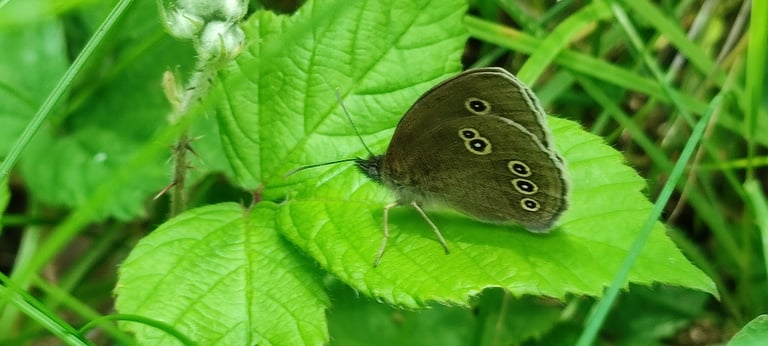
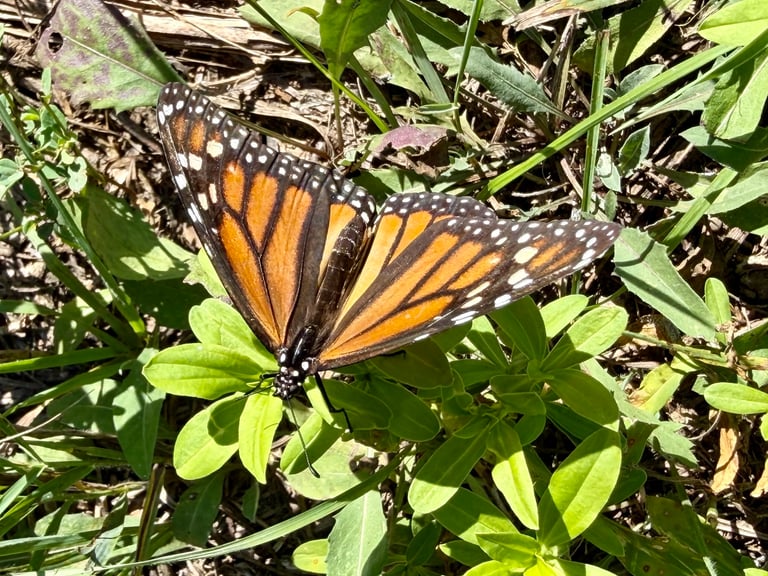
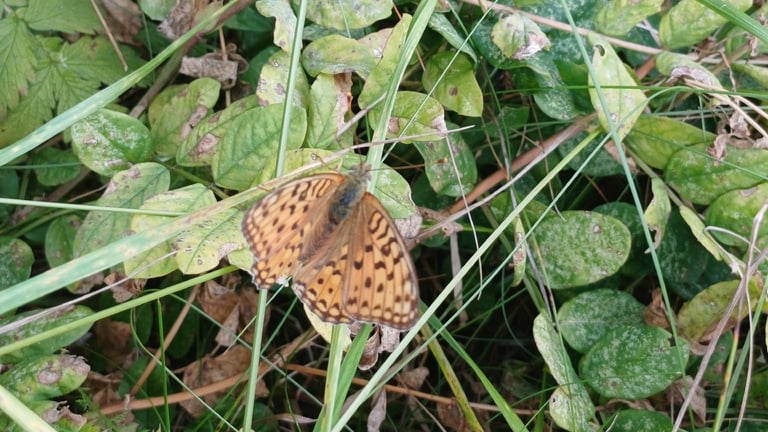
In 1980, a nationwide survey in the UK found only 31 surviving colonies of the heath fritillary, and the species was then considered the most endangered British butterfly. It is a member of the family Nymphalidae, found across the Palaearctic region from western Europe to Japan.
The butterfly occupies grassy, flowery places in heathland, grassland and coppiced woodland. It is considered threatened in the UK and Germany, but not across Europe or globally.
Identification and Appearance
The upperside is mostly dark brown and orange-brown. Orange-brown spots are outlined in dark brown along and across the veins, and a white fringe runs around the wings. The body is dark brown, matching the wings. The wingspan measures 39–47 mm.
The underside is the clearest guide. It shows bands of red and off-white, with each vein and colour edged in dark brown. The pattern of white spots at the base of the hindwing is visible when the butterfly is at rest and is diagnostic for identification.
The heath fritillary looks very similar to Melitaea cinxia. The dark brown bands on the underside are sharper in the heath fritillary, which helps separate the two.
Distribution and Habitat
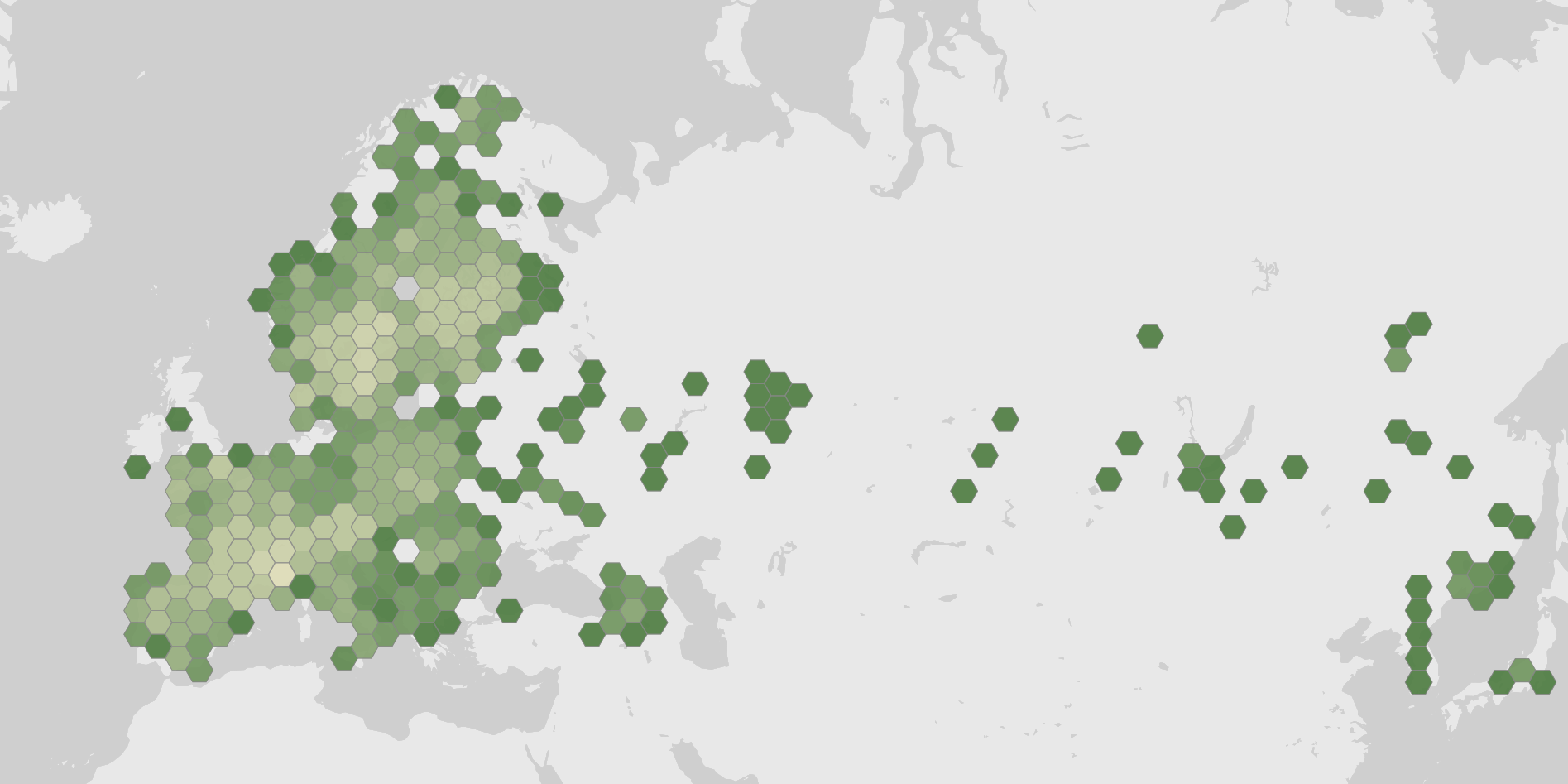
The heath fritillary ranges across the Palaearctic region from western Europe to Japan. In Europe it is absent from Iceland, Ireland, Scotland, Wales, southern Portugal, southern Spain, the Mediterranean islands and southern Greece.
In the UK, it is restricted to three areas. These are grasslands in Cornwall and Devon (abandoned hay meadows), heathland on Exmoor, and coppiced woodland on acid soils in Kent and Essex. The Essex population results from reintroductions, and further reintroductions are under way in other parts of the UK.
In England it uses three habitats: unimproved grassland with short or sparse swards of ribwort plantain or germander speedwell on stony soils, sheltered heathland with common cow-wheat among bilberry on mineral soils in valleys, and coppiced woodland with common cow-wheat, especially in clearings. In France it also occurs on unimproved hay meadows and pastures.
The species occurs from sea level up to 2,600 m. Observation records peak in June and July, with activity falling away sharply by late summer.
Diet and Nutrition
The heath fritillary feeds on a wide range of flowering plants. The main food group is the figwort order (Lamiales), which includes common cow-wheat and ribwort plantain. Plants in the daisy family (Asterales) and the honeysuckle order (Dipsacales) are also important food sources.
Common cow-wheat is one of the plants that stands out in its diet, and it is closely tied to the butterfly's woodland and heathland sites. Ribwort plantain is also frequently used, especially in grassland habitats.
Smaller groups include plants from the pink order (Caryophyllales) and the pea family (Fabales).
Population and Ecological Role
The heath fritillary is eaten by songbirds, mainly pipits, skylarks, long-tailed tits and warblers. Bats such as the brown long-eared bat and the greater horseshoe bat also prey on it.
Parasitic wasps of the genus Cotesia attack the butterfly, with Cotesia acuminata and Cotesia melitaearum among the main species. These wasps are part of the species' natural enemies and help link it to the wider food web.
Conservation and Threats
The heath fritillary is not listed on the IUCN Red List, so it is not considered globally threatened. It is classed as Least Concern at the European scale, but it is on the Red List in Germany and is considered threatened in the UK.
In the UK, the species was given protection under the Wildlife and Countryside Act 1981. It has been a high priority species in the UK Biodiversity Action Plan since 1995 and has its own Species Action Plan. Even so, its distribution has fallen by 25% since the 1970s, and its abundance declined by 46% between 1995 and 2004.
Woodland sites in Kent and Essex are managed by coppicing to maintain suitable conditions. The Wilder Blean project, led by the Wildwood Trust and Kent Wildlife Trust, is introducing European bison to the UK for the first time in 6,000 years. Their grazing creates open, sunlit patches that encourage the growth of cow-wheat. A herd of three females and one male will be released in 2022 within a 2,500-acre conservation area in Blean Woods near Canterbury.
Photos
Photographs from via iNaturalist, licensed under CC0 1.0., by Edmundas Greimas via iNaturalist, licensed under CC BY 4.0., by iwonaadamska via iNaturalist, licensed under CC BY 4.0., by Leonard Worthington via iNaturalist, licensed under CC BY 4.0., by Kai Löhr via iNaturalist, licensed under CC BY 4.0., by Oleg Kosterin via iNaturalist, licensed under CC BY 4.0., by Jonas Sielenkämper via iNaturalist, licensed under CC BY 4.0., by Jeff Clark via iNaturalist, licensed under CC BY 4.0., by Bobo-X via iNaturalist, licensed under CC BY 4.0., and by Benjámin Gábor Balog via iNaturalist, licensed under CC BY 4.0., credited on each photo.
Ecology and classification
Classification
- Phylum
- Arthropoda
- Class
- Insecta
- Order
- Lepidoptera
- Family
- Nymphalidae
- Genus
- Mellicta
- Species
- Mellicta athalia
Sources
- GBIF Species names and classification
- iNaturalist Photos
- Wikidata Common names and conservation status
- Wikipedia Summary extract
- GloBI What it eats, what eats it, parasites and pollinators
- trophiCH
- Wardeh et al. 2015 (EID2)
- DoPI
- Schwarz et al. 2021
- EuPPollNet