The mourning cloak often becomes the first butterfly seen each year, emerging from hibernation before the last snow has melted across much of its range.
Known as the Camberwell beauty in Britain, Nymphalis antiopa is a large butterfly native to both Eurasia and North America, ranging from hardwood forests to gardens and parks. It carries a Least Concern conservation status. A powerful, sometimes far-ranging flier, it turns up occasionally well outside its usual range, and its unmistakable wing pattern and unusual winter habits make it one of the more distinctive butterflies in its family.
Identification and Appearance
The single best field mark is the wing pattern: dark maroon uppersides with ragged, pale-yellow borders and a row of iridescent blue spots set against the black band separating the two colors. No other butterfly shares this combination, making the species easy to identify once seen.
Adults reach a wingspan of up to four inches. The underside of the wings shows gray striations, keeping the same pale-yellow edging, which helps the butterfly blend into bark when its wings are closed. The species shows no obvious sexual dimorphism, so males and females look alike.
The caterpillar looks very different from the adult: velvety black with white dots, rust-colored prolegs, black spines, and a row of eight reddish-orange dots down its back, an aposematic pattern that warns predators. Fully grown caterpillars reach about two inches. The chrysalis is tan to gray, up to 2.8 cm long, with two head horns, a beak-like projection, and rows of red-tipped spikes along its sides.
Eggs start out amber-yellow or pale olive-green, shifting to lilac-pink and then almost black as they near hatching, and are laid in rings around twigs.
Distribution and Habitat
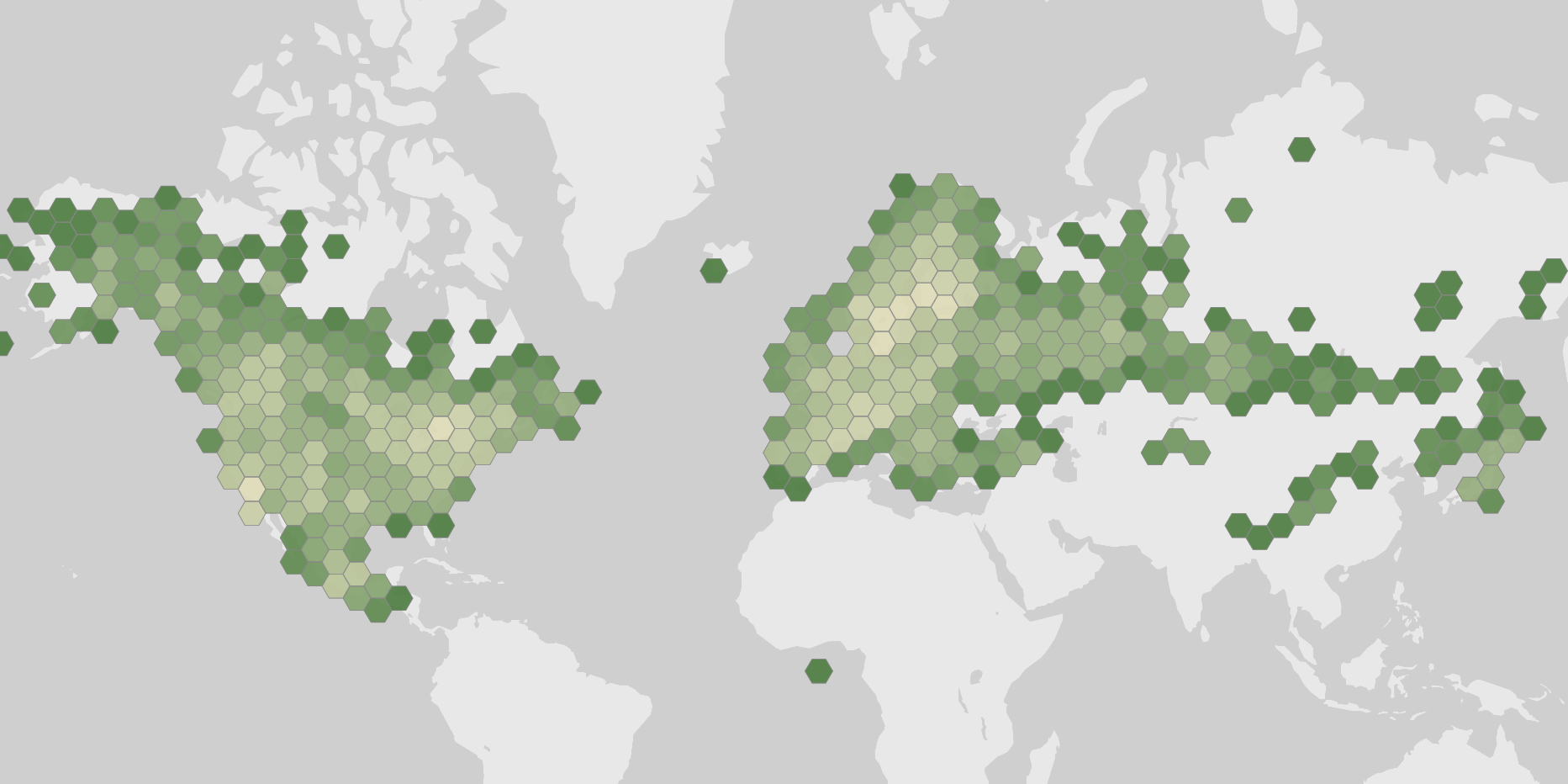
The mourning cloak has one of the broadest ranges among Northern Hemisphere butterflies, found throughout North America, northern Eurasia, and reaching as far south as northern South America, though it is seen less often in states like Florida, Louisiana, and Texas. In North America three subspecies are recognized: the northern N. a. hyperborea, eastern N. a. lintnerii, and southwestern N. a. thomsoni.
It favors hardwood forests but turns up in nearly any habitat, including watercourses, sunny glades, forest borders, parks, gardens, and open woodlands. During hibernation it shelters under the eaves of houses, in cellars, crevices, and hollows.
In Great Britain, migrants arrive most years in summer and autumn, but in low numbers, and there is no evidence the species breeds there; mild, wet winters are thought to prevent long-term survival. One butterfly farmer speculated that Camberwell beauty sightings clustered suspiciously around timber-trade ports such as London, Hull, and Harwich, suggesting some arrivals may have hibernated in shipped timber stacks rather than flying to Britain naturally.
Observation records peak from spring through late summer, consistent with the species being active and breeding during those warmer months before entering hibernation.
Behavior and Lifestyle
The mourning cloak is on the wing nearly all year, most active in spring, late summer, and early fall, with hibernation through winter interrupted by occasional emergences. It is often the first butterfly of spring, breaking dormancy before snow has fully melted.
After breeding in spring, adults become more active in summer, frequenting higher altitudes such as treetop branches, before entering a summer dormancy called estivation. They emerge again in autumn to build up fat reserves ahead of winter. Population numbers do not show large swings across this annual cycle.
For camouflage, the butterfly rests on dark bark, and it deliberately seeks direct sunlight on leaves or trunks, a behavior that, paired with its dark wings, maximizes heat absorption in colder, mountainous habitats. Males are strongly territorial, defending areas averaging more than 300 square meters, chasing off other butterflies and even birds with aggressive flights, and rotating between favored perches to cover the whole territory.
The species is generally non-migratory, though wandering individuals occur, and one set of experiments in Germany documented a long-distance one-way movement from Bonn to Greece. As a defense mechanism, larvae and pupae twitch in unison when disturbed.
Diet and Nutrition
Adult mourning cloaks feed mainly on tree sap, landing above a flow and bending the head downward to siphon it, along with rotting fruit; they rarely visit flowers but may take nectar from scabious and knapweed in summer. Their role as pollinators is minor given this preference for sap over nectar.
Caterpillars feed in groups on the leaves of deciduous trees, with willows such as Salix caprea, birches like Betula pendula and Betula pubescens, and aspens such as Populus tremula standing out among recorded host plants, alongside elm, hackberry, cottonwood, rose, and mulberry. Alder species also appear among recorded hosts.
Reproduction and Life Cycle
Males practice a polygynous, lekking mating strategy, defending sunny perches near ravines, wood margins, parks, ponds, or stream edges that can exceed 300 square meters, either waiting for females to pass through or actively searching for them in scramble competition. Prime territories raise a male's chances of encountering and mating with multiple females over a season.
Mating begins in spring, when females seek out a host plant and lay eggs in clusters that ring the twigs; eggs measure about 0.9 by 0.7 mm and darken to black before hatching. Adults typically appear from late spring through early summer, then enter estivation, a dormant state, before some individuals begin migrating in September and October ahead of overwintering.
Caterpillars pass through five instars, shedding their skin four times, growing to about two inches with black, spiny bodies lined with white dots and a mid-dorsal row of red spots. The chrysalis hangs upside down from a silk pad attached to a stem, reaching up to 28 mm, tan to gray with two head horns and a beak-like tip. The number of broods produced, usually two or three, depends on the latitude and altitude of the population.
Because adults overwinter and breed again the following spring, the full cycle from April through June repeats annually, with only occasional, minor pollination playing a side role in the species' interactions with flowering plants.
Population and Ecological Role
The mourning cloak faces predation at every life stage. Eggs are taken by beetles, true bugs, ants, beetle larvae, wasps, assassin bugs, and mites, while adults and caterpillars fall prey to praying mantises, dragonflies, and vertebrate predators including birds, reptiles, amphibians, and mammals; among recorded predators, small insectivorous birds and bats such as Plecotus auritus and Rhinolophus ferrumequinum stand out. Parasitic flies in the family Tachinidae, including Compsilura concinnata, have also been recorded attacking the species.
To counter this pressure, adults fold their wings against dark bark for camouflage, sometimes group together to fly menacingly at attacking birds, play dead by closing their wings and tucking in their legs, and produce loud clicks when fleeing. Newly hatched caterpillars can be cannibalistic, eating unhatched eggs, while older larvae cluster in groups that reduce individual predation risk and twitch in unison when disturbed.
Conservation and Threats
The mourning cloak carries a Least Concern status, with no special protections under IUCN, US federal law, CITES, or Michigan state lists, though it is legally protected in Austria and Switzerland. Population trends are reported as increasing in Finland, and the species holds a safe status in the Czech Republic.
The species appears to benefit from certain human land-use changes: fire breaks, which open up clearings, create habitat conditions the butterfly finds more inviting.
Cultural Significance
The species' scientific name, Nymphalis antiopa, draws on Greek mythology, with the epithet antiopa thought to derive from Antiope, a figure from Greek legend.
As the Camberwell beauty, it has left a mark on British culture and literature: it appears in Fred M. White's 1918 short story "A Plague of Butterflies," lends its name to a buddleia cultivar bred at the East Malling Research Station, and is depicted in a large mosaic on the Passmore Edwards library building near Camberwell in south London, once the emblem of the Samuel Jones paper company. The name has also titled several literary works, including Louis Golding's 1935 novel Camberwell Beauty, August Derleth's 1952 Solar Pons pastiche "The Adventure of the Camberwell Beauty," V.S. Pritchett's 1974 short story collection of the same name, and Jenny Eclair's 2000 debut novel.
The butterfly's cultural reach extends further still, appearing on a 1990 album cover by the band The House of Love, in a 2015 short film and earlier 1982 stage play by Chris Ward, as a track title on composer Sarah Angliss's 2017 album Ealing Feeder, and even referenced in an episode of Fear the Walking Dead.
Fun Facts
- Despite being a butterfly known mainly for feeding on tree sap and rotting fruit rather than flowers, the mourning cloak still occasionally acts as a pollinator.
- Its scientific and cultural identities diverge sharply by region: the same insect is called the mourning cloak in North America and the Camberwell beauty in Britain, with older names including grand surprise and white petticoat.
- The Camberwell beauty name has inspired works across many media in Britain, from a 1935 novel to a 2017 album track, far beyond what its modest presence as an occasional migrant there might suggest.
Photos
Photographs from via iNaturalist, licensed under CC0 1.0., by Lauren Markewicz via iNaturalist, licensed under CC BY 4.0., by Seth Wollney via iNaturalist, licensed under CC BY 4.0., by Steve Addison via iNaturalist, licensed under CC BY 4.0., by Patrick Comins via iNaturalist, licensed under CC BY 4.0., by allan5519 via iNaturalist, licensed under CC BY 4.0., by Bernie Paquette via iNaturalist, licensed under CC BY 4.0., by Wiljam Eklund via iNaturalist, licensed under CC BY 4.0., and by Jacek Kurzawa via iNaturalist, licensed under CC BY 4.0., credited on each photo.
Ecology and classification
Classification
- Phylum
- Arthropoda
- Class
- Insecta
- Order
- Lepidoptera
- Family
- Nymphalidae
- Genus
- Nymphalis
- Species
- Nymphalis antiopa
Sources
- GBIF Species names and classification
- iNaturalist Photos
- Wikidata Common names and conservation status
- Wikipedia Summary extract
- Animal Diversity Web Animal habitat, behavior and diet
- GloBI What it eats, what eats it, parasites and pollinators
- trophiCH