The gatekeeper butterfly patrols hedges and field gates with such regularity that it earned its common name from this very behavior, and it ranks among Europe's more adaptable grassland butterflies.
A member of the Nymphalidae family found widely across Europe, Pyronia tithonus is classified as Least Concern. Its caterpillars feed on common grasses like fescues and bents found in meadows and roadside verges, while the adults serve as pollinators as they move between flowers. Its sensitivity to climate makes it a useful indicator of how warming summers are reshaping insect ranges.
Identification and Appearance
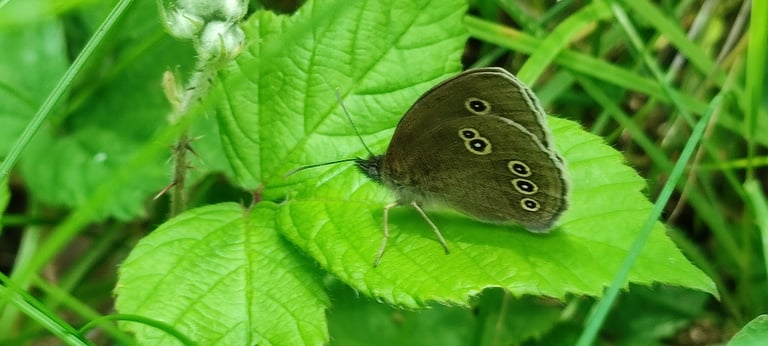
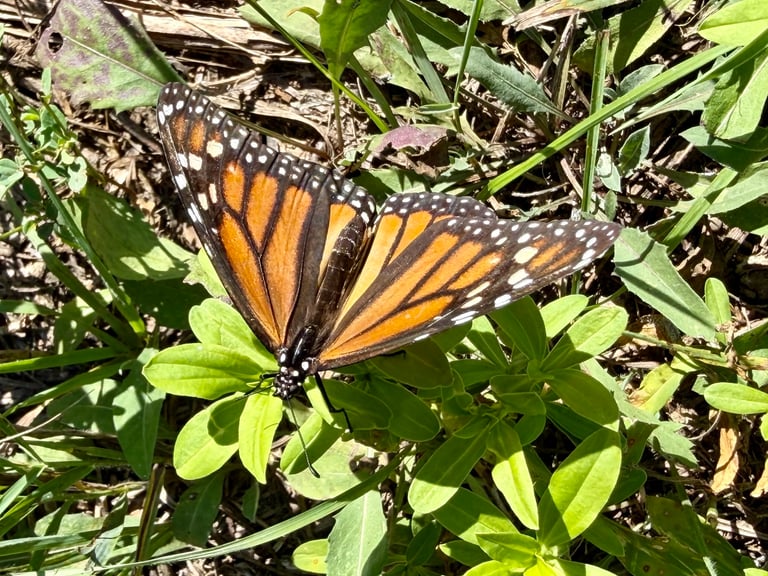
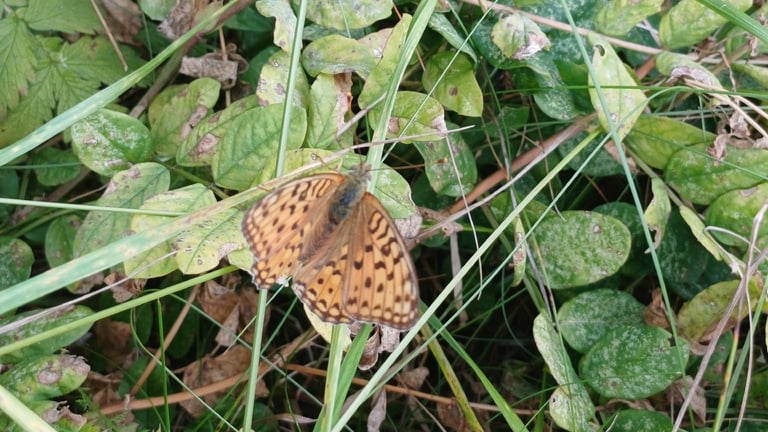
The gatekeeper is most easily recognized by its orange wings marked with two large brown spots and a brown-patterned wing edge. The eyespots on the forewings likely help deflect bird attacks toward a less vital part of the wing, which may explain why the butterfly is so often seen resting with its wings held open rather than closed.
Many aberrant forms exist, including the form excessa, in which individuals carry two to four extra spots on the forewing upperside; the number of spots on the hindwing underside also varies naturally between individuals.
Males carry a distinctive dark patch on the upperside of the forewing containing androconia, specialized scent-producing scales thought to play a role in courtship, though the exact chemistry of the pheromones involved remains unknown. Females can be told apart by having more spots overall, with eyespots spread more broadly across the wing margin, whereas males have eyespots placed closer to the wing's leading edge.
Distribution and Habitat
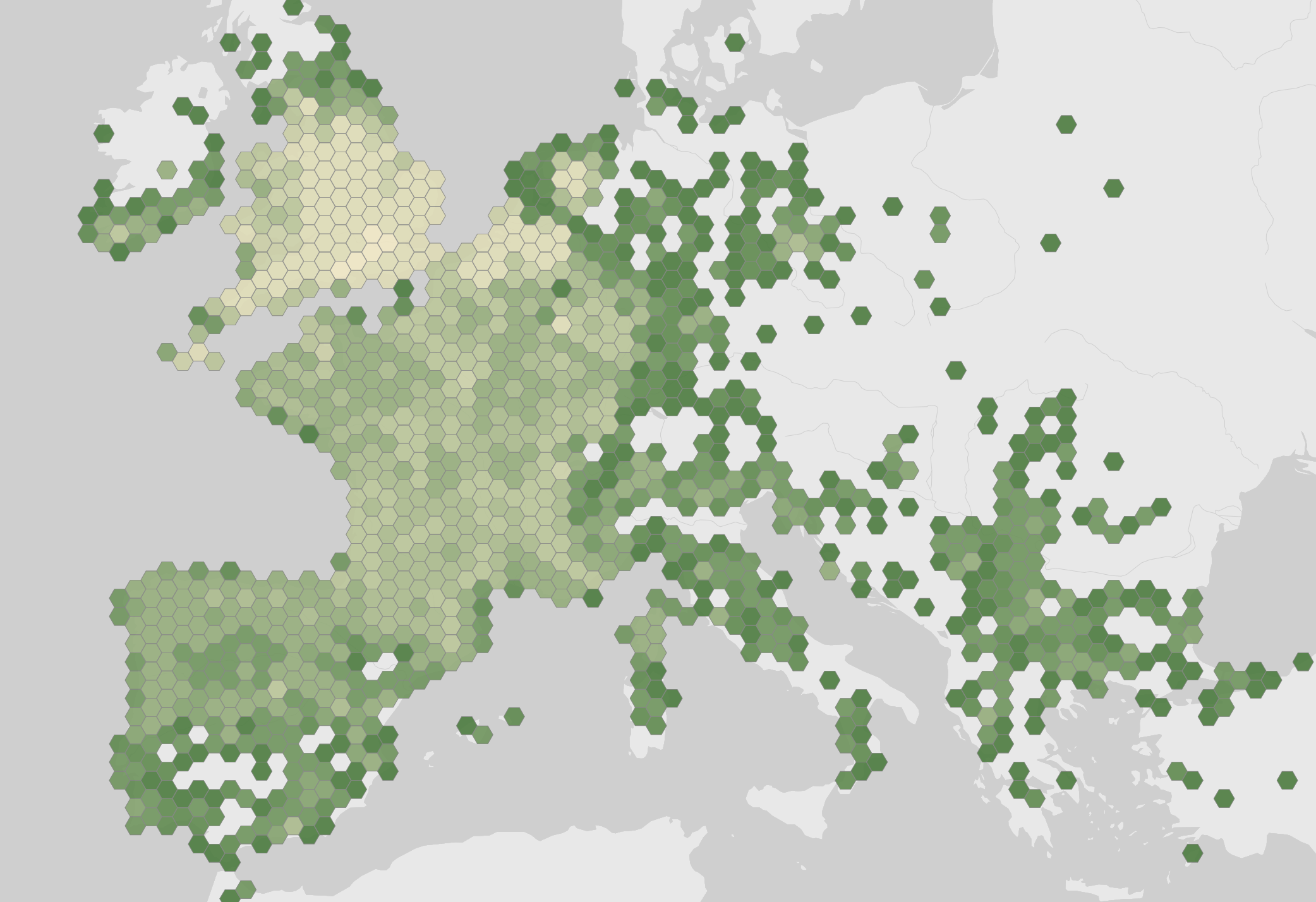
The gatekeeper favors meadow margins, hedgerows, and field gates, a preference reflected in its common name and one that sets it apart from the more widespread meadow brown. Early in the 20th century it was common across southern Britain but sparse in the north; the population then contracted before beginning a northward re-expansion in the 1940s that has continued since.
Near the edges of its range, the flight period is noticeably shorter, suggesting a link between range expansion and the lengthening of the flight season, even though mean flight date and flight-period length are not themselves related. Larger individuals have been found to travel farther, which may help explain the larger body size seen in recently expanded populations.
This expansion has brought the gatekeeper into a wide range of habitats, with some of the largest colonies found in scrubby grassland, woodland rides, country lanes, and hedgerows. That habitat breadth has given the species greater genetic diversity than more habitat-limited relatives such as Pyronia aegeria, although earlier population bottlenecks during the 20th-century contraction may have constrained how much of that diversity could be realized.
Behavior and Lifestyle
Weather governs much of the gatekeeper's daily and seasonal life: on overcast or hazy days it rests on vegetation, but in sunshine it moves actively from flower to flower gathering nectar. The species is notably active but not very mobile, a distinction that matters because activity and mobility do not always track together; in wing-damage studies, gatekeepers showed faster wear from their high activity levels despite covering relatively little ground. This low mobility may explain why the butterfly can be abundant at one site while scarce at a similar habitat only a few kilometers away.
Males are more active than females, spending much of their time searching for mates, since Pyronia tithonus is protandrous, with males emerging before females. Because females typically mate only once, they can devote more time to resting, feeding, and selecting host plants for egg-laying.
Warm, dry summers drive the biggest population increases, a pattern that helps explain the historically low numbers in cooler northern Britain and ties directly into the species' climate-driven range expansion. Synchronous abundance changes seen across multiple butterfly species point to weather as a shared underlying cause, and projections suggest gatekeeper numbers could rise by as much as 50% by 2080 under substantial climate change.
Diet and Feeding Habits
As adults, gatekeepers feed on nectar from a wide range of flowers, with a short proboscis suited to shallow blooms such as bramble, which they are frequently found around. They also visit carline thistle, devil's-bit scabious, fleabane, hemp agrimony, wild privet, ragwort, red clover, various thistles, thyme, and water mint, drawing nectar from this mix of grassland and hedgerow plants.
The larvae feed exclusively on grasses, particularly bents, fescues, and meadow-grasses, along with common couch. Among recorded food plants, perennial ryegrass, common bent, and red fescue stand out as the most frequently noted grasses, alongside cock's-foot grass and wild carrot among the broader recorded associations.
The larvae themselves are green or brown, matching their grassy surroundings, and pupate in a flimsy chrysalis that either hangs upside down or lies within the grass.
Reproduction and Life Cycle
The gatekeeper produces a single generation each year, with adults emerging in July, peaking in early August, and dwindling by month's end. No distinct courtship display has been documented, though the male's scent-producing wing patch likely plays a role in attracting mates.
Males establish small territories from which they actively seek out females. Copulation is notably long, lasting about an hour, during which the pair remains still with wings closed.
Females lay between 100 and 200 eggs, often placing them in shade or simply releasing them into the air at random rather than attaching them carefully to a plant. The larvae are initially yellow but develop brown patches and darken further as they grow inside the egg, which hatches after about 14 days.
Cultural Significance
The genus name Pyronia and the species name tithonus draw on Greek mythology: Tithonus was a Trojan prince, son of King Laomedon and the Naiad Strymo, who became the lover of Eos, the goddess of the dawn.
As a Trojan royal figure, Tithonus carries associations with narratives of eastern trade and Greco-Persian cultural exchange, linking the butterfly's name to a much older set of stories about mortality and the ties between mortals and immortals.
Fun Facts
- The butterfly's genus and species names both come from Greek mythology, honoring Tithonus, a Trojan prince loved by Eos, the goddess of the dawn.
- In one version of the myth, Eos forgot to request eternal youth for her lover, so Tithonus grew old and withered, eventually being transformed into a cicada.
- Much of what is known about the gatekeeper's population trends in Britain and Ireland comes from long-running monitoring of more than 1,500 sites since 1976.
Photos
Photographs from via iNaturalist, licensed under CC0 1.0., by Barry Stewart via iNaturalist, licensed under CC BY 4.0., by Tilgate Zoo via iNaturalist, licensed under CC BY 4.0., by Simon Baldwin via iNaturalist, licensed under CC BY 4.0., by Leonard Worthington via iNaturalist, licensed under CC BY 4.0., by geoffWCNR via iNaturalist, licensed under CC BY 4.0., and by James Heal via iNaturalist, licensed under CC BY 4.0., credited on each photo.
Ecology and classification
Classification
- Phylum
- Arthropoda
- Class
- Insecta
- Order
- Lepidoptera
- Family
- Nymphalidae
- Genus
- Pyronia
- Species
- Pyronia tithonus