The chalk-browed mockingbird is known for mimicking other species, including raptors, within its own loud and varied song.
It belongs to the family Mimidae within the order Passeriformes, and lives across a wide stretch of South America, including Brazil, Bolivia, Argentina, Paraguay, Suriname, and Uruguay. The IUCN lists it as Least Concern.
Its comfort around people, from pastures to city parks, combined with its vocal versatility, makes it one of the more noticeable birds across its range.
Identification and Appearance
The broad white supercilium (eyebrow stripe) against a dark brown crown is the bird's most useful field mark, paired with a blackish line through the eye and white cheeks. It measures 23.5 to 26 centimeters long and weighs between 55 and 73 grams, with males running slightly larger than females.
The upperparts are brownish with darker streaking, and the rump is buffier than the back in the nominate form. The wings and tail are blackish; most tail feathers carry white tips, and the outer ones show white edges, producing a flash of white in flight. The folded wing shows two faint bars.
Below, the bird is white from throat to vent, though the breast carries a gray tinge and the flanks are buffy with faint dark streaking. Juveniles are browner overall, with buffier underparts and dark streaks across the breast.
The four subspecies differ subtly: M. s. frater is browner with a rump that lacks the nominate's buff tone, M. s. arenaceus resembles frater but has a larger bill, and M. s. modulator shows blackish-brown spotting on the crown and back, lacks the gray breast tinge, and has paler, often unstreaked flanks.
Distribution and Habitat
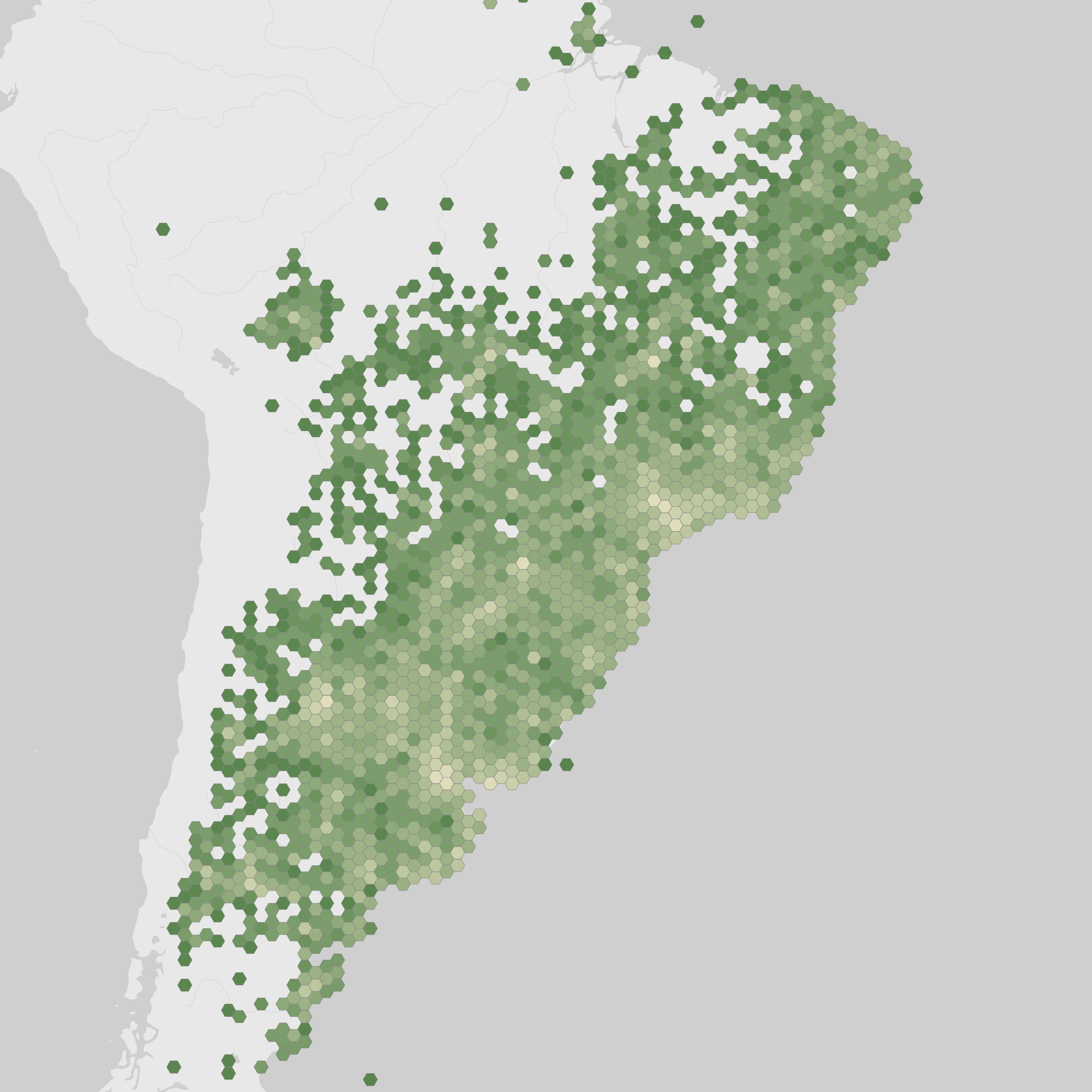
The chalk-browed mockingbird occupies a very large range across South America, spanning Brazil, Bolivia, Argentina, Paraguay, Suriname, and Uruguay, with an estimated extent of about 7,200,000 square kilometers. Its four subspecies divide this range geographically: the nominate form occurs in southern Suriname and adjoining Pará state in Brazil, M. s. arenaceus in eastern Brazil from Paraíba to eastern Bahia, M. s. frater across central and eastern Bolivia and much of central Brazil, and M. s. modulator from southeastern Bolivia and Paraguay into central Argentina and extreme southeastern Brazil.
It favors open and semi-open country: savannas, low woodland, bushland, palm swamp, pasture, forest edges, and urban parks and gardens. It avoids only the extremes — dense forest on one side and treeless land on the other. Though mainly a lowland bird, it reaches as high as about 2,500 meters in northern Argentina.
Monthly presence observations show counts rising toward the later months of the year, peaking around October, though these figures reflect observation activity rather than a true population count.
Communication
The chalk-browed mockingbird's song is loud and varied, made up of a shifting series of notes, trills, and phrases. Its calls include a sharp, penetrating "tshrip" and a snorting "sha-sha-sha."
A notable feature of its vocal repertoire is mimicry: the species often imitates other birds, including raptors, weaving their sounds into its own song.
Recordings
song · Argentina · Pedro Sanetti · Public domain
song · Argentina · Pedro Sanetti · Public domain
Diet and Nutrition
As an omnivore, the chalk-browed mockingbird feeds on fruits, seeds, berries, insects, and other small vertebrates, foraging mostly on the ground. Its diet shifts opportunistically among plant and animal food depending on what is available.
It occasionally preys on the eggs and nestlings of other birds, adding an opportunistic predatory element to its otherwise varied, ground-based foraging.
Nesting and Breeding
Breeding runs from September to January. The species is monogamous and territorial, though both related and unrelated helpers have been recorded assisting with territory defense and care of the young, a form of cooperative breeding.
The nest is a shallow cup of twigs lined with finer material, typically placed in a low tree or dense shrub within 3 meters of the ground, though sometimes higher. Clutches contain three or four eggs.
Nests often fall victim to brood parasitism by the shiny cowbird (Molothrus bonariensis), which lays its own eggs for the mockingbird to raise alongside or instead of its own.
Conservation and Threats
The IUCN classifies the chalk-browed mockingbird as Least Concern, reflecting its large range — estimated at 10,600,000 square kilometers — and its abundance across much of that range. The population is believed to be stable, and the species occurs in several protected areas.
No major threats have been identified. The main pressure on reproduction comes from nesting losses to shiny cowbird brood parasitism, described as considerable, though this has not translated into an overall population decline.
Cultural Significance
The species' scientific name, saturninus, echoes the Roman god Saturn, a deity tied to agriculture, wealth, and time, traditionally pictured as an older bearded man holding a sickle or scythe.
Beyond this naming link, the bird appears in digital heritage and natural history collections documenting specimens from across its South American range, such as historical field records from Amapá, Brazil.
Fun Facts
- The species is divided into four subspecies — arenaceus, frater, modulator, and the nominate saturninus — each occupying a distinct part of its South American range.
- Its scientific name, saturninus, traces back to the Roman god Saturn.
Photos
Photographs from via iNaturalist, licensed under CC0 1.0., by Ernesto Fernandez Polcuch via iNaturalist, licensed under CC BY 4.0., by PampaSorro via iNaturalist, licensed under CC BY 4.0., by William Stephens via iNaturalist, licensed under CC BY 4.0., by The Great Walter via iNaturalist, licensed under CC BY 4.0., by Roger A. Morales-Flores via iNaturalist, licensed under CC BY 4.0., by Davi Eduardo via iNaturalist, licensed under CC BY 4.0., by Manuel Farias via iNaturalist, licensed under CC BY 4.0., by Gabriel O. Keller via iNaturalist, licensed under CC BY 4.0., by Nahuel Di Marco via iNaturalist, licensed under CC BY 4.0., by Joaquín Krasuk via iNaturalist, licensed under CC BY 4.0., by Lauu via iNaturalist, licensed under CC BY 4.0., by avocat via iNaturalist, licensed under CC BY 4.0., and by Nicolas Olejnik via iNaturalist, licensed under CC BY 4.0., credited on each photo.
Ecology and classification
Classification
- Phylum
- Chordata
- Class
- Aves
- Order
- Passeriformes
- Family
- Mimidae
- Genus
- Mimus
- Species
- Mimus saturninus
Sources
- GBIF Species names and classification
- iNaturalist Photos
- Wikidata Common names and conservation status
- Wikipedia Summary extract
- Encyclopedia of Life Habitat, diet and behavior traits
- Xeno-canto Audio recordings
- AVONET Bird mass, habitat, migration, diet and range size