Weighing barely 28 grams, Myotis myotis can live more than 35 years, an extraordinary lifespan for an animal that could sit comfortably in the palm of a hand.
The greater mouse-eared bat belongs to the family Vespertilionidae and ranges across most of Europe, along with parts of the Mediterranean and the Middle East. It is currently assessed as Least Concern by the IUCN.
What makes it worth a closer look is its size and its hunting style: it is one of the largest bats on the continent, and unlike most of its relatives, it catches much of its food by listening for prey moving on the ground rather than chasing insects through the air.
Identification and Appearance
The most useful field mark is the combination of a long, broad muzzle and large, long ears, topped by a tragus that reaches about half the length of the ear and usually ends in a small black tip.
This is a big bat by European standards, weighing up to 45 grams and measuring 8 to 9 centimeters from head to tail, a little larger than a house mouse (Mus musculus). Its wingspan reaches about 40 centimeters, with a forearm around 6 centimeters long and a tail of 4 to 5 centimeters.
The fur is brown to reddish-brown across the back, fading to a dirty white or beige on the belly. The wing membranes are brownish, matching the overall tone of the animal.
Females are slightly larger than males, a modest sexual dimorphism typical of vespertilionid bats, though the two sexes otherwise look alike.
Distribution and Habitat
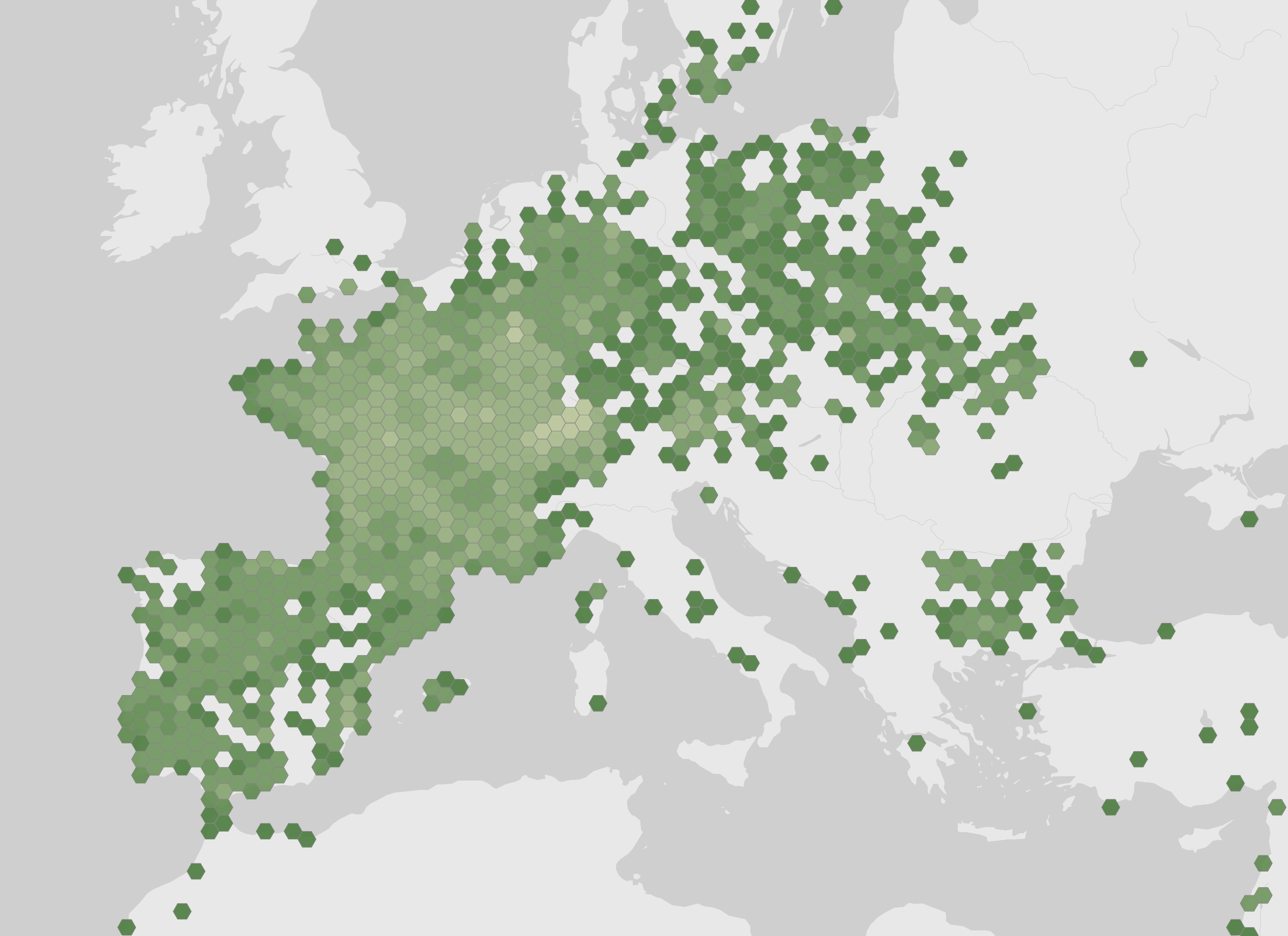
Myotis myotis occurs across most of Europe, though it is absent from Ireland, Denmark, Latvia, Estonia, Finland and the Scandinavian Peninsula. It also lives on Mediterranean islands such as Sicily, Malta and the Gymnesian Islands, and reaches into the Middle East in Turkey, Israel, Syria, Jordan and Lebanon; a small, possibly reestablished presence exists in the United Kingdom.
The species relies on caves and buildings such as churches and castles as its main roosts, while foraging in relatively open, lightly wooded forests, deciduous woodland edges and pastures.
In the Balearic Islands it is the most abundant bat species, found on Mallorca and Menorca in caves holding colonies of 200, 400 and even 500 individuals; it is also common across the Iberian Peninsula and France. In Great Britain the species was already rare by the 20th century, and its only known hibernation roost lost its remaining males before the population was thought locally extinct — though occasional individuals found in recent years hint that a colony persists or that new bats have arrived from the mainland.
Monthly observation counts rise sharply from spring, peaking in June and July at over 10,000 and 12,700 records respectively, before falling to a low near 1,000 in November. This pattern likely reflects greater surface activity and detectability during the maternity season rather than any change in true population size, since the counts are presence records only.
Behavior and Lifestyle
This bat is strictly nocturnal, ranging over an activity space with a radius of around 10 kilometers and flying low, typically just 5 to 10 meters above the ground.
It lives in colonies of roughly 10 to 100 individuals, favoring caves or attics with stable temperatures, though some continental European roosts hold more than 4,500 bats under one roof. It has been recorded roosting alongside other species such as Myotis capaccinii and Miniopterus schreibersii.
Summer and winter roosts can lie more than 10 kilometers apart, and in mainland Europe the species performs annual dispersals of up to 200 kilometers in spring, although most individuals move only about 10 kilometers.
During hibernation its physiology changes dramatically: heart rate drops from around 600 beats per minute during activity to as low as 18 to 80 beats per minute, a deep slowdown that conserves energy through the cold months.
Communication
Documented sensory channels for this species are tactile and chemical, suggesting that close bodily contact within roosting clusters and scent cues play a role in colony life, alongside sound.
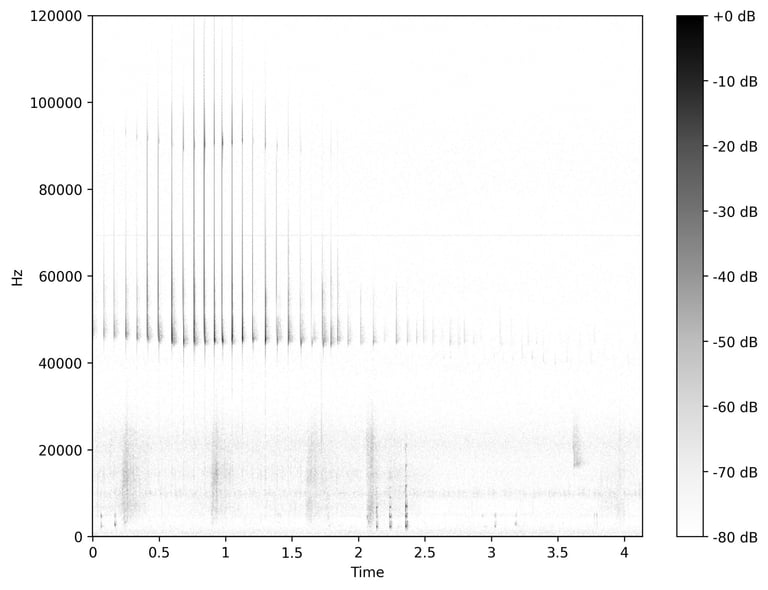
Its ultrasonic calls, ranging from 22 to 86 kHz with most energy concentrated around 37 kHz and an average duration of 6.0 milliseconds, are used mainly for spatial orientation rather than communication between individuals. The bat also emits short ultrasound pulses as it closes in on prey, though it relies on listening rather than echo return to actually locate that prey.
Hunting and Diet
Rather than chasing insects on the wing, Myotis myotis hunts by gleaning prey directly off the ground, locating it passively by listening for the sounds insects make as they move rather than by echolocating them; echolocation is reserved for general orientation, with only brief ultrasound pulses emitted as it closes in.
Ground beetles (Carabidae) make up the bulk of its diet, supplemented by grass beetles, other beetles, large moths, centipedes and spiders. It behaves as an opportunistic predator, switching to alternative prey when its preferred beetles are scarce.
Foraging concentrates in open woodland with sparse ground cover, where beetles and other prey are easier to detect and reach on bare or lightly vegetated soil.
Given the energy demands of nightly flight and hunting, an individual bat can consume between 25 and 50 percent of its own body weight in a single night.
Reproduction and Raising Young
Mating in Myotis myotis follows a polygynandrous, promiscuous system and takes place in autumn, but females store the sperm through winter and delay fertilization until the following spring, mostly in February.
Gestation lasts about 60 to 70 days, with most births occurring between April and June, though occasional winter births have been recorded. Litters are small, typically one pup and rarely two.
Pups are born blind, already equipped with claws on their hind feet and a set of milk teeth. They cling to their mothers for roughly two weeks after birth, during which time females gather into nursery colonies that exclude males entirely.
Weaning is complete by about 60 days, and young bats become independent around two months of age, after which they must quickly build fat reserves ahead of their first hibernation. Sexual maturity arrives at about 502 days, roughly a year and a half, in both sexes, and females mate again as soon as their current young become independent.
Conservation and Threats
Globally, Myotis myotis is assessed as Least Concern, reflecting its broad distribution across most of Europe and generally stable numbers at the continental scale.
One concrete protection effort is the LIFE-Nature project launched in 2012 to safeguard several thousand greater mouse-eared bats at the Gola della Rossa and Frasassi Nature Park in the Marches region of Italy, focused on securing their cave roosts.
Cultural Significance
The clearest documented link between this bat and people is ecological rather than symbolic: by feeding heavily on ground beetles and large moths, Myotis myotis helps control insect populations that can affect agriculture and forestry.
This pest-control role gives the species a practical value to people living near its roosts, even without a strong tradition of folklore or symbolism attached specifically to it.
Fun Facts
- A greater mouse-eared bat weighs only around 28 grams yet can live for more than 35 years, one of the longest lifespans known for a mammal of its size.
- It is close in body length to a house mouse (Mus musculus), despite being one of the largest bat species in Europe.
- Some of its cave roosts in continental Europe hold more than 4,500 individuals at once.
- It often shares roosts with other bat species, including Myotis capaccinii and Schreiber's bent-winged bat, Miniopterus schreibersii.
- During hibernation its heart rate can slow to as little as 18 beats per minute, down from around 600 beats per minute when active.
Photos
Photographs from via iNaturalist, licensed under CC0 1.0., by longwang via iNaturalist, licensed under CC BY 4.0., by Bria Abeles-Allison via iNaturalist, licensed under CC BY 4.0., by Sawyer Baran via iNaturalist, licensed under CC BY 4.0., by Victor Hooper via iNaturalist, licensed under CC BY 4.0., by Sarah Culliton via iNaturalist, licensed under CC BY 4.0., by ayden via iNaturalist, licensed under CC BY 4.0., by Jared Lincenberg via iNaturalist, licensed under CC BY 4.0., by Allison Gray via iNaturalist, licensed under CC BY 4.0., by Northcut via iNaturalist, licensed under CC BY 4.0., by Lorna Grant via iNaturalist, licensed under CC BY 4.0., and by Cass Reaume via iNaturalist, licensed under CC BY 4.0., credited on each photo.
Ecology and classification
Classification
- Phylum
- Chordata
- Class
- Mammalia
- Order
- Chiroptera
- Family
- Vespertilionidae
- Genus
- Myotis
- Species
- Myotis myotis
Sources
- GBIF Species names and classification
- iNaturalist Photos
- Wikidata Common names and conservation status
- Wikipedia Summary extract
- Animal Diversity Web Animal habitat, behavior and diet
- AnAge Longevity