The genus name Nephrops comes from the Greek for "kidney eye," a reference to the animal's oddly bean-shaped compound eyes, and this slim, coral-colored lobster is now the only living species left in that genus after its relatives were reclassified into Metanephrops.
Known by a handful of names depending on where it is caught and served, including the Norway lobster, Dublin Bay prawn, langoustine, and scampi, it belongs to the family Nephropidae and lives across the north-eastern Atlantic Ocean and parts of the Mediterranean Sea. The IUCN lists it as Least Concern.
Beyond the kitchen, this burrowing crustacean has a genuinely strange claim to fame: it was the first known host of an entirely new animal phylum, discovered clinging to its mouthparts. That alone makes it worth a closer look.
Identification and Appearance
The clearest way to recognize Nephrops norvegicus is by its kidney-shaped compound eyes, the feature that gave the genus its scientific name from the Greek words for "kidney" and "eye." Combined with its narrow, elongated body, this sets it apart at a glance from bulkier lobsters.
Most adults measure 18 to 20 centimeters long, including tail and claws, though exceptional individuals reach 25 centimeters. The body follows the typical lobster plan but is noticeably slimmer than the larger-bodied genus Homarus. A hard carapace covers the cephalothorax, while the long, segmented abdomen ends in a broad tail fan.
Coloration is a pale orange across the whole body. The first three pairs of legs carry claws, and the very first pair is greatly elongated and armed with ridges of spines, giving the animal its characteristic reaching pincers. A long, spine-covered rostrum projects from the head, and of the two pairs of antennae, the second pair is longer and thinner than the first.
Distribution and Habitat
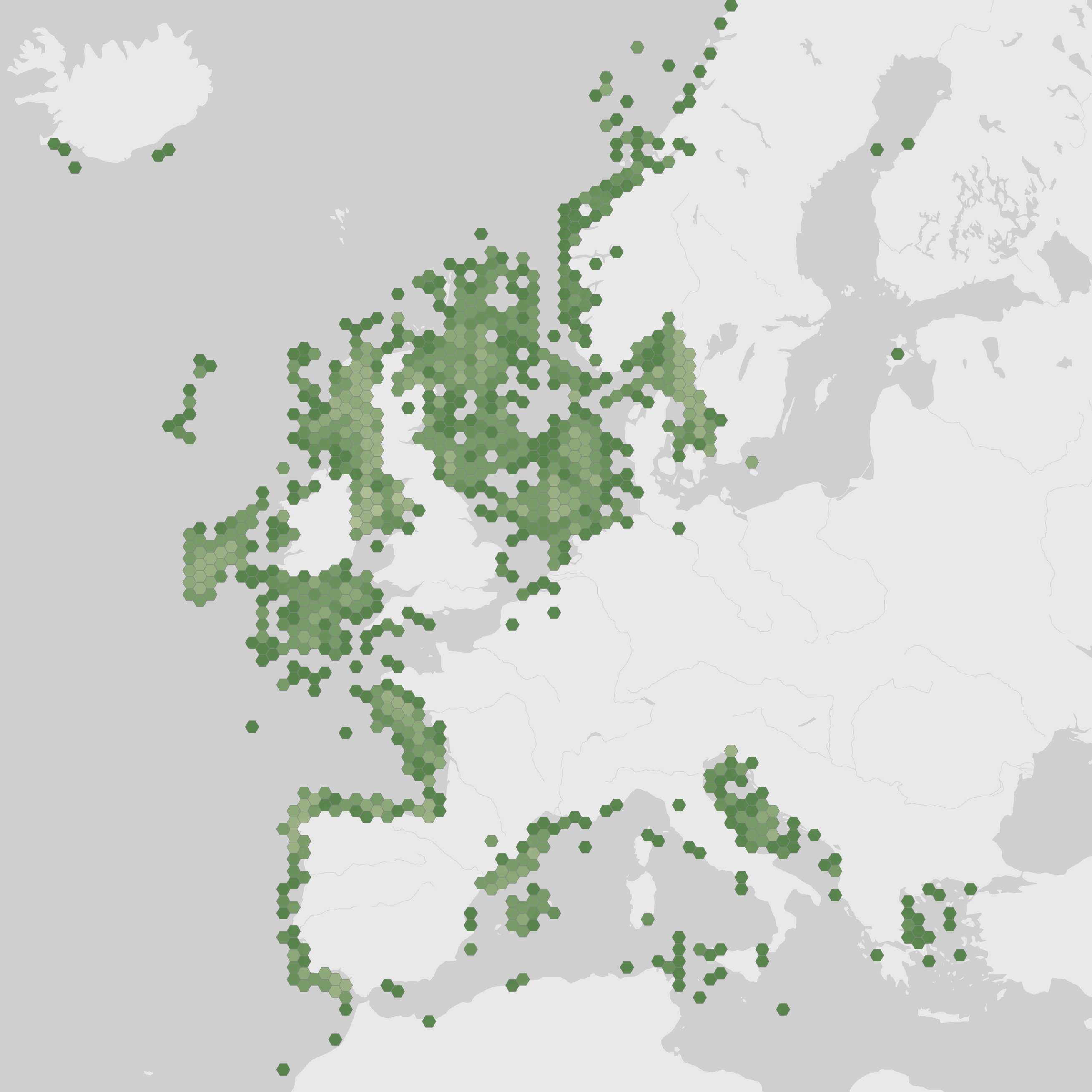
Nephrops norvegicus ranges across the north-eastern Atlantic Ocean and North Sea, from as far north as Iceland and northern Norway down to Portugal in the south. It also occurs in the Mediterranean Sea, where it is common in the Adriatic, particularly the northern Adriatic. It is entirely absent from both the Black Sea and the Baltic Sea.
Because the species needs specific muddy sediments to burrow into, its distribution is patchy rather than continuous, splitting into more than 30 recognized populations. These groups are separated by stretches of unsuitable seabed, and individual adults rarely move more than a few hundred meters from their burrows, which limits mixing between populations.
Monthly GBIF observation counts show a clear seasonal pattern, with recorded sightings climbing through the summer and peaking sharply in November before dropping off in December and staying low from April through June. Since these figures reflect presence observations rather than abundance, they hint at when the species is most detectable, likely tied to survey effort or emergence patterns, rather than a full picture of its population.
Hunting and Diet
Nephrops norvegicus leaves its burrow on short foraging trips, mainly during periods of subdued light, and actively hunts moving prey rather than waiting for food to arrive. It seizes worms and fish using its chelipeds and walking legs, passing captured food to the mouth with the help of the anterior walking legs and maxillipeds.
Despite this active hunting behavior, the species is also a scavenger, taking advantage of whatever edible material it encounters on the seabed. There is evidence that it is a major consumer of jellyfish, a food source that is easy to exploit opportunistically and adds an unusual item to what might otherwise seem a diet of typical bottom-dwelling prey.
Population and Ecological Role
Nephrops norvegicus shapes its environment as much through its burrows as through its numbers. Adults favor muddy seabeds with more than 40 percent silt and clay, digging semi-permanent burrows typically 20 to 30 centimeters deep, with the front and back entrances spaced 50 to 80 centimeters apart. Individuals spend most of their time inside these burrows or lingering at the entrance, only leaving to forage or mate.
This burrowing lifestyle supports a distinct community of parasites and symbionts. Several sessile organisms attach to the exoskeleton, including the barnacle Balanus crenatus and the foraminiferan Cyclogyra, though Nephrops carries fewer such hitchhikers than many other decapod crustaceans. The species also hosts a dinoflagellate parasite of the genus Hematodinium, which has caused epidemic infections in fished populations since the 1980s, turning the carapace opaque and the blood milky white in affected animals. Other parasites recorded on Nephrops norvegicus include the protozoan Porospora nephropis, the trematode Stichocotyle nephropis, and the polychaete Histriobdella homari.
In December 1995, researchers found the commensal Symbion pandora attached to the mouthparts of Nephrops norvegicus, and it turned out to represent an entirely new phylum, Cycliophora. The discovery has since been documented in populations across the north Atlantic and the Mediterranean, with individuals concentrated on the central parts of the larger mouthparts, from the mandible to the third maxilliped.
Fun Facts
- Its genus name, Nephrops, is built from the Greek words for "kidney" and "eye," describing the animal's distinctively kidney-shaped compound eyes.
- In December 1995, a tiny organism found attached to its mouthparts, Symbion pandora, turned out to belong to an entirely new animal phylum, Cycliophora, a discovery the paleontologist Simon Conway Morris called "the zoological highlight of the decade."
- This species goes by several names on menus and in markets, including Norway lobster, Dublin Bay prawn, langoustine, and scampi.
- It is a major commercial fishery species around the British coastline, with especially large populations in the Clyde Sea and Scottish sea lochs.
Conservation status
- LC
- NT
- VU
- EN
- CR
Least Concern
Ecology
Habitat
- Marine
Diet
- Carnivore
Behavior
- Nocturnal
- Predator
- Burrowing
- Scavenger