Few crabs wear as many names as Portunus pelagicus. Depending on where you meet it, it is called the blue crab, blue swimmer crab, blue manna crab or flower crab.
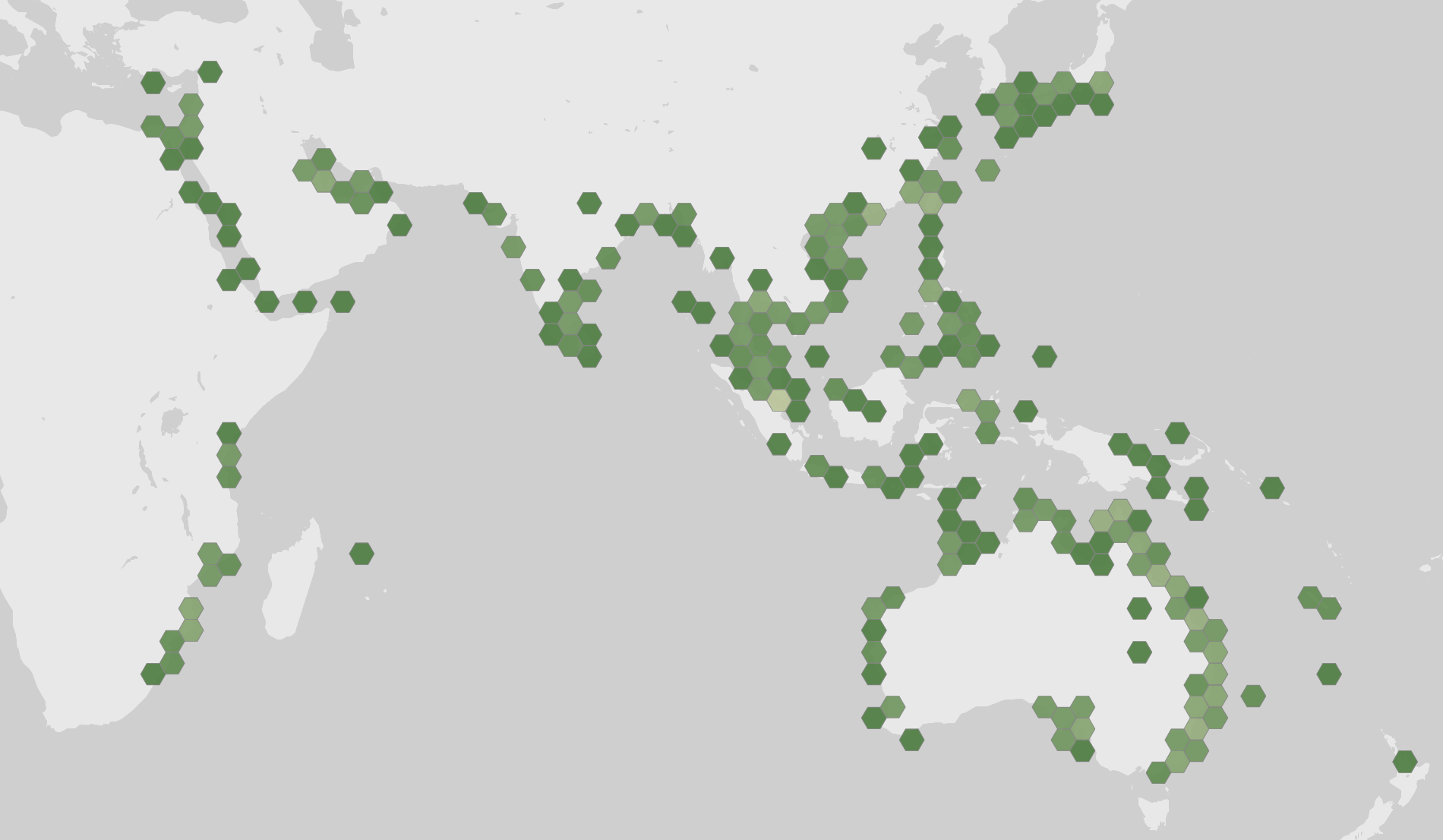
This is a large marine crab found across the Indo-Pacific, from the coasts of Indonesia, Malaysia, Cambodia, Thailand, the Philippines and Vietnam to the intertidal estuaries that ring most of Australia and extend east to New Caledonia. Its wide range and striking blue coloration in males have made it one of the more recognizable swimming crabs in the region, and its biology and cultural footprint give it more depth than its familiar seafood-counter image suggests.
Identification and Appearance
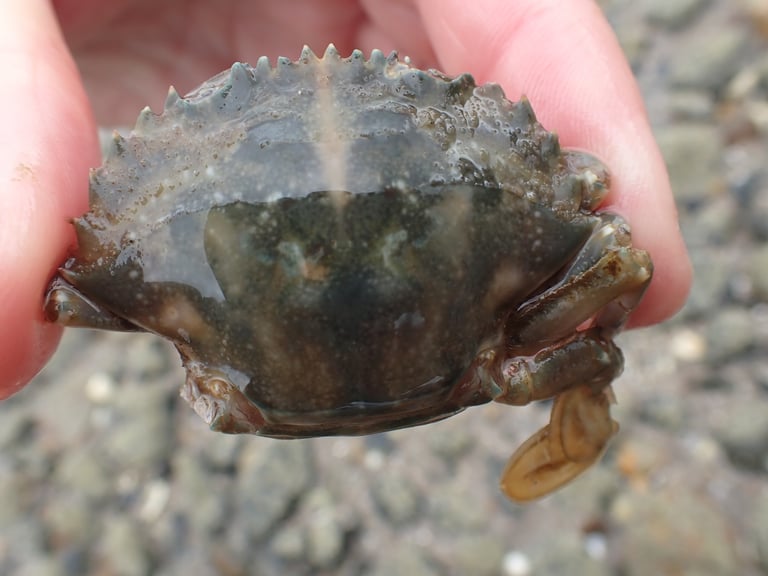
The clearest way to tell the sexes apart is color: males are bright blue with white spots, while females show a duller green or brown tone. This dimorphism is paired with shape differences, since males also carry characteristically long chelipeds (claw-bearing legs) and females have a more rounded carapace.
Size is substantial for a swimming crab, with the carapace reaching up to 20 centimeters (7.9 inches) across. Combined with the vivid blue of the males, this makes the species easy to pick out among estuarine and coastal crabs at a glance.
The long chelipeds of males likely play a role beyond feeding, given how pronounced the difference is compared with females, though the context does not detail their specific use in displays or combat.
Distribution and Habitat
Portunus pelagicus ranges across the Indo-Pacific, occurring along the coasts of Indonesia, Malaysia, Cambodia, Thailand, the Philippines and Vietnam. In Australia it is common in intertidal estuaries around most of the continent, with its range extending east as far as New Caledonia.
Monthly observation counts show a rise from around 650–700 sightings in the early months of the year to a peak of 933 in August, before tapering to 549 and 510 in November and December. Because these figures come from GBIF occurrence records, they reflect presence observations rather than true abundance or a complete picture of the species' range, but the mid-year peak hints at greater seasonal visibility or activity during that period.
The species relies heavily on estuarine and shallow coastal habitats, using them for shelter, feeding and, at key life stages, growth of its larvae and juveniles.
Behavior and Lifestyle
For most of the day, and especially during winter, Portunus pelagicus stays buried under sand or mud rather than moving about in the open. This burrowing habit may explain its unusually high tolerance for ammonium and ammonia, chemicals that build up in confined, low-oxygen sediment.
The crab emerges to feed as the tide rises, taking advantage of high tide to hunt bivalves and fish, with macroalgae forming a smaller part of its diet. Its paddle-shaped hind legs, flattened for swimming, make it an excellent swimmer, a trait that sets it apart from many other crabs and lets it move efficiently through open water when it comes out to feed.
Despite this swimming ability, the species is tied closely to water. Unlike the related mud crab, Scylla serrata, it cannot survive for long stretches out of the water, which keeps its foraging trips tethered to wet, submerged habitat.
Population and Ecological Role
The species' life cycle runs through estuaries at almost every stage. Females move into shallow marine habitats to release their eggs, and the newly hatched zoea I larvae then move into estuarine waters, where they feed on microscopic plankton and progress through to the zoea IV stage over about 8 days, followed by 4 to 6 days as megalopa, a stage marked by large chelipeds used to catch prey.
Once megalopae metamorphose into the crab stage, they continue to use estuaries for shelter and food. Early juveniles, however, cannot tolerate low salinity for long, a weakness linked to poor hyper-osmoregulatory ability, and this likely drives a mass emigration from estuaries to full seawater during the rainy season.
Adult behavior also shifts with water temperature: males are thought to become more territorial in colder water. This may explain why males are rarely seen close together in temperate waters, and why females appear more numerous there by comparison.
Cultural Significance
The genus name traces back to Portunus, the Roman god of keys, doors, livestock and ports, who may have originally protected grain warehouses before becoming linked to harbors. As Romans grew familiar with Greek mythology, Portunus came to be identified with the Greek god Palaemon, and a square temple dedicated to him still stands at the same plaza associated with his worship.
The crab's own movements have left a mark on regional performance culture: in Carcar, Cebu, in the Philippines, the crab is known as "Lambay," and its motion is the basis for the dance steps of the Linambay, a variation of the Moro-moro theatrical tradition.
Fun Facts
- The species carries at least four common names in English alone: blue crab, blue swimmer crab, blue manna crab and flower crab.
- Its genus name honors Portunus, the Roman god of ports and doorways, who was commonly invoked before sea journeys to ensure safe passage and protect harbors.
- A temple to the god Portunus, whom Romans later identified with the Greek Palaemon, still stands today, tying the crab's namesake directly to Roman religious life.
Ecology
Habitat
- Wetland
- Marine
- Coastal
Behavior
- Predator
- Burrowing
- Territorial
- Aquatic
Diet
- Omnivore