The New Zealand fantail, known to Māori as pīwakawaka, tīwakawaka or piwaiwaka, is the only fantail species found in New Zealand, and it carries a mythological weight far beyond its tiny size.
This small insectivorous bird belongs to the family Rhipiduridae and is classified as Least Concern by the IUCN. It has four recognized subspecies: R. f. fuliginosa in the South Island, R. f. placabilis in the North Island, R. f. penita on the Chatham Islands, and the now-extinct R. f. cervina, which once lived on Lord Howe Island.
Beyond its cultural resonance, the fantail is worth watching simply for its restless energy and its signature fanned tail, a feature that gives the species both its common name and its scientific one.
Identification and Appearance
The fantail's most recognizable feature is its fan-shaped tail, which it often displays spread wide, revealing light-colored outer feathers framing a dark center. The bird reaches about 16 centimeters in length, with the tail accounting for roughly half of that.
Most individuals show mid to dark grey or grey-brown upperparts and yellowish to orange underparts, with a dark band crossing the chest below a white throat and white markings above the eye. Depending on the subspecies, the outer tail feathers are either white-edged or entirely white.
A distinct dark morph, known as the black fantail, appears in about 4% of South Island birds and less than 1% of North Island birds, and is absent entirely from the Chatham Islands. This morph lacks the pale markings, appearing dark all over except for a white spot behind the eye.
Juveniles resemble adults but have browner bodies and less distinct markings. A rare all-white individual photographed in Northland in 2017 is believed by experts to show leucism rather than albinism.
Distribution and Habitat
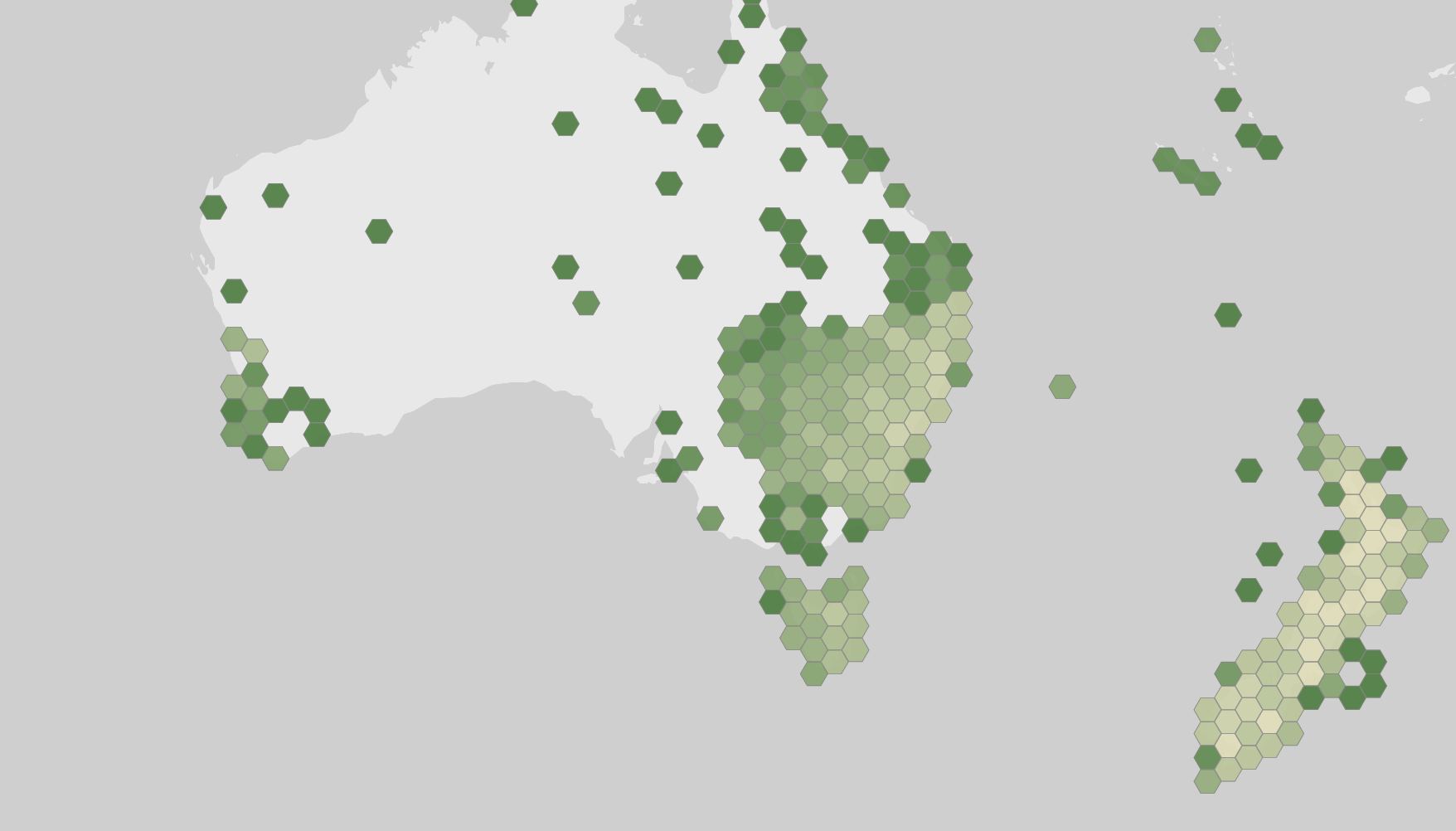
The New Zealand fantail occupies a range of about 267,000 square kilometers across the country, favoring semi-open woodland habitats. It is a sedentary species, not undertaking long migrations.
Monthly observation counts remain fairly steady throughout the year, without a single sharp peak, consistent with a resident bird present in its habitat year-round rather than one that arrives or departs seasonally.
Behavior and Lifestyle
The fantail is almost never still during daylight hours, flitting constantly from perch to perch, whether on the ground, among tree twigs, or on other convenient objects, in pursuit of flying insects. This ceaseless motion has even given rise to the saying that a fidgety person is called "a fantail's tail."
The birds show little fear of people, often flitting within a few meters of humans, particularly in forested areas and suburban gardens. This boldness is practical: human activity such as walking or digging disturbs small flying insects, giving the fantail an easy meal.
In cold weather, fantails huddle together in small flocks to conserve warmth, a behavior that points to their vulnerability to low temperatures despite their constant activity.
Nesting and Breeding
The New Zealand fantail breeds seasonally, with timing that shifts by region: August to March in the North Island, September to January in the South Island, and October to January on the Chatham Islands. Pairs typically raise two or more broods each season.
Both sexes build a compact, cup-shaped nest, usually wedged into the fork of a tree and constructed from moss, bark and fiber, often finished off with spider web. A clutch usually contains three to four cream-colored eggs spotted with grey and brown, and incubation lasts around two weeks, with both parents sharing incubation and feeding duties.
Nesting is often overlapping: adults may build a new nest and begin incubating a second brood while still feeding fledglings from the first. Young males can begin breeding themselves just two months after fledging.
Nesting success is far from guaranteed. Of 81 nesting attempts monitored in urban Wellington, only about 45% successfully fledged chicks, with roughly one in four nests abandoned or deserted and a similar proportion lost to predation. Nests built on thin branches escaped predation by ship rats more often than those built on thick branches, and the nests are also occasionally parasitized by New Zealand's two cuckoo species.
Cultural Significance
In Māori mythology, the pīwakawaka is cast as a messenger, carrying death or news of death from the gods to the people. Its bulbous eyes and erratic flight are attributed to Māui having squeezed the bird after it refused to reveal the whereabouts of his ancestress Mahuika, the fire deity.
The bird's most significant mythological role comes later: as Māui attempts to gain immortality by passing through the body of the goddess Hine-nui-te-pō, a group of fantails laughs at the sight, waking the goddess, who crushes him to death. This single act is said to be why death remains part of the world in Māori belief.
The name Tiwakawaka was also carried by one of the first Māori settlers to reach New Zealand, linking the bird further to the country's cultural memory.
Fun Facts
- In Māori proverbs, the phrase "Me ko Piwaiwaka koe!" is used to chide a tattletale, drawing on the bird's mythological role as an indiscreet observer.
- The pīwakawaka is sometimes said to symbolize adaptability, energy and persistence in Māori culture, reflecting its constant, agile movement through the forest.
Photos
Photographs from by Carl Ramirez via iNaturalist, licensed under CC BY 4.0., via iNaturalist, licensed under CC0 1.0., by Frank Ashwood via iNaturalist, licensed under CC BY 4.0., by Pluto Hooper via iNaturalist, licensed under CC BY 4.0., by 大澤風季 ohsawa_Fuki via iNaturalist, licensed under CC BY 4.0., by Kris Connor via iNaturalist, licensed under CC BY 4.0., by sam-rajnikant via iNaturalist, licensed under CC BY 4.0., by Michael Berardozzi via iNaturalist, licensed under CC BY 4.0., by Christopher Hynes via iNaturalist, licensed under CC BY 4.0., by Maureen Howard via iNaturalist, licensed under CC BY 4.0., by Emily Roberts via iNaturalist, licensed under CC BY 4.0., and by Arnim Littek via iNaturalist, licensed under CC BY 4.0., credited on each photo.
Ecology and classification
Classification
- Phylum
- Chordata
- Class
- Aves
- Order
- Passeriformes
- Family
- Rhipiduridae
- Genus
- Rhipidura
- Species
- Rhipidura fuliginosa
Sources
- GBIF Species names and classification
- iNaturalist Photos
- Wikidata Common names and conservation status
- Wikipedia Summary extract
- AVONET Bird mass, habitat, migration, diet and range size
- GloBI What it eats, what eats it, parasites and pollinators
- Wardeh et al. 2015 (EID2)