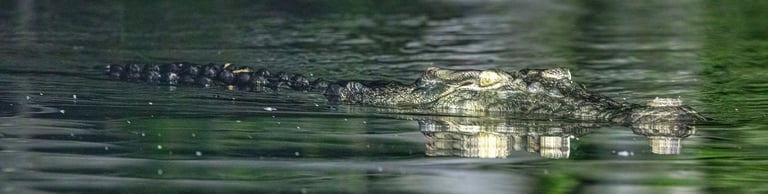
Nile crocodiles can sit motionless in water for up to 2 hours. Their blood carries lactic acid levels that would kill most vertebrates, and this tolerance is one of the traits that makes the species so hard to outlast in its habitat.
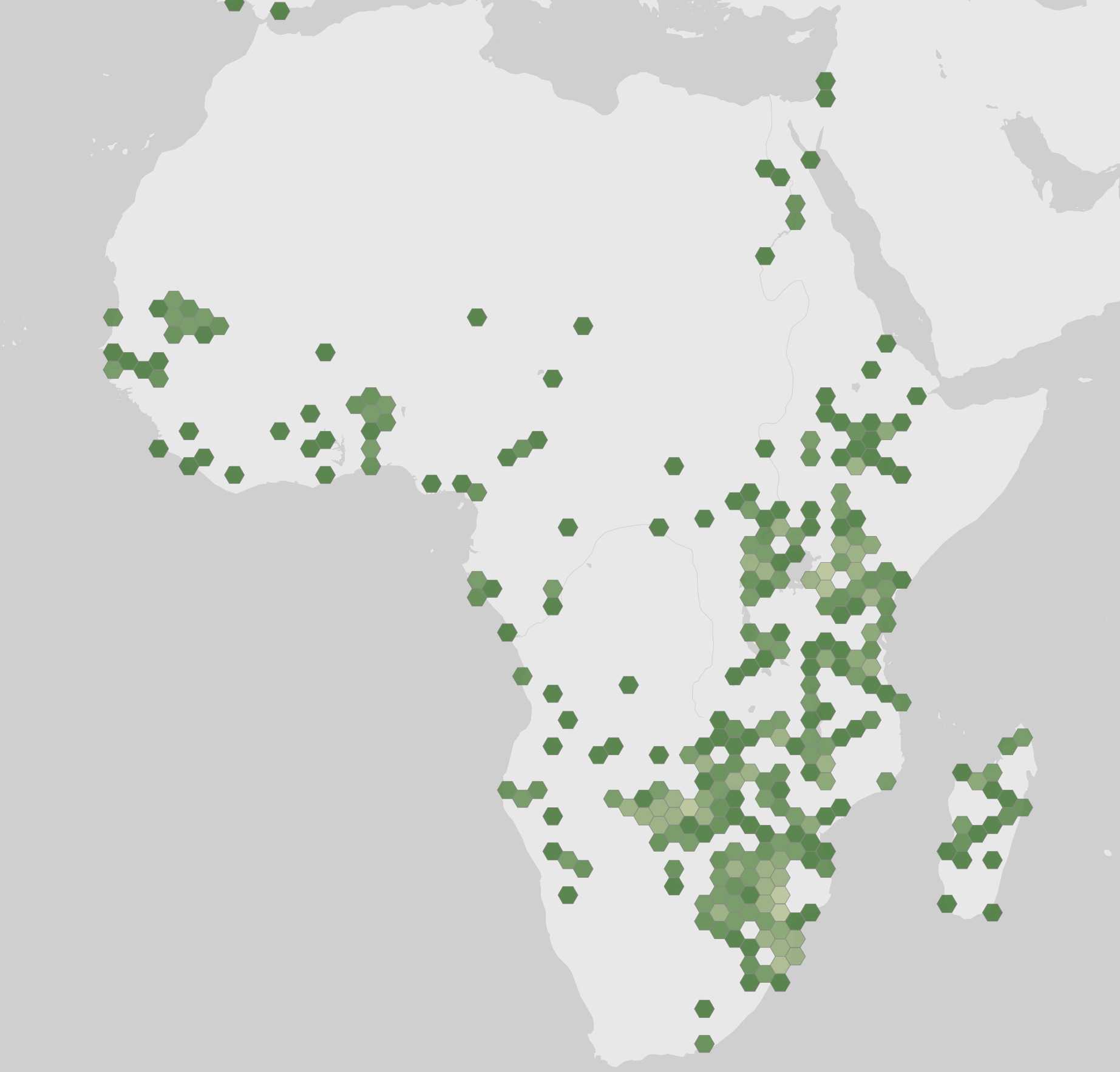
The Nile crocodile is a large crocodilian of freshwater habitats across Africa. It occurs in 26 countries, mostly in the eastern, southern and central parts of the continent, and lives in lakes, rivers, swamps and marshlands. Adults can reach up to and .
The IUCN lists the species as Least Concern. Individuals can live up to . Its ambush hunting, long-lived adults and heavy history of persecution make it one of the most closely studied crocodilians.
Identification and Appearance
The most useful field mark is the dark bronze back, which carries faded blackish spots and stripes that vary from animal to animal. The belly is a dingy off-yellow, though mud often hides the true colour. Adults have green eyes, and their flanks are yellowish-green with dark patches arranged in oblique stripes.
Colour varies with habitat. Specimens from swift-flowing water tend to be lighter than those living in murkier lakes or swamps, which suits each environment's camouflage.
Juveniles are grey, multicoloured or brown, with dark cross-bands on the tail and body. Their underbelly is yellowish-green. As they mature, the cross-bands fade, especially on the upper body, and the back darkens.
Like other crocodilians, the Nile crocodile has four short, splayed legs, a long, powerful tail and a scaly hide with rows of bony scutes along the back and tail. Its jaws are long and powerful. Its snout is about 1.6 to 2.0 times as long as it is broad at the front corners of the eyes, which is a medium width among crocodilians.
The mouth holds 64 to 68 sharply pointed teeth, about a dozen fewer than an alligator has. The enlarged fourth lower tooth shows when the jaws are closed, a trait shared with all true crocodiles.
Distribution and Habitat
The current range runs from the Nile tributaries in Sudan and Lake Nasser in Egypt to the Cunene River in Angola, the Okavango Delta in Botswana and the Olifants River in South Africa. It is the most common crocodilian in Africa, and it occurs in about 26 countries, including Kenya, Uganda, Tanzania, Zambia, Zimbabwe and Mozambique.
The species once reached much farther. Its historic range extended to the Mediterranean coast in Libya, Tunisia, Algeria and Morocco, and across the Red Sea into the Palestine region and Syria. In ancient Egypt, Herodotus saw it in Lake Moeris.
An isolated population lives in western and southern Madagascar, from the Sambirano River to Tôlanaro. It likely arrived after the endemic crocodile Voay died out within the last 2,000 years. In the remnant Madagascar population, animals have adapted to living in caves.
In East Africa, crocodiles favour open, broad bodies of water such as rivers, lakes, marshes and dams. They also use swamps, wooded riverbanks and forest edges. The species can tolerate small brackish streams, fast rivers and tidal estuaries, and it sometimes enters the sea. Wild-caught individuals have also turned up in South Florida, but no sign of wild breeding has been found there.
Behavior and Lifestyle
Nile crocodiles are relatively inert, and they can stay almost motionless for hours. In one study, more than half of the crocodiles observed spent the hours from 9:00 a.m. to 4:00 p.m. basking with their jaws open on sunny days. Open-mouthed gaping helps them cool down, but it can also act as a threat display to other crocodiles. Animals in Lake Turkana rarely bask at all during the day, and they sit partly exposed in shallows instead.
The species is more easily seen in winter in South Africa, when it spends more time basking. In the southern part of its range, crocodiles dig tunnels to escape dry, cool conditions. In Royal Natal National Park, young crocodiles of 60 to 90 cm dug burrows about 1.2 to 1.8 m deep, and the longest was 3.65 m. They enter a lethargic state similar to hibernation, and aestivation has been recorded from May to August.
Most dives last only a few minutes, but a threatened crocodile can swim underwater for up to 30 minutes. When it stays fully inactive, it can hold its breath for up to 2 hours. On land it usually crawls on its belly, but it can also raise its body to walk. Larger animals can briefly reach up to 14 km/h, while the top swimming speed is 30 to 35 km/h.
Nile crocodiles swallow stones, called gastroliths, for reasons that are not fully understood. Hatchlings have none, and the stones become common in animals of about 2 to 3.1 m before becoming rare again in very large animals. One 3.84 m crocodile carried 5.1 kg of stones in its stomach.
Hunting and Diet
Nile crocodiles are apex predators throughout their range, and they take nearly all their food by ambush. They sense movement and water pressure through sensors in their skin, and they grab prey within seconds. Most hunting happens in the water, where the crocodile almost fully submerges and slips toward animals that come to drink or cross.
When it attacks, the crocodile surfaces only its eyes and nostrils, then lunges out of the water and seizes the prey. Its teeth sink in and hold, and the bite can reach 5,000 lbf (about 22,000 newtons) in large adults. Smaller prey is overpowered and swallowed, while larger prey is pulled into the water and drowned or torn apart, sometimes with help from other crocodiles.
Subadults and smaller adults herd groups of fish toward a bank and snap them up with quick sideways jerks of the head. Some use their tails to knock land animals off balance and force them into the water. Groups even block migrating fish by forming a semicircle across a river, and the most dominant crocodile feeds first.
The species also scavenges and steals kills from other predators such as lions and leopards. Groups may travel hundreds of metres from the water to feast on a carcass. Despite this active feeding, the stomach is small, roughly the size of a basketball in an average adult, so many adults go long periods without eating. Young crocodiles feed more actively than adults, and brooding females have empty stomachs, allowing them to go several months without food.
Nesting and Breeding
Nile crocodiles reach sexual maturity at about 12 to 16 years. Males mature at about 3.3 m long and 155 kg, a size that stays fairly consistent. Females vary more, and on average they mature at 2.2 to 3 m, with a southern African average of 2.33 m.
Nesting females in southern Africa average 3 to 3.6 m long. Clutch size rises with body size: a 2.75 m female never lays more than 35 eggs, while a 3.64 m female can lay up to 95. Clutches range from , and each nesting female produces one clutch per season. Most females nest only every two to three years, while mature males may breed every year.
During the mating season, males bellow, slap their snouts on the water and blow water from their nostrils. Dominant males fight over territory, and the loser usually retreats to deep water. Once a female accepts a male, the pair warble and rub the undersides of their jaws together. Mating is rough, and the male often pins the female underwater. Most populations are annually monogamous, though some males mate with several females in their territory.
Females lay eggs about one to two months after mating. The timing depends on latitude: in the north, around Somalia and Egypt, nesting falls from December to February, while in the south, in South Africa and Tanzania, it falls from August to December. Crocodiles in between usually lay from April to July, about a month or two into the dry season.
Population and Ecological Role
An estimated 250,000 to 500,000 Nile crocodiles live in the wild today. Populations are strongest in many countries of eastern and southern Africa, where crocodiles remain widespread along rivers and lakes.
As apex predators, Nile crocodiles keep fish and land animal populations in check along the waterways they share with other wildlife. Their hunting also feeds scavengers and other predators, since they haul large prey into the water and leave remains behind.
In Central and West Africa, populations are much sparser and have not been adequately surveyed. Competition with slender-snouted and dwarf crocodiles may keep numbers lower there.
Conservation and Threats
The IUCN Red List assesses the Nile crocodile as Least Concern. CITES lists it under Appendix I in most of its range, which covers threatened species, and under Appendix II in the rest, where trade must be controlled. Appendix II allows ranching or sets an annual quota of skins taken from the wild.
The main threats are habitat loss, pollution, hunting, and accidental entanglement in fishing nets. The species was hunted on a large scale from the 1940s to the 1960s for high-quality leather. Between the 1950s and 1980s, an estimated 3 million Nile crocodiles were killed for the leather trade. In Lake Sibaya, South Africa, persecution continues to stop populations from recovering, and recovery remains gradual.
Laws and trade rules have helped many populations recover. Ranching has become a major source of skins, and in 1993 about 80,000 skins were produced, most from ranches in Zimbabwe and South Africa. Central and West Africa face a grimmer situation, where extirpation may be a serious threat in some areas. In Egypt the species disappeared as a breeding animal in the 20th century, but it has re-established locally, for example near the Aswan Dam.
Photos
Photographs from via iNaturalist, licensed under CC0 1.0., by Luis G Restrepo via iNaturalist, licensed under CC BY 4.0., by Cindy Bell via iNaturalist, licensed under CC BY 4.0., by Patrick Jackson via iNaturalist, licensed under CC BY 4.0., by Timothy Whitehead via iNaturalist, licensed under CC BY 4.0., and by Stefan Wolmarans via iNaturalist, licensed under CC BY 4.0., credited on each photo.
Ecology and classification
Classification
- Phylum
- Chordata
- Class
- Crocodylia
- Family
- Crocodylidae
- Genus
- Crocodylus
- Species
- Crocodylus niloticus
Sources
- GBIF Species names and classification
- iNaturalist Photos
- Wikidata Common names and conservation status
- Wikipedia Summary extract
- AnAge Longevity
- The Reptile Database Reptile distribution and common names
- ReptTraits Reptile size, lifespan, clutches or litters, habitat and habits
- GloBI What it eats, what eats it, parasites and pollinators
- Wardeh et al. 2015 (EID2)
- HWML Parasite Collection