Few aquatic plants span as much of the Old World as Nymphaea alba, which grows naturally across North Africa, the Middle East, temperate Asia, and nearly every country in Europe. Known as the white water lily, European white water lily, or white nenuphar, it is a floating-leaved perennial in the family Nymphaeaceae.
The species is currently classified as Least Concern, reflecting its wide range and abundance in still and slow-moving waters. Beyond its conservation status, the plant has a long history of human use and mythological association that makes it more than just a pond ornamental.
Identification and Appearance
The most useful field mark is the pairing of round, dark green floating leaves with pure white, many-petaled flowers that rest directly on the water's surface. Leaves reach up to 35 centimeters in length, forming a dense carpet as the plant spreads up to 150 centimeters per individual.
The flowers change shape dramatically as they mature. They open as tight cups roughly 8 centimeters across, then expand over time into flat, star-shaped blooms up to 20 centimeters wide. Each flower has petals arranged in a single ring, angled upward and outward around a dense cluster of yellow stamens at the center.
Blooming occurs during the daytime in summer, with both leaves and flowers floating rather than emerging above the surface. The context does not describe differences between sexes, ages, or seasonal forms beyond this cup-to-star transition, nor does it name specific look-alike species to distinguish it from.
Distribution and Habitat
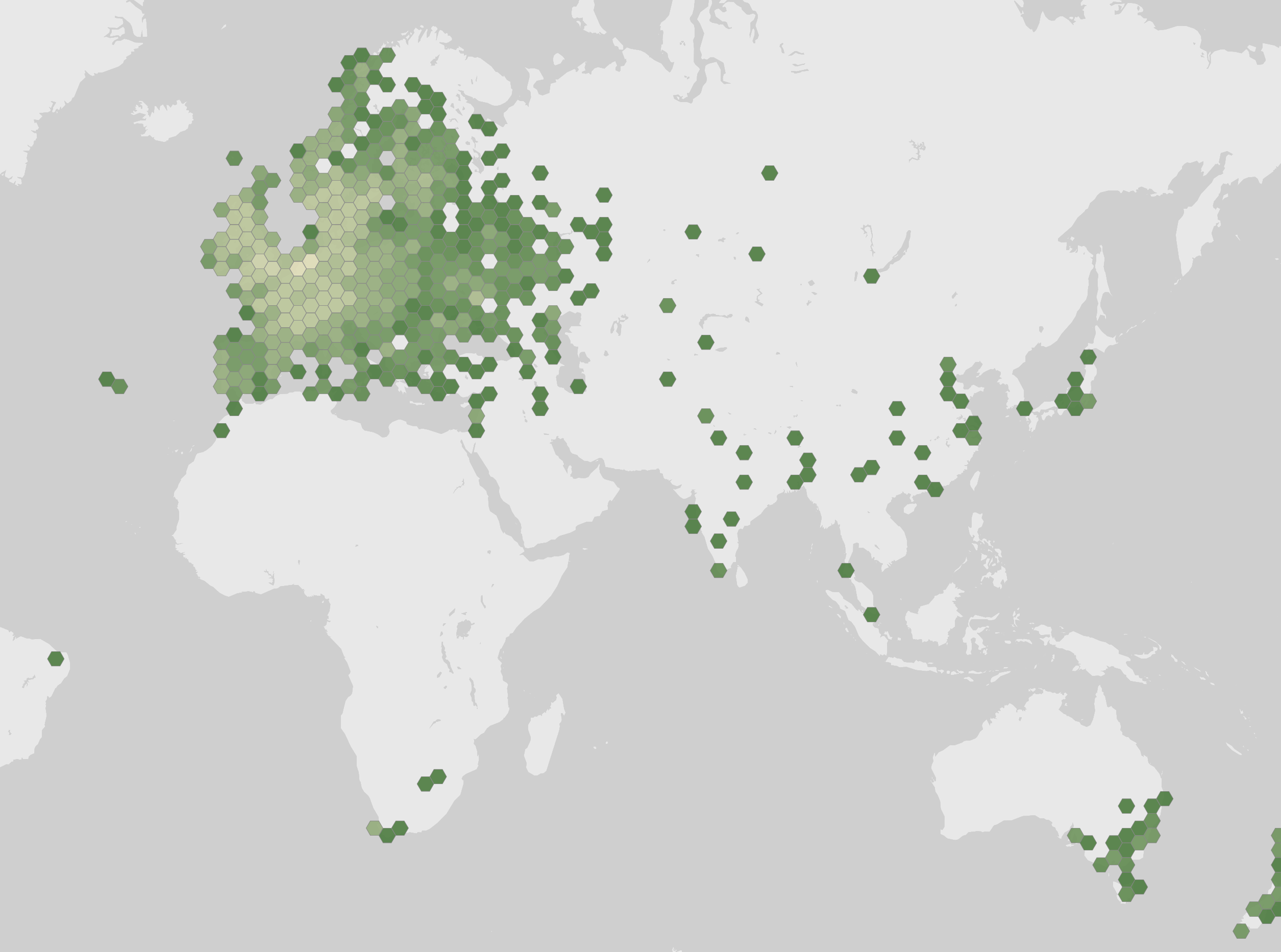
Nymphaea alba is native across an unusually broad swath of the Old World: North Africa (Algeria, Morocco, Tunisia), the Middle East and temperate Asia (Armenia, Azerbaijan, Iran, Iraq, Palestine, Turkey, and Siberia), the Indian territory of Jammu and Kashmir, and nearly all of Europe, from the United Kingdom and Scandinavia south to Spain, Portugal, Italy, Greece, and the Balkans. It has also been introduced beyond its native range, establishing in the Azores, Bangladesh, parts of China, Chile, Myanmar, and New Zealand.
The species favors standing or slow-moving fresh water, including ponds, large ditches, mires, lakes, canals, and the backwaters of rivers. In parts of China such as Hebei, Shaanxi, Shandong, and Zhejiang it is both cultivated and naturalized in ponds.
Monthly observation counts show a sharp seasonal pattern, rising from a few hundred sightings in winter months to a peak of over 23,000 in July, with high counts also in June and August. This pattern likely reflects when the floating leaves and showy flowers are visible and actively observed, rather than year-round changes in the plant's actual abundance.
Uses and Human Relationships
People have harvested Nymphaea alba as food for generations, particularly in northeastern India, where young leaves and peduncles of this and related species are eaten as vegetables, and the rhizomes are boiled and consumed. Parts of the plant have also served as traditional medicine for ailments including diarrhea, piles, and coughing.
The flowers are cut for decoration, valued for their pleasant scent and notably long vase life once removed from the water.
The plant's cultural resonance runs deeper than practical use. Its genus name, Nymphaea, comes from the nymphs of Greek and Roman mythology, minor deities said to inhabit springs, wells, and waterways, and the white flower carried symbolic associations with purity and rebirth in rituals across Mediterranean cultures. A related plant, the white lotus, held similarly deep spiritual and mythological significance in Ancient Egypt.
Fun Facts
- Nymphaea alba is the type species of the genus Nymphaea, the exact plant Linnaeus used to define the genus in 1753.
- The genus has three recognized synonyms: Castalia Salisb. (1805), Leuconymphaea Kuntze (1891), and Ondinea Hartog (1970).
- The name Nymphaea comes from the nymphs of Greek and Roman mythology, water-dwelling deities linked to springs, wells, and rivers.
- Its white blooms carried symbolic weight in Mediterranean ritual traditions, representing purity and rebirth.
- It shares its watery habitats with the unrelated yellow water lily, Nuphar lutea, which holds its flowers on thick stems rather than floating them flat on the surface.
Photos
Photographs from via iNaturalist, licensed under CC0 1.0., by Codrin Bucur via iNaturalist, licensed under CC BY 4.0., by João D'Andretta via iNaturalist, licensed under CC BY 4.0., by Sandra Stewart via iNaturalist, licensed under CC BY 4.0., by Sascha Nunheim via iNaturalist, licensed under CC BY 4.0., by CaracalShan via iNaturalist, licensed under CC BY 4.0., by Vasyl Pokynchereda via iNaturalist, licensed under CC BY 4.0., by Christoph Moning via iNaturalist, licensed under CC BY 4.0., by Ewan Shilland via iNaturalist, licensed under CC BY 4.0., and by zebedeugalinha via iNaturalist, licensed under CC BY 4.0., credited on each photo.
Ecology and classification
Classification
- Phylum
- Tracheophyta
- Class
- Magnoliopsida
- Order
- Nymphaeales
- Family
- Nymphaeaceae
- Genus
- Nymphaea
- Species
- Nymphaea alba
Sources
- GBIF Species names and classification
- iNaturalist Photos
- Wikidata Common names and conservation status
- Wikipedia Summary extract
- Encyclopedia of Life Habitat, diet and behavior traits