The orange roughy can live up to , which makes it one of the longest-lived fish known. This large deep-sea fish belongs to the slimehead family, Trachichthyidae, and is found in cold, deep waters of the Western Pacific, the eastern Atlantic, the Indo-Pacific, and the eastern Pacific off Chile.
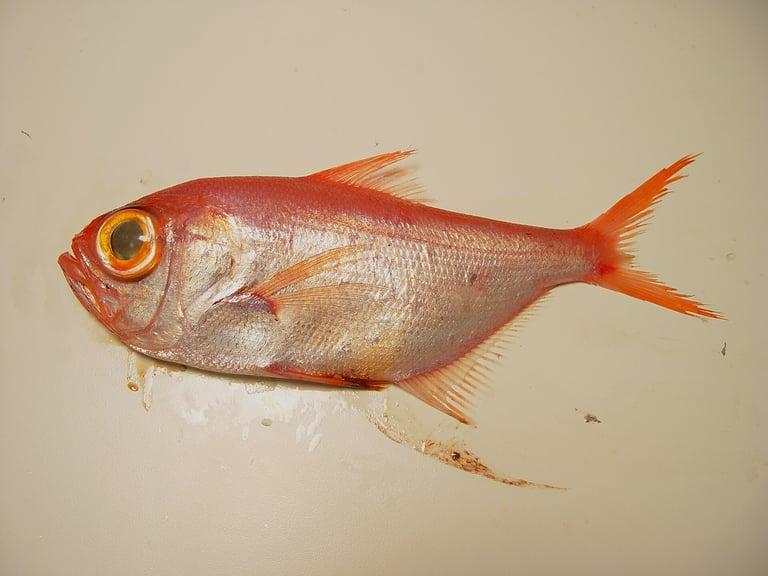
Its body is laterally compressed, and it is typically a bright, brick-red color. The color fades to a yellowish-orange after death, which is why the fish is sometimes described by its paler tones on ice.
The species is worth reading about because its long life and late maturity shape how slowly its populations can grow back after fishing.
Identification and Appearance
The most useful field mark is the hard, bony ridge of 19 to 25 ventral scutes between the pelvic fins and the anus. The head is rounded and marked with muciferous canals, a trait typical of slimeheads, and the eyes are large.
The body is laterally compressed with a forked tail fin. The single dorsal fin has four to six spines and 15 to 19 soft rays, and the anal fin has three spines and 10 to 12 soft rays. Each pectoral fin carries 15 to 18 soft rays.
The scales are ctenoid and tightly attached. The lateral line is uninterrupted and has 28 to 32 scales, with spinules that largely hide its pores. The inside of the mouth and gill cavity is bluish black.
The orange roughy is the largest known slimehead. Adults can reach a maximum standard length of 75 centimeters (30 inches) and a maximum weight of 7 kilograms (15 pounds). Commercial catches are commonly 35 to 45 centimeters (14 to 18 inches) long, though this varies by area.
Distribution and Habitat
The orange roughy lives in deep, cold water over steep continental slopes, ocean ridges, and seamounts. It is found on both rough bottoms and steep, rough grounds, where it feeds close to the seabed.
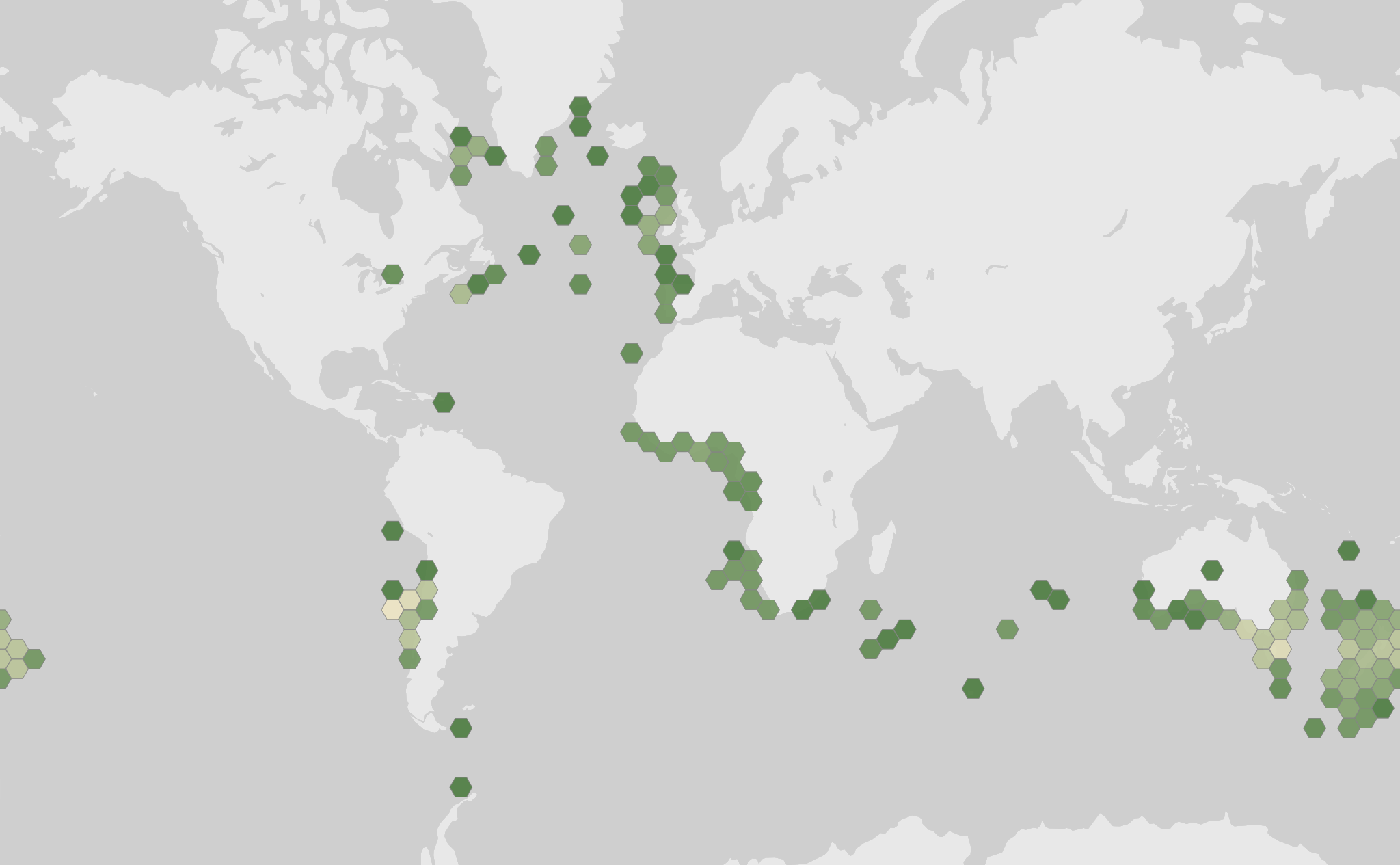
Its range covers the Western Pacific, the eastern Atlantic, the Indo-Pacific, and the eastern Pacific off Chile. Its habitat is marine and deep, far from shallow coastal waters.
Observations of the species cluster in June and July, which suggests a seasonal pattern in when people see it. This timing may be linked to its spawning season.
The fish is known from seamounts and knolls, where it gathers over the rough terrain of these underwater features.
Behavior and Lifestyle
Orange roughy are bathypelagic fish that live in the deep ocean, and they spend their lives in the water column above the seabed. They feed on prawns, mysids, amphipods, euphausiids, and fishes, including cardinalfish and lanternfish.
The young fish live in a different way from adults. Little is known of the larvae and juveniles, which do not appear to form aggregations.
Adults gather in large groups to spawn, then disperse to feed. These movements between feeding and spawning areas are a central part of how the species lives.
Diet and Nutrition
Orange roughy are carnivores that feed opportunistically on bentho-pelagic and meso-pelagic fish, crustaceans, and squid. Their diet shifts as they grow. Juveniles feed mainly on crustaceans, while adults prefer fish and squid.
The species appears to have moderately high rates of food consumption. Changes in diet are linked to changes in body shape as the fish grow.
Feeding takes place on the continental slope, where the fish hunt over the seabed and in the water above it.
Reproduction and Life Cycle
Orange roughy are pelagic spawners that live entirely in the sea. Each year they migrate several hundred kilometers between feeding areas and localized spawning areas, where they form large spawning aggregations. Males and females may gather separately.
During spawning, the fish release large, spherical eggs and sperm into the water at the same time. The eggs are 2.0 to 2.5 millimeters (0.079 to 0.098 inches) across and float because of an orange-red oil globule. Fertilized eggs and larvae drift as plankton and rise to around 200 meters (660 feet) to develop, and young fish later move down to deeper water as they mature.
Fecundity is low. Each female produces only about 22,000 eggs per kilogram of body weight, which is less than 10 percent of the average for other fish species, and females rarely produce more than 90,000 eggs in one spawning event. Spawning can last up to three weeks and usually begins around June or July. Hatching follows about 10 to 20 days after fertilization.
Orange roughy grow very slowly and do not begin to breed until at least 20 years old, when they are around 30 centimeters (12 inches) long. In a 2022 assessment of populations off the east coast of New Zealand's North Island, spawning did not start until about 40 years, only half of females were spawning by 55 years, and 95 percent of fish were spawning by 73.3 years. Maturation ages used in stock assessments range from 23 to 40 years, and this long delay limits how quickly populations can recover.
Photos
Photographs from by division, CSIRO via Wikimedia Commons, licensed under CC BY 4.0., by DTIS NIWA/ Seamount voyage. via Wikimedia Commons, licensed under CC BY 4.0., by NOAA Photo Library via Wikimedia Commons, licensed under CC BY 4.0., by Pengo via Wikimedia Commons, licensed under CC BY-SA 4.0., by This illustration was made by Citron You must credit this : Citron / CC-BY-SA-3.0 via Wikimedia Commons, licensed under CC BY-SA 4.0., and by Pengo via Wikimedia Commons, licensed under CC BY 4.0., credited on each photo.
Ecology and classification
Habitat
Diet
- Carnivore
Classification
- Phylum
- Chordata
- Order
- Beryciformes
- Family
- Trachichthyidae
- Genus
- Hoplostethus
- Species
- Hoplostethus atlanticus
Sources
- GBIF Species names and classification
- Wikidata Common names and conservation status
- Wikipedia Summary extract
- Encyclopedia of Life Habitat, diet and behavior traits
- AnAge Longevity
- Wikimedia Commons Photos