The splendid alfonsino is a deep-sea fish found around the world at depths between 25 and 1,250 meters, though it is most commonly encountered between 400 and 600 meters. It belongs to the genus Beryx in the family Berycidae, within the order Beryciformes.
The species is currently assessed as Least Concern. Its wide depth range, global distribution, and culinary importance make it a fish worth knowing, even though it rarely comes into view outside a fishing net or a sushi counter.
Identification and Appearance
The splendid alfonsino is most easily recognized by its golden eyes, which give rise to its Japanese name kinmedai, or "golden eye snapper." Its body is reddish-pink, a coloration typical of many deep-sea fishes.
Its most common size is about 40 centimeters, though individuals can reach lengths of up to 70 centimeters.
Distribution and Habitat
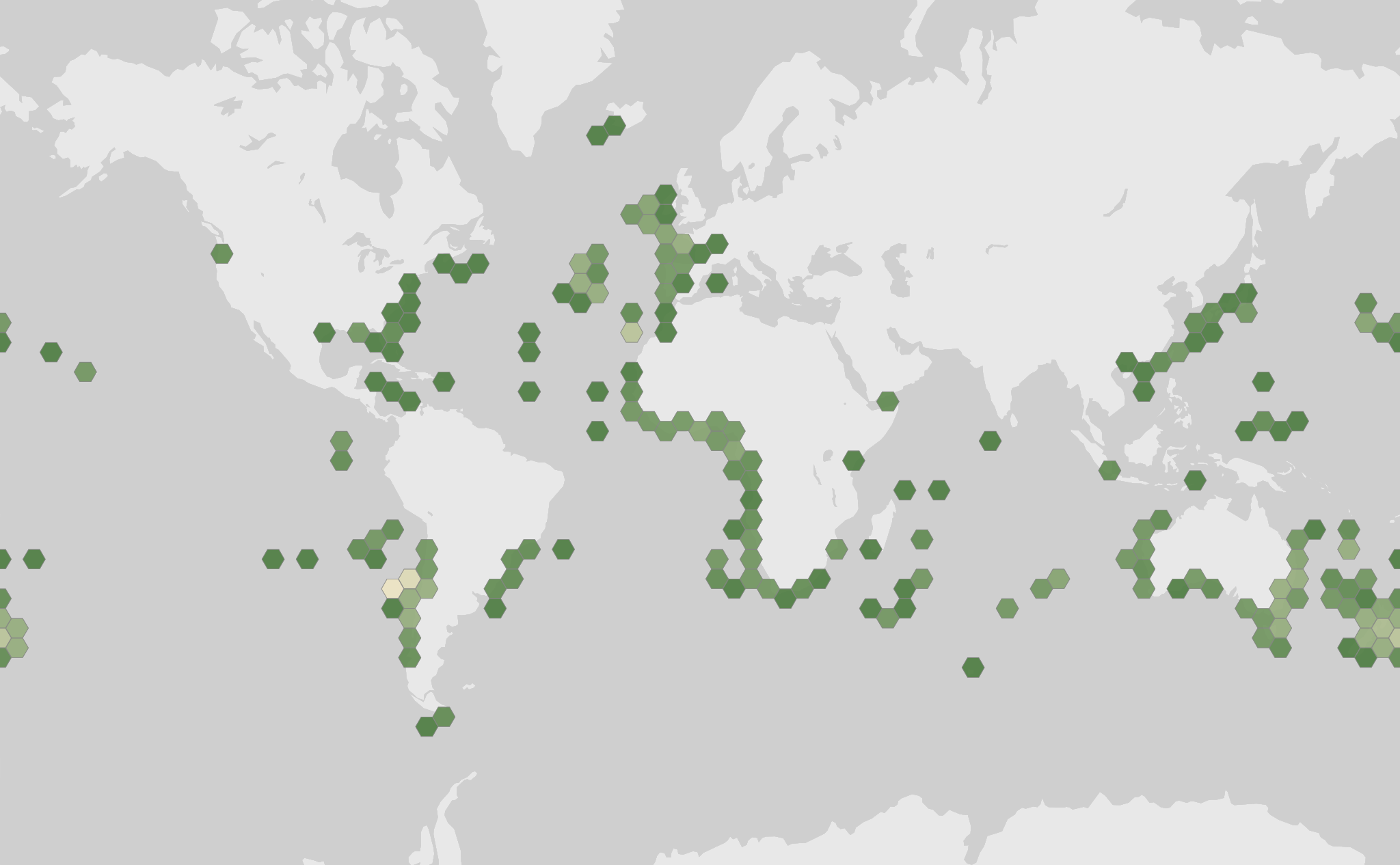
The splendid alfonsino has a global distribution, occurring in deep waters at depths ranging from 25 to 1,250 meters, with most individuals found between 400 and 600 meters. This broad depth range allows the species to occupy a wide variety of deep marine habitats across oceans.
Monthly observation records show a pronounced peak during the middle of the year, particularly in what appear to be summer months, when reported sightings rise sharply compared to the rest of the year. These figures reflect presence records rather than actual abundance or a complete picture of the species' range, so the seasonal pattern should be read as an indication of when the species is more often recorded rather than when it is most numerous.
Cultural Significance
The splendid alfonsino holds a distinct place in Japanese cuisine, where it is known as kinmedai, or "golden eye snapper." It is used in sushi and other traditional dishes, valued for qualities tied to its name and appearance.
Fun Facts
- The species belongs to the family Berycidae, which contains only two genera: Beryx and Centroberyx.
- One of its recognized synonyms is Beryx mollis.
Photos
Photographs from by NOAA's Fisheries Collection , SEFSC Pascagoula Laboratory; Collection of Brandi Noble, NOAA/NMFS/SEFSC via Wikimedia Commons, licensed under Public Domain., by NOAA Photo Library via Wikimedia Commons, licensed under Public Domain., by Nesnad via Wikimedia Commons, licensed under CC BY 4.0., by RuinDig/Yuki Uchida via Wikimedia Commons, licensed under CC BY 4.0., by Hugues Evano (IFREMER, Délégation océan Indien (DOI), Département Ressources Biologiques et Environnement (RBE), F-97420 Le Port, France) via Wikimedia Commons, licensed under CC BY 4.0., and by Totti via Wikimedia Commons, licensed under CC BY-SA 4.0., credited on each photo.
Ecology and classification
Habitat
Classification
- Phylum
- Chordata
- Order
- Beryciformes
- Family
- Berycidae
- Genus
- Beryx
- Species
- Beryx splendens
Sources
- GBIF Species names and classification
- Wikidata Common names and conservation status
- Wikipedia Summary extract
- AnAge Longevity
- Wikimedia Commons Photos
- GloBI What it eats, what eats it, parasites and pollinators
- Wardeh et al. 2015 (EID2)