Paeonia lactiflora grows wild across a vast stretch of Asia, from the highlands of eastern Tibet through northern China to the forests of eastern Siberia. It is a herbaceous perennial in the family Paeoniaceae, dying back to the ground each year and regrowing from its rootstock in spring.
Its combination of hardiness and broad natural distribution has made it one of the most recognizable flowering plants to emerge from Asia's temperate regions.
Identification and Appearance
The most reliable field mark is the flower itself: a large, cup- or bowl-shaped bloom 8 to 16 centimeters across, fragrant, with 5 to 10 broad petals in white, pink, or crimson surrounding a cluster of bright yellow stamens. The buds are large and rounded, appearing in late spring, typically May in the Northern Hemisphere, before opening fully.
The plant itself stands 50 to 70 centimeters tall and spreads about as wide, giving it a rounded, bushy habit. Its leaves are compound, divided into nine lobes, and can reach 20 to 40 centimeters in length, forming a dense mound of foliage beneath the flowers.
The blooms are notably attractive to butterflies, which visit the open flowers for nectar and pollen. The species favors dry, open, stony slopes, riverbanks, and the edges of sparse woodland, settings that offer good drainage and ample light for the wide flowers to open fully.
Distribution and Habitat
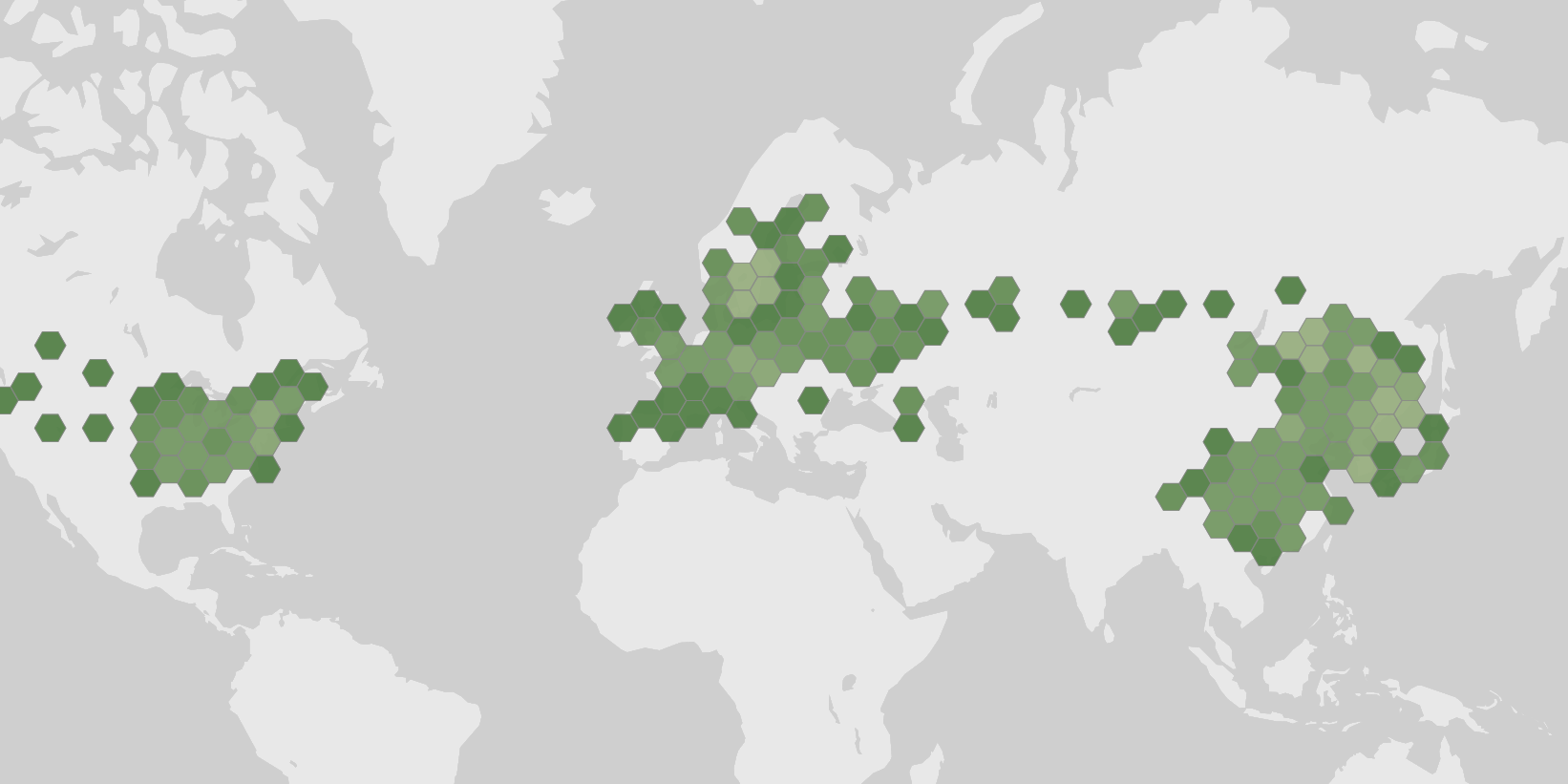
Paeonia lactiflora occurs in woods and grasslands at elevations between 400 and 2,300 meters, favoring open or semi-open ground where light reaches the forest floor or grassy slopes. This elevational range places it in temperate and montane zones across its native Asian territory.
Observation data collected through the year show a sharp seasonal pattern, with sightings climbing from a handful in the winter months to a pronounced peak in June, when nearly a thousand observations were logged, before falling away again by autumn. This pattern most likely reflects the plant's flowering period, when its large, showy blooms make it far easier to spot and record, rather than any actual change in where the species grows.
As with any presence-based observation record, these counts describe when and where the plant was noticed, not its abundance or the full extent of its native range.
Uses and Human Relationships
The peony's name traces back to Paeon, the physician to the gods in Greek mythology, a connection that cemented the flower's reputation as a medicinal plant across the ancient Mediterranean. Greek and Roman physicians used its roots and seeds to treat conditions ranging from epilepsy to kidney stones, and the flower came to symbolize healing and protection in both cultures.
In China, the plant's standing rose even higher: by the eighth century it had been crowned the "King of the Flowers," a symbol of health, royalty, and wealth that endured for centuries. Traditional Chinese medicine made particular use of the white peony root, drawn specifically from Paeonia lactiflora, to address ailments including menstrual irregularities and inflammation.
Across these traditions, the peony came to represent more than ornament. Its association with compassion, protection, and both physical and spiritual healing runs through Greek legend, Roman medicine, and Chinese herbal practice alike.
Fun Facts
- The peony's name comes from Paeon, the physician to the gods in Greek mythology, linking the flower to healing from its earliest recorded mentions.
- One Greek legend tells of a nymph named Paeonia, said to have been envied by Aphrodite for her extraordinary beauty.
- In eighth-century China, the peony was crowned the "King of the Flowers," a title that reflected its status as a symbol of health, royalty, and wealth.
- Ancient physicians once believed the peony held the power to cure twenty different ills, a claim that fueled its long-standing reputation as a medicinal plant across cultures.
Photos
Photographs from by Urgamal Magsar via iNaturalist, licensed under CC BY 4.0., via iNaturalist, licensed under CC0 1.0., by beandonnn via iNaturalist, licensed under CC BY 4.0., by Hilda Chan via iNaturalist, licensed under CC BY 4.0., by Святослав Власенко via iNaturalist, licensed under CC BY 4.0., by Lena Perova via iNaturalist, licensed under CC BY 4.0., by Holly Black via iNaturalist, licensed under CC BY 4.0., by Clayton VonDras via iNaturalist, licensed under CC BY 4.0., and by Paul Mero via iNaturalist, licensed under CC BY 4.0., credited on each photo.
Ecology and classification
Classification
- Phylum
- Tracheophyta
- Class
- Magnoliopsida
- Order
- Saxifragales
- Family
- Paeoniaceae
- Genus
- Paeonia
- Species
- Paeonia lactiflora
Sources
- GBIF Species names and classification
- iNaturalist Photos
- Wikidata Common names and conservation status
- Wikipedia Summary extract
- Encyclopedia of Life Habitat, diet and behavior traits