Few spring shrubs announce themselves as boldly as Ribes sanguineum, whose dangling clusters of blood-red flowers open at the very same moment its leaves emerge. This deciduous shrub belongs to the currant family, Grossulariaceae, and is native to the western United States and Canada.
Native to moist regions west of the Cascades, from British Columbia down through Oregon and Washington into coastal California, it has also become a garden favorite far beyond its homeland, naturalized across temperate Europe and Australasia.
Identification and Appearance
The most useful field mark is the dangling raceme of 5 to 30 flowers, each just 5 to 10 millimeters across, appearing in red, pink, or white at the same time the leaves unfurl in early spring. This deciduous shrub grows to about 3 meters tall and equally broad, with an upright-arching to rounded, naturally multi-stemmed habit, though it can also be trained into tree form.
Its bark is dark brownish-gray, marked with prominent paler brown lenticels. Leaves are alternate, simple, 2 to 7 centimeters long and broad, palmately lobed into five lobes, and carry a strong resinous scent when young in spring.
The fruit is a dark purple, oval berry about 1 centimeter long, notable for its insipid taste rather than any striking flavor.
Distribution and Habitat
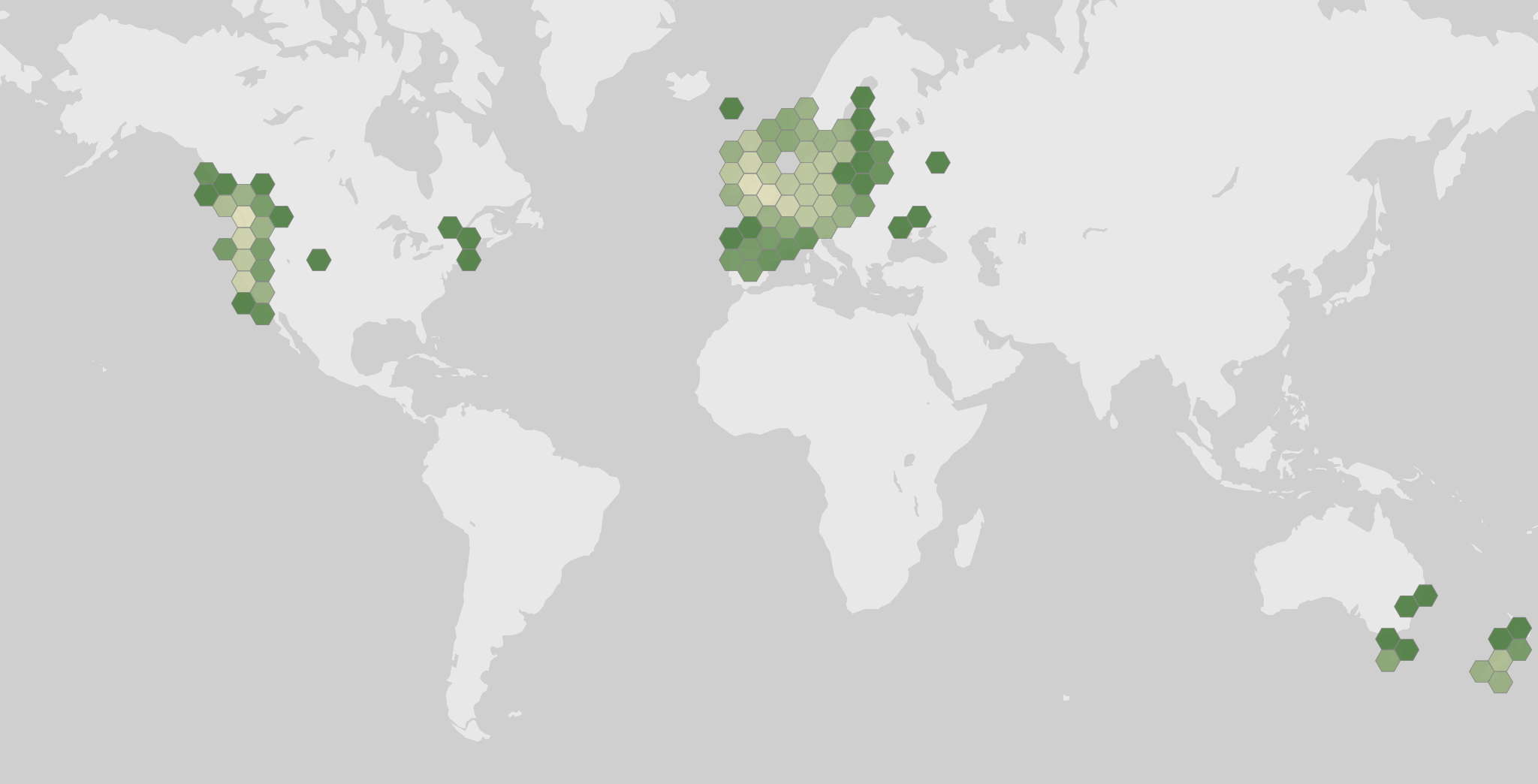
Ribes sanguineum is native to the western United States, Canada, and Mexico, occurring widely in the moist regions west of the Cascades across western British Columbia, Washington, and Oregon. In California its range narrows to areas near the coast, reaching as far south as Santa Barbara County, while in Mexico it survives only on the Pacific island of Guadalupe, where it may already be extirpated.
The species is generally secure across most of its range, but in Idaho it is critically imperiled, known only rarely from Bonner, Kootenai, Benewah, and Adams counties.
Beyond its native range, the shrub has been widely cultivated and has naturalized throughout temperate Europe and Australasia, including Czechia-Slovakia, Germany, Great Britain, Ireland, Norway, Spain, Sweden, and Tasmania.
Observation records peak sharply in spring, consistent with the shrub's conspicuous flowering season drawing attention during that time of year, though these counts reflect presence rather than actual abundance.
Growth and Form
Ribes sanguineum is a deciduous shrub, naturally multi-stemmed with an upright-arching to rounded form, though it can be trained into a tree shape. It reaches about 3 meters in both height and spread.
Ecology and Relationships
The early spring nectar of Ribes sanguineum draws hummingbirds and butterflies, while moths and butterflies browse its leaves as larvae. Deer and elk occasionally feed on the foliage, and birds and small mammals eat the berries; its branches also provide nesting habitat for birds. Among flower visitors, bumblebees such as Bombus terrestris, Bombus lucorum, and Bombus pratorum are recorded most often, alongside the honeybee Apis mellifera.
The shrub is shade tolerant but prefers sunny sites, and it tolerates drought well while favoring cool, moist conditions. It also serves as a host to white pine blister rust, which led to eradication efforts against the genus Ribes in the United States from the 1920s; the federal ban was lifted in 1966 once resistance had increased in both Ribes and western white pine populations.
Outside its native range, the species has become invasive: naturalized in New Zealand since 1904, it forms dense stands in shrublands and along waterways that crowd out native vegetation, and it is considered a significant environmental weed in Tasmania, though only a minor problem there due to its limited spread.
Uses and Human Relationships
Ribes sanguineum was introduced to British cultivation in the fall of 1826 by the Scottish botanist David Douglas, who sent seeds back during his explorations of the Pacific Northwest for the Royal Horticultural Society. It quickly became popular among English gardeners and remains a valued garden shrub today, prized for its brightly colored, scented early spring flowers and its support for birds and habitat. Numerous cultivars have been selected with flowers ranging from white to dark red, including 'Koja', 'Poky's Pink', and White Icicle ('Ubric'), all of which have received the Royal Horticultural Society's Award of Garden Merit.
Both indigenous and non-indigenous peoples have long used the berries for food, eating them fresh or dried, or preparing them into jams, pies, juice, or syrup, despite their poor flavor. The flowers have also been used to infuse beverages, particularly spirits.
Fun Facts
- The genus name Ribes likely derives from the Arabic ribas, originally referring to a different plant, Rheum ribes, used by Arabian physicians for its acidic properties.
- The species name sanguineum is Latin for "blood red," describing the flower color rather than any part of the fruit.
Photos
Photographs from by Steve Taylor via iNaturalist, licensed under CC BY 4.0., via iNaturalist, licensed under CC0 1.0., by dorian via iNaturalist, licensed under CC BY 4.0., by Ryan McMinds via iNaturalist, licensed under CC BY 4.0., by krickard0505 via iNaturalist, licensed under CC BY 4.0., by Kalvin Chan via iNaturalist, licensed under CC BY 4.0., by John Barkla via iNaturalist, licensed under CC BY 4.0., by Chris Conard via iNaturalist, licensed under CC BY 4.0., by Barry Stewart via iNaturalist, licensed under CC BY 4.0., by IDClaire via iNaturalist, licensed under CC BY 4.0., by slob973 via iNaturalist, licensed under CC BY 4.0., and by Rebecca Johnson via iNaturalist, licensed under CC BY 4.0., credited on each photo.
Ecology and classification
Classification
- Phylum
- Tracheophyta
- Class
- Magnoliopsida
- Order
- Saxifragales
- Family
- Grossulariaceae
- Genus
- Ribes
- Species
- Ribes sanguineum
Sources
- GBIF Species names and classification
- iNaturalist Photos
- Wikidata Common names and conservation status
- Wikipedia Summary extract
- Plants of the World Online Native range, life form and climate (WCVP)
- GloBI What it eats, what eats it, parasites and pollinators
- trophiCH
- DoPI
- Guzman et al. 2022
- EuPPollNet