The green-staining coral gets its name from a striking reaction: wherever its flesh is bruised or injured, the color darkens into a deep olive green. This coral mushroom belongs to the family Gomphaceae, growing in coniferous forests across parts of North America and Europe.
That single trait, easy to test with a gentle touch, makes this small, branching fungus a useful case study in how subtle chemical reactions can separate closely related species that otherwise look almost identical.
Fruiting Body and Identification
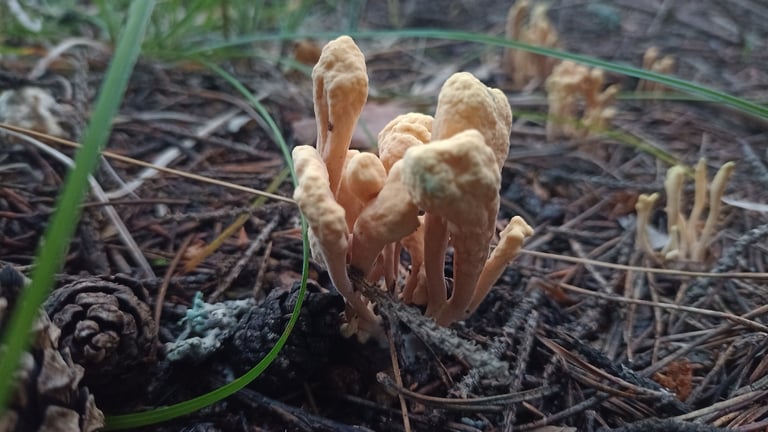
The most reliable way to identify Phaeoclavulina abietina is its bruising reaction: fresh tissue darkens to olive green or dark olive green wherever it is injured, standing out against its normal medium yellow-green to light olive color. The fruit bodies are small, standing 2 to 5 centimeters tall and 1 to 5 centimeters wide, branching from a central stem up to five times into slender, slightly flattened branches that fork or form crests near their tips.
The stem measures 5 to 15 millimeters long and 2 to 10 millimeters thick, with a mat of mycelium at its base connecting to rhizomorphs that branch into the substrate below. The tissue is leathery in texture and becomes brittle once dried. Its odor ranges from indistinct to earthy, and the taste starts sweet before turning somewhat bitter.
Spores collected in mass appear dark orange-yellow. Individually they are pip-shaped to broadly elliptical with one oblique end, measuring 6 to 9 by 3.5 to 4.5 micrometers, and are borne on four-spored basidia with sterigmata up to 7 micrometers long.
Distribution and Habitat
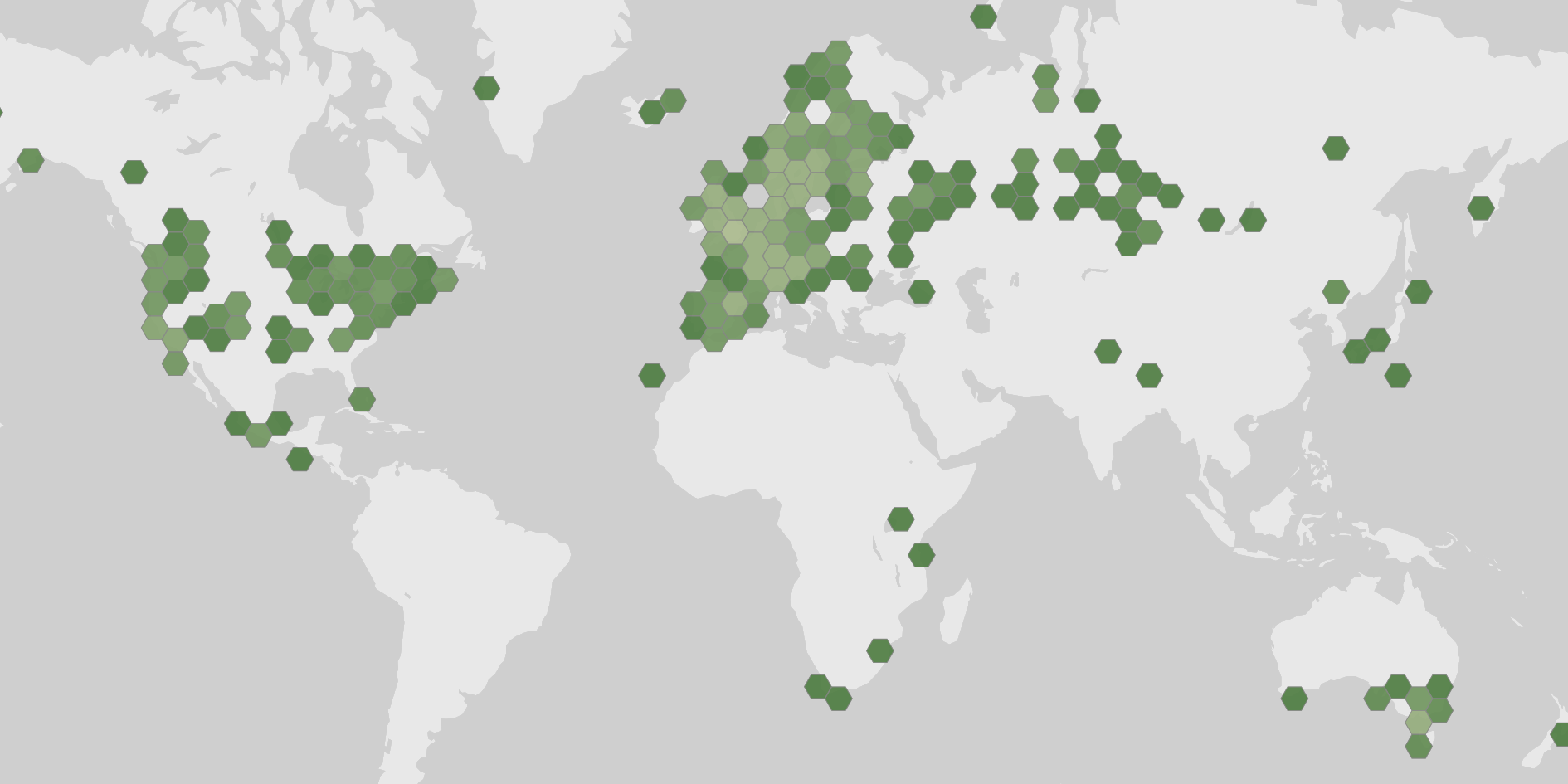
Phaeoclavulina abietina grows on the ground in the duff of coniferous forests, appearing scattered or in groups, sometimes arranged in rows. In North America it occurs in the United States, including the Pacific Northwest, and in Mexico, and it is also recorded in Europe.
Fruiting timing differs by region within the United States: on the West Coast it appears mostly from October to February, while inland populations tend to fruit from July to October. Observation records show a pronounced late-summer to autumn peak, consistent with its association with cooler, wetter conditions in conifer duff, though these records reflect presence rather than actual abundance.
Fun Facts
- Its scientific description traces back to Christian Hendrik Persoon, who originally named it Clavaria abietina, with a related name, Clavaria ochraceovirens, also given by Franz Wilhelm Junghuhn.
- The species now carries the genus name Phaeoclavulina, reflecting a later reclassification credited to the mycologist Giachini.
Photos
Photographs from via iNaturalist, licensed under CC0 1.0., by victor laborde via iNaturalist, licensed under CC BY 4.0., by Marc-Olivier Beausoleil via iNaturalist, licensed under CC BY 4.0., by Bethany Dennis via iNaturalist, licensed under CC BY 4.0., by Harrison West via iNaturalist, licensed under CC BY 4.0., by Elliot Greiner via iNaturalist, licensed under CC BY 4.0., by Mark Richman via iNaturalist, licensed under CC BY 4.0., by Johan Adler via iNaturalist, licensed under CC BY 4.0., and by luis angel leon santibañez via iNaturalist, licensed under CC BY 4.0., credited on each photo.
Ecology and classification
Habitat
Classification
- Phylum
- Basidiomycota
- Class
- Agaricomycetes
- Order
- Gomphales
- Family
- Gomphaceae
- Genus
- Phaeoclavulina
- Species
- Phaeoclavulina abietina
Sources
- GBIF Species names and classification
- iNaturalist Photos
- Wikidata Common names and conservation status
- Wikipedia Summary extract