Despite being named for a city it rarely visits, the Philadelphia vireo spends its life between the boreal forests of Canada and the scrublands of Central America, and its presence in a forest can go undetected even by experienced birdwatchers because of its close resemblance to the far more abundant red-eyed vireo.
This small songbird belongs to the vireo family (Vireonidae) within the order Passeriformes. It breeds across the boreal forests of southern Canada and winters in Mexico and Central America, and the IUCN lists it as Least Concern. Its close ties to successional forest habitats and its quiet rivalry with the red-eyed vireo make it a subtle but interesting subject for anyone interested in forest bird ecology.
Identification and Appearance
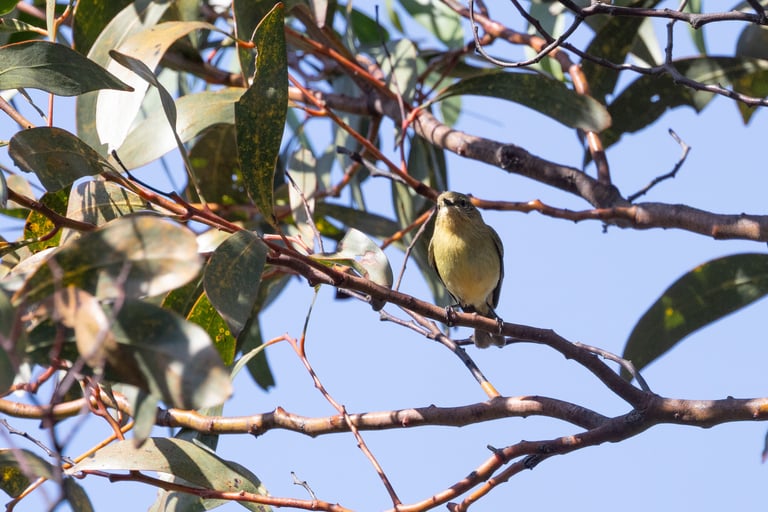
The most reliable field mark for the Philadelphia vireo is its combination of yellow underparts with dark lores, a pairing that distinguishes it from the similar warbling vireo. Adults show olive-brown upperparts and a grey crown, with dark eyes set off by a dark line through the eye and a white stripe just above it. The bill is stout and the legs thick and blue-grey.
This is a small bird, weighing only about 0.012 kilograms (12 grams). It has no wing bars and no eye ring, features that help separate it from many other vireo species at a glance.
The species most easily confused with the Philadelphia vireo is the warbling vireo, but the Philadelphia's much yellower underparts and dark lores provide a clear distinction. Its song is also very similar to that of the red-eyed vireo, though higher-pitched and with longer pauses between phrases.
Distribution and Habitat
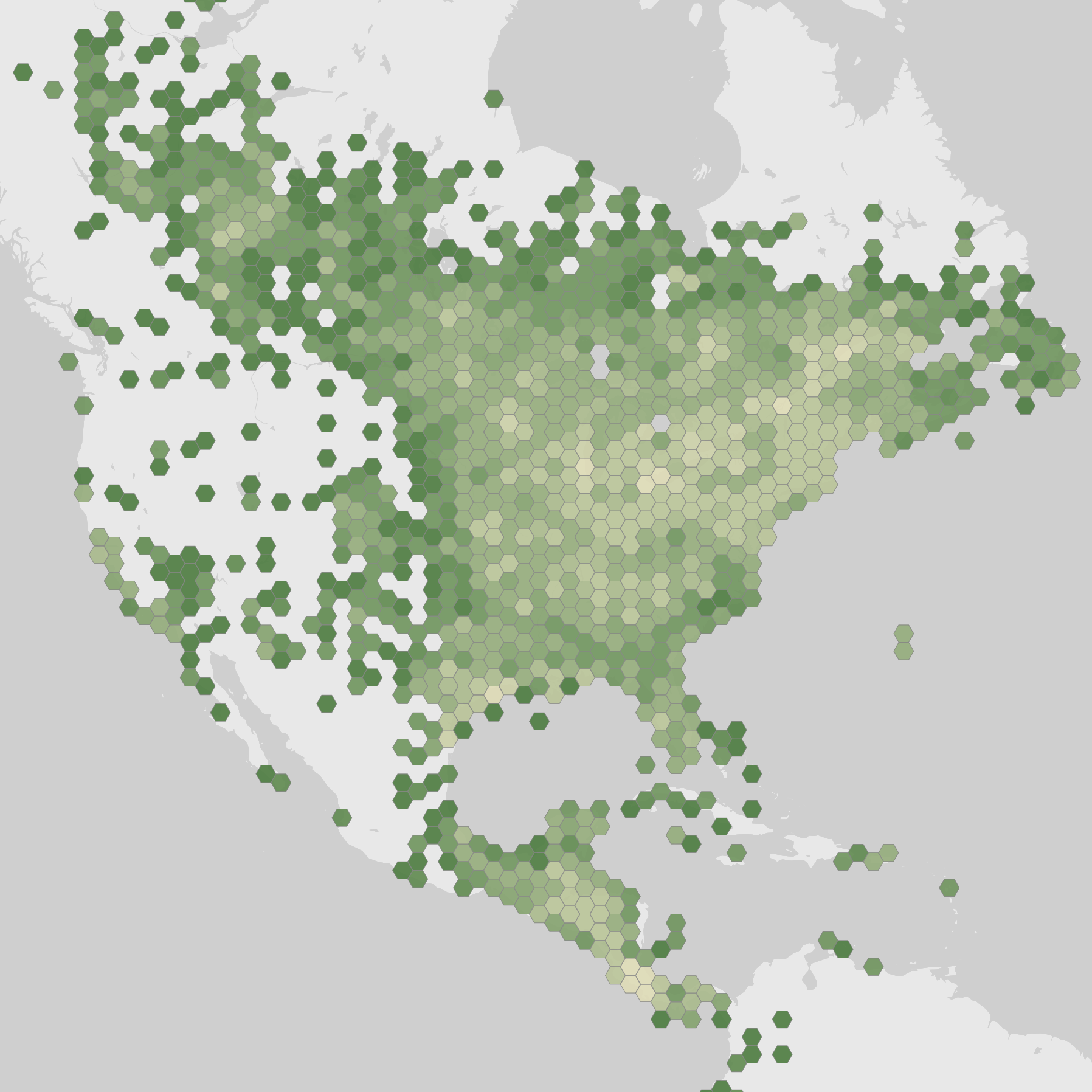
The Philadelphia vireo breeds primarily in the boreal forests of southern Canada, favoring second-growth or early- to mid-successional forests made up of aspen, birch, alder, and ash. It prefers dense habitats with complex vertical structure and canopy closure of 70 to 100 percent, often nesting high in the tallest trees.
During migration, the species uses similar wooded habitats but is more often found in dense, shrubby thickets. It migrates south to winter in Mexico and Central America, where it favors scrubby edge habitats and occasionally plantations or gardens, and has been recorded at elevations up to 1,600 meters. It is a very rare vagrant to western Europe.
Its overall breeding and wintering range spans roughly 2,750,000 square kilometers. Monthly observation patterns show a strong spike in spring and again in late summer, consistent with the species' seasonal movement through migration corridors rather than any change in abundance at a single site.
Behavior and Lifestyle
The Philadelphia vireo is an arboreal species, foraging and nesting almost exclusively in tall canopy trees, and it is a neotropical migrant that makes two long journeys each year, one in spring and one in fall, traveling mostly at night despite being diurnal during breeding and winter. During the non-breeding season it often joins mixed flocks with warblers and other vireos, and in winter it may travel in small, loosely associated groups.
During breeding, pairs form soon after arrival on the breeding grounds and defend feeding and nesting territories, which range from 0.3 to 0.8 hectares depending on population density and resource availability. Males sing to advertise territory and use warning postures, such as erecting crest feathers, thrusting the head forward with an open beak, or fanning the tail, to deter intruders. Physical aggression, including aerial chases, pecking, or grappling, occurs but is not the species' typical response.
A notable feature of its behavior is competition with the more aggressive red-eyed vireo, which often breeds in the same habitat. When both species are present, aggressive encounters are frequent, though the two species partly divide resources: Philadelphia vireos forage and nest in the highest canopy layer and prefer white ash and yellow birch, while red-eyed vireos occupy the middle canopy and use a broader range of tree species.
Communication
Communication relies on acoustic and visual signals, since vireos perceive their surroundings through visual, auditory, tactile, and chemical cues. The male's primary song, described as "cherrie-o-witt, cheree, sissy-a-witt, tee-o," closely resembles the red-eyed vireo's song but is higher-pitched with longer pauses between phrases. Both sexes use a harsh "ehh" call to respond to intruders or to stay in contact with a mate.
Visual signals play a large role in territorial and courtship displays. Warning postures include erecting crest feathers, fanning the tail, gaping the beak, or lowering the head with the body held horizontal, all used to deter intruders before any physical confrontation occurs. Courtship displays are similarly visual: males erect crest feathers, fan their tails, and occasionally sway, while females respond with a crouched wing-quivering posture.
Diet and Nutrition
The Philadelphia vireo is primarily an insectivore that gleans insects from leaves while flying past or hovering, with a particular preference for foraging on white ash and yellow birch. Caterpillars are its most frequent prey, and populations may increase in years when caterpillars are especially abundant, sometimes leading to double broods.
Beyond caterpillars, it also takes butterflies and moths, beetles (including ladybugs, leaf-eating beetles, weevils, and wood-boring beetles such as Buprestidae and Cerambycidae), click beetles, and flies.
Berries make up about 7% of its diet year-round but rise to as much as 20% during winter, providing an important seasonal supplement as insect availability changes.
Nesting and Breeding
The Philadelphia vireo is monogamous, with pairs forming soon after arrival on the breeding grounds in late May. Courtship involves males snapping their bills, fanning their tails, and erecting crest feathers, while females respond by wing-quivering, and aggression between mates is notably lower than in the closely related red-eyed vireo.
The breeding season runs from May through August. After pairing, the female selects a forked branch high in the canopy, typically 9 to 24 meters above the ground, and builds a hanging, cup-shaped nest from birch bark, grass, feathers, vegetation, and spider webs. She lays 3 to 5 white eggs speckled with brown or black, each about 19 millimeters long.
Both parents share incubation duties, which last 11 to 13 days, and males develop a small brood patch during this period. After hatching, the altricial young are fed and brooded by both parents, fledging at 12 to 14 days old but remaining dependent on their parents for about 10 more days.
Nesting near the more aggressive red-eyed vireo creates added risk: parents must actively defend their fledglings, which the red-eyed vireos may treat as intruders, sometimes ushering young from open areas into nearby shrubs for shelter.
Population and Ecological Role
The Philadelphia vireo's population is increasing across a large geographic range, benefiting from its preference for successional forests, habitats now created almost exclusively by human disturbance such as select harvesting or clear-cutting. As an insectivore, it likely influences local insect communities, particularly during caterpillar outbreaks, and its consumption of wood-boring beetles helps reduce damage to trees.
Its nests are occasionally parasitized by brown-headed cowbirds, adding a layer of interaction with another bird species within its breeding range.
Conservation and Threats
The Philadelphia vireo is listed as Least Concern by the IUCN Red List, reflecting its increasing population and broad geographic distribution. It is protected under the US Migratory Bird Act, though it carries no special status under CITES or federal or state endangered species lists.
The species depends heavily on successional forests dominated by white ash and yellow birch, habitats largely produced by human logging practices such as select harvesting or clear-cutting. Because of this dependence, heavy harvesting of ash and birch could negatively affect its populations, even as the species as a whole remains secure.
Cultural Significance
The vireo, as a group, carries symbolic weight in some cultures as a sign of good luck and fortune, with sightings believed to bring a lucky streak.
Beyond symbolism, the Philadelphia vireo's ecological habits carry indirect benefit to people: by consuming wood-boring beetles and caterpillars during outbreaks, it helps protect trees valued for timber harvest, oxygen production, and erosion control.
Fun Facts
- Despite its name, the Philadelphia vireo is unlikely to visit the city of Philadelphia itself, except perhaps during migration.
- The species is a very rare vagrant to western Europe, turning up far outside its normal range on occasion.
- Its song is so similar to the red-eyed vireo's that many birders overlook its presence entirely, even in forests where it is present.
- In some cultures, vireos as a group are considered symbols of good luck, with sightings said to foretell a lucky streak.
Photos
Photographs from via iNaturalist, licensed under CC0 1.0., by Dan Vickers via iNaturalist, licensed under CC BY 4.0., by Brandon Johnson via iNaturalist, licensed under CC BY 4.0., by Court Harding via iNaturalist, licensed under CC BY 4.0., by Andrew Lai via iNaturalist, licensed under CC BY 4.0., by Rita Clare via iNaturalist, licensed under CC BY 4.0., by Zac Peterson via iNaturalist, licensed under CC BY 4.0., by foxsu via iNaturalist, licensed under CC BY 4.0., by kirk gardner via iNaturalist, licensed under CC BY 4.0., by Dan MacNeal via iNaturalist, licensed under CC BY 4.0., by Tom Field via iNaturalist, licensed under CC BY 4.0., by brendanboyd via iNaturalist, licensed under CC BY 4.0., and by sudomir via iNaturalist, licensed under CC BY 4.0., credited on each photo.
Ecology and classification
Classification
- Phylum
- Chordata
- Class
- Aves
- Order
- Passeriformes
- Family
- Vireonidae
- Genus
- Vireo
- Species
- Vireo philadelphicus
Sources
- GBIF Species names and classification
- iNaturalist Photos
- Wikidata Common names and conservation status
- Wikipedia Summary extract
- Encyclopedia of Life Habitat, diet and behavior traits
- Animal Diversity Web Animal habitat, behavior and diet
- AnAge Longevity
- AVONET Bird mass, habitat, migration, diet and range size