The tuber that feeds much of the world isn't a root at all — it's a modified underground stem, thickened at the tip of a stolon to store the plant's food reserves. That simple biological trick helped turn Solanum tuberosum into one of the most widely eaten staple foods on the planet.
The potato is a herbaceous perennial in the nightshade family, Solanaceae, native to the Americas. Though it originated in South America, it is now cultivated across temperate regions worldwide, from the Andes to China, wherever growers can meet its need for a defined growing season.
Beyond its role as a dietary staple, the potato carries a history as old as the Inca Empire and a genetic story still being rewritten by modern plant breeders — reasons enough why a single tuber deserves a closer look.
Identification and Appearance
A potato plant is easiest to recognize by its soft, hairy stems and compound leaves, each made up of roughly four pairs of leaflets. It grows as a herbaceous perennial reaching up to one metre (three feet) in height, with a sprawling, leafy habit above ground that gives little hint of the tubers forming below.
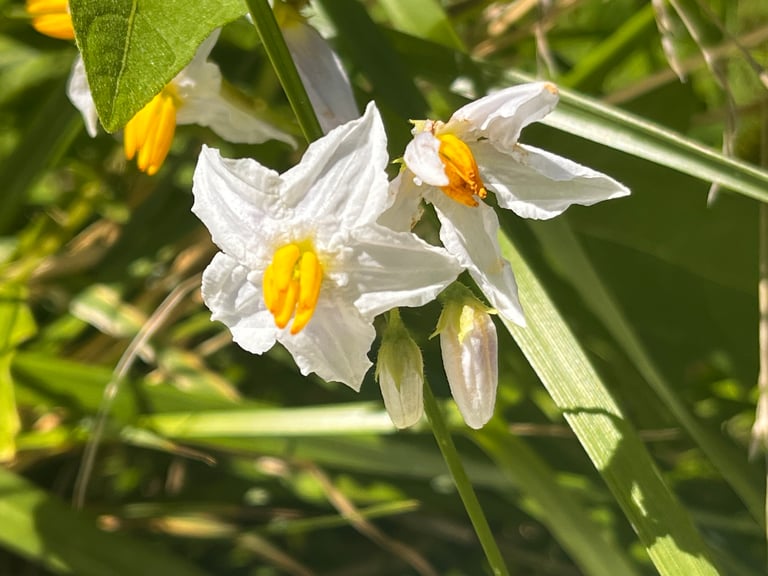
Its flowers range from white or pink to blue or purple, each with a bright yellow center, and are pollinated by insects. Flower color varies between varieties, but the yellow central cone formed by the fused anthers stays constant across the color range.
The tubers themselves are stems, not roots: they form from thickened rhizomes at the tips of long, thin stolons and are studded with "eyes" arranged in a helical pattern, each protecting a vegetative bud from which a new stem can sprout. Small round pores called lenticels cover the tuber surface, allowing it to breathe; their number varies with tuber size and growing conditions. Tuber formation is triggered by shortening day length, though modern commercial varieties have been bred to reduce this sensitivity.
After flowering, the plant produces small green fruits that closely resemble miniature cherry tomatoes, each containing roughly 300 tiny seeds — a reminder of its close kinship with tomatoes within the nightshade family.
Distribution and Habitat
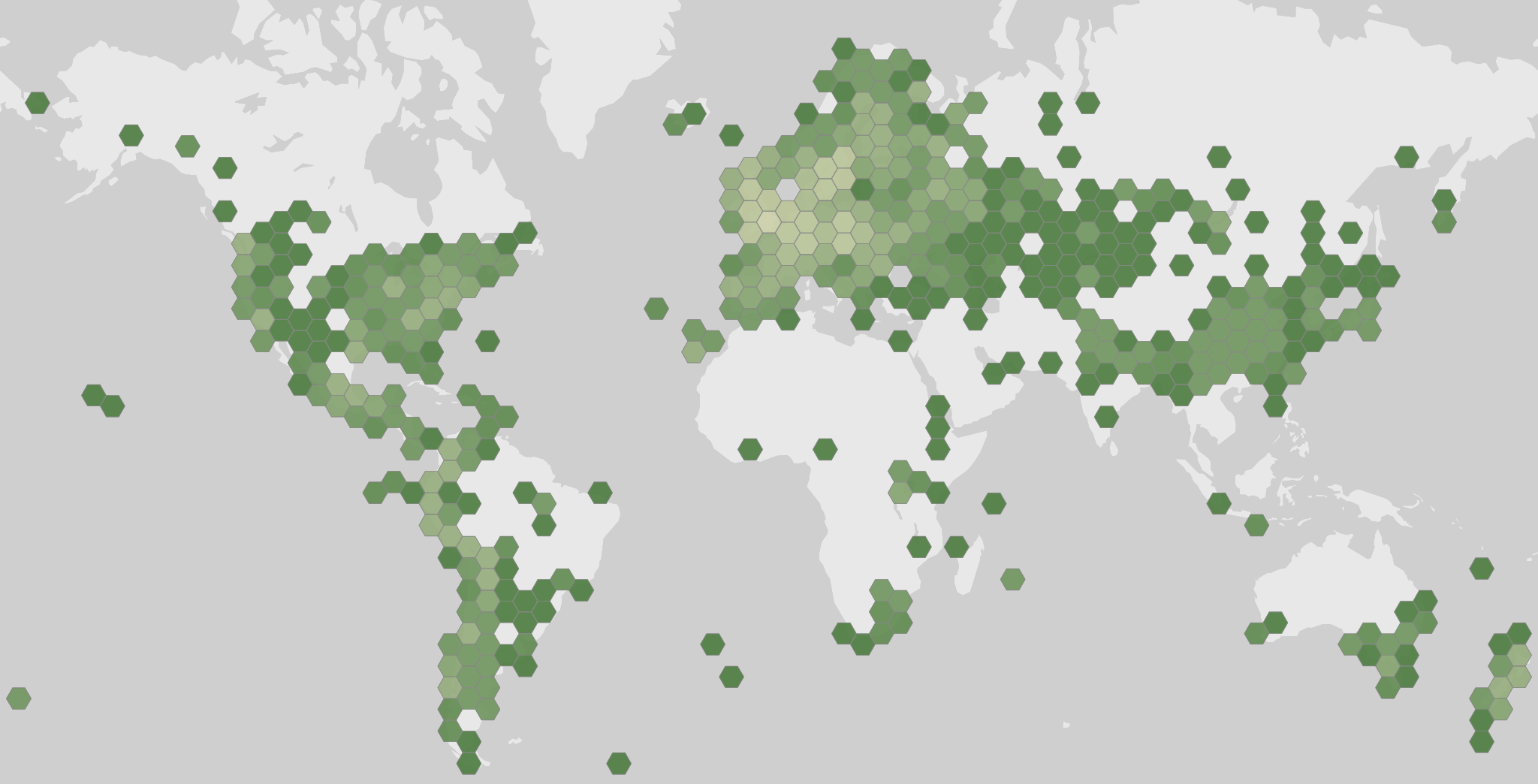
Solanum tuberosum is native to South America, and today it is cultivated across temperate regions worldwide, including widespread cultivation throughout China.
Observation records show sightings peaking sharply between June and August, with monthly counts of roughly 3,900 to 5,500, compared with under 1,400 during the winter months of November through February. Because these figures are presence records rather than population counts, they most likely reflect when the plant is visible and actively growing — in leaf and flower — rather than any measure of true abundance.
The seasonal pattern fits a plant that dies back to its tubers outside the growing season, becoming far less visible, and therefore less often recorded, once its aboveground foliage has senesced.
Growth and Form
Growth proceeds through five distinct phases. Sprouts first emerge from seed potatoes as root growth begins; the plant then develops leaves and branches above ground while stolons form from lower underground leaf axils. In the third phase the stolon tips swell into new tubers as flowering typically begins, followed by a bulking phase in which the plant channels most of its resources into the developing tubers — soil moisture, temperature, nutrient balance and pest pressure during this stage are decisive for yield. In the final phase the leaves and stems senesce and the tuber skins harden as the plant matures.
Tubers that form at or near the soil surface turn green and develop solanine as a defense against sunlight, so growers cover them by hilling soil around the base of the plant as it grows, or by mulching with straw or plastic sheeting. Commercial fields are prepared with deep tillage in well-drained, mildly acidic to neutral soil (pH 6 to 7), typically a sandy loam, with rows spaced about 80 centimetres (31 inches) apart; home gardeners plant tubers in trenches or holes roughly 15 centimetres (5.9 inches) deep, often enriched with compost or manure.
The plant is sensitive to heavy frost, which damages tubers both in the ground and in storage.
Reproduction and Life Cycle
Solanum tuberosum and most of its wild relatives are self-incompatible — pollinating a flower with its own pollen produces no useful fruit, so all sexually produced seedlings are hybrids. This has long complicated breeding, but the gene responsible has now been identified, along with mutations that disable it. Researchers have used CRISPR-Cas9 to introduce self-compatibility into diploid potato lines, including a specialized line of S. tuberosum carrying the "Sli" gene, which allows pollen to fertilize flowers on the same or genetically similar plants. Wageningen University and the company Solynta cloned this gene in 2021, opening the door to faster, more targeted breeding.
Breeders also draw on wild potato relatives for traits such as blight resistance, including Solanum demissum and S. stoloniferum, and recent work in diploid hybrid breeding has shown that fixing donor alleles in a homozygous state is possible, a step that could speed the development of new varieties.
Genetic engineering has produced several notable varieties: Monsanto's Bt-resistant 'New Leaf' line, discontinued in 2001 after major food companies declined to use genetically modified potatoes; BASF's 'Amflora', engineered to produce starch almost entirely of amylopectin for industrial use, approved in the EU in 2010 but withdrawn in 2012; BASF's blight-resistant 'Fortuna', which carried resistance genes from the wild Mexican species S. bulbocastanum; and a non-browning, low-acrylamide variety developed by Simplot and approved by the USDA in 2014. All have faced public resistance in the United States and European Union.
Uses and Human Relationships
For the Inca, and for today's Aymara and Quechua farmers of the Andes, the potato carries meaning well beyond nutrition — it is described as a symbol and a protective spirit, tied to legends of saving people from slavery. More broadly, nightshade plants have a history in traditional medicine and shamanic ritual tied to their psychoactive and medicinal alkaloids, compounds modern science continues to study for potential new drugs.
Commercial production begins with disease-free "seed potatoes," grown in regions selected for climates that limit pests and disease. In the United States, only 15 of the 50 states that grow potatoes are approved for seed production, chosen for cold winters that kill pests and long summer daylight hours; in the UK, most seed potatoes come from Scotland, where prevailing westerly winds reduce aphid activity and the spread of viral pathogens. Growers must still contend with late blight (Phytophthora infestans), along with Rhizoctonia, Sclerotinia, bacterial black leg, powdery mildew and powdery scab, and pests such as the Colorado potato beetle, potato tuber moth, aphids and the potato cyst nematode.
After harvest — by hand and hoe on a small scale, or by mechanical harvester on farms — potatoes are cured at 10 to 16°C (50 to 60°F) under high humidity to set their skins and heal wounds before storage. Long-term storage requires dark, well-ventilated conditions near 4°C (39°F); temperatures below that convert starch to sugar, altering flavor and raising acrylamide levels when the potatoes are fried. Sprouting during storage is controlled chemically, most often with chlorpropham, though this has been banned in the EU over toxicity concerns and replaced with alternatives such as ethylene, spearmint and orange oils. Under good conditions, commercial storage can keep potatoes viable for 10 to 12 months.
Fun Facts
- The Spanish conquest of Peru, between 1532 and 1572, ended the Inca civilization but carried Solanum tuberosum back to Europe — arguably the most lasting treasure the conquistadors took from the Andes.
- The potato served as a staple crop of the Inca Empire, providing a dependable source of food and energy long before it ever reached Europe.
- For Aymara and Quechua farmers today, the potato remains more than food: it is regarded as a symbol and protective spirit, with legends crediting it with saving people from slavery.
Photos
Photographs from via iNaturalist, licensed under CC0 1.0., by Tracy PW via iNaturalist, licensed under CC BY 4.0., by Ian Wright via iNaturalist, licensed under CC BY 4.0., by jamie-aa via iNaturalist, licensed under CC BY 4.0., by Frank Ashwood via iNaturalist, licensed under CC BY 4.0., by Евгений Маринкин via iNaturalist, licensed under CC BY 4.0., by Pluto Hooper via iNaturalist, licensed under CC BY 4.0., by Andrew Tree via iNaturalist, licensed under CC BY 4.0., by Christopher Hynes via iNaturalist, licensed under CC BY 4.0., by Robert Martin via iNaturalist, licensed under CC BY 4.0., by Alex Press via iNaturalist, licensed under CC BY 4.0., by Igor Balashov via iNaturalist, licensed under CC BY 4.0., and by naturewatchwidow via iNaturalist, licensed under CC BY 4.0., credited on each photo.
Ecology and classification
Growth habit
- Herb
Classification
- Phylum
- Tracheophyta
- Class
- Magnoliopsida
- Order
- Solanales
- Family
- Solanaceae
- Genus
- Solanum
- Species
- Solanum tuberosum
Sources
- GBIF Species names and classification
- iNaturalist Photos
- Wikidata Common names and conservation status
- Wikipedia Summary extract
- Encyclopedia of Life Habitat, diet and behavior traits