Though it is eaten as a vegetable in kitchens worldwide, the tomato is botanically a berry — a fleshy, seed-bearing fruit produced by a flowering plant in the nightshade family, alongside tobacco, potato, and chili peppers.
The species originated in western South America, though it may have been domesticated there, in Mexico, or in Central America; the exact site remains uncertain. Spanish colonizers carried it across the Atlantic during the Columbian exchange of the 16th century, setting it on a path to becoming one of the most widely grown food crops on Earth.
Few plants have traveled as far or transformed as many cuisines as the tomato has, and its journey from a wild South American berry to a global staple is worth understanding in detail.
Identification and Appearance
The tomato is most easily recognized by its sprawling, vining growth habit: left unsupported, the stems become decumbent and can reach up to 3 meters (9.8 feet) in length, while bush varieties stay under 100 centimeters (3.3 feet) tall. As a tender perennial usually grown as an annual, the plant sends a series of branching stems from a terminal bud, with lateral buds taking over growth whenever the tip is pruned or begins flowering instead.
Both stems and leaves are densely covered in fine hairs, a pubescence that serves a practical purpose: wherever a stem touches moist ground, especially if its connection to the main root has been damaged, these hairs can develop into new roots. The leaves themselves are 10 to 25 centimeters (4 to 10 inches) long, odd-pinnate with five to nine leaflets on short stalks, each leaflet up to 8 centimeters (3 inches) long with a serrated edge.
Flowers are yellow, 1 to 2 centimeters (0.4 to 0.8 inches) across, with five pointed lobes on the corolla, and grow in clusters of three to twelve. Their anthers fuse into a cone-like column that surrounds the pistil's style, a structure that supports self-fertilization, though the flowers are not truly self-pollinating without help from wind or vibration.
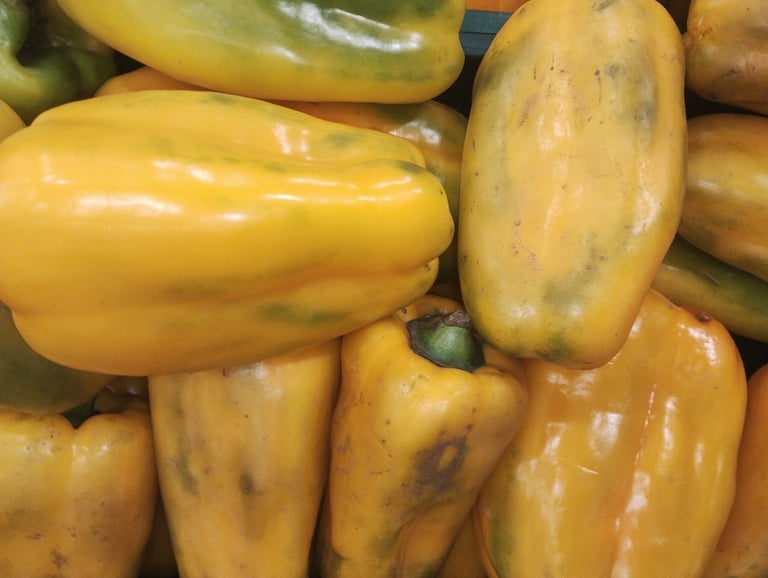
The fruit that follows varies by variety: small tomatoes typically have two internal locules, globe-shaped types three to five, beefsteak varieties many small locules, and plum tomatoes very few, tiny ones. Lycopene turns the ripening fruit red, but not every variety produces it in the same amount — yellow tomatoes accumulate more delta-carotene and lutein, while orange types favor beta-carotene and prolycopene instead.
Distribution and Habitat
Tomatoes spread from the Americas to the rest of the world in the wake of Hernán Cortés's 1521 capture of Tenochtitlan, which opened the exchange of crops, animals, and ideas known as the Columbian exchange. By the 1540s the plant was already being cultivated in Europe, thriving in Mediterranean climates.
The earliest European record appears in Pietro Andrea Mattioli's 1544 herbal, which described a new type of eggplant, blood-red or golden when ripe, that could be sliced and eaten cooked with salt, pepper, and oil; a decade later Mattioli gave it the name pomi d'oro, or "golden apples." By the early 17th century tomatoes were being eaten as food in Spain, as shown by a 1618 reference in Lope de Vega's play La octava maravilla.
From Spain's American colonies, the fruit spread through the Caribbean, and Spanish introduction to the Philippines carried it onward across Southeast Asia and the rest of Asia, completing its transformation from a regional South American plant into a near-universal crop.
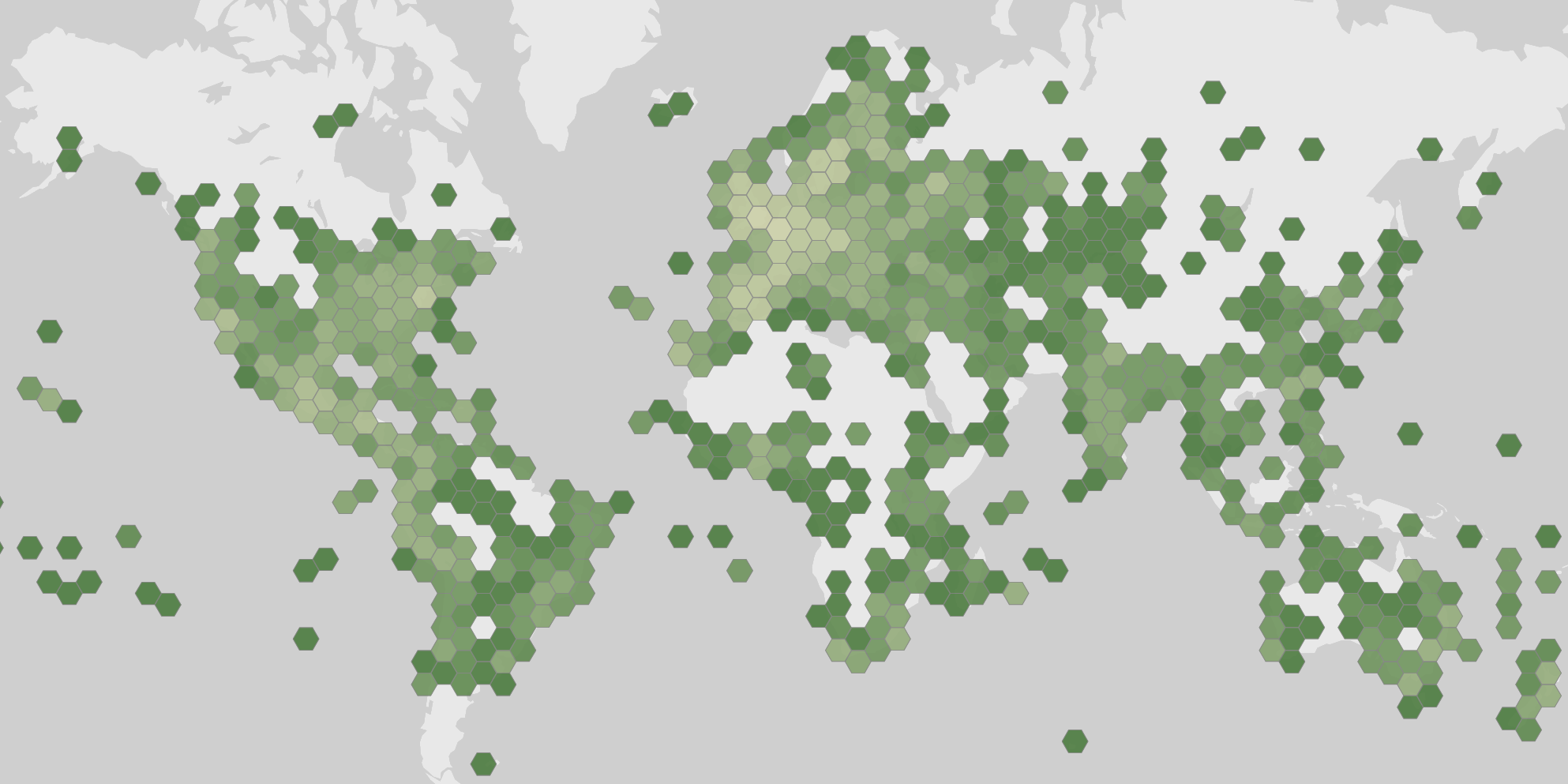
Modern observation records, which reflect presence rather than abundance, show a clear seasonal pattern: reported sightings climb sharply from around 2,400 in June to a peak of over 10,200 in September, before falling back below 1,200 by December. This pattern likely tracks the peak of the Northern Hemisphere's outdoor growing and fruiting season rather than any change in the species' underlying range.
Reproduction and Life Cycle
Modern tomatoes owe much of their taste, or lack of it, to a mutation discovered in the mid-20th century. Before it appeared, most fruit ripened unevenly, keeping a green ring around the stem, but produced more sugar and stronger flavor in the process. Breeders crossed in a mutant "u" phenotype that ripens fruit uniformly red, and this trait was widely adopted — at a cost.
The u mutation produces defective, lower-density chloroplasts in the developing fruit, and while this yields the even redness prized in the market, it also cuts sugar content in the ripe fruit by 10 to 15 percent. In fruit with the normal "U" phenotype, these chloroplasts can generate 10 to 20 percent of the fruit's total fixed carbon through photosynthesis, and during ripening they remodel into chromoplasts that build up lycopene, beta-carotene, and other pigments responsible for both color and flavor. The trade-off is that "U" fruit can develop green or cracked yellow shoulders near the stem from oxidative stress in strong sunlight, meaning breeders still have not fully reconciled sweetness with cosmetic uniformity.
To push past these limits, breeders increasingly turn to wild tomato relatives, which can carry genes for higher fruit solids and sugar content or resistance to diseases such as the early blight pathogen Alternaria solani. This strategy has its own downside: selecting for a single trait like disease resistance can inadvertently reduce fruit production or otherwise conflict with other desirable characteristics, a linkage problem breeders continue to work around.
Uses and Human Relationships
Tomatoes are grown worldwide for their fruit, with thousands of cultivars suited to everything from field production to greenhouse and hydroponic systems. Large commercial greenhouses favor smaller cherry, grape, or fruit-on-the-vine clusters, while owner-operated greenhouses more often grow beefsteak varieties, and greenhouse production overall is expanding to supply fruit outside the normal field season. Many tomatoes are picked green to survive transport and then ripened afterward using the plant hormone ethylene, while industrial canning operations harvest mechanically, cutting whole vines and sorting ripe fruit with sensors before returning the remaining plant matter to the farm as green manure or livestock feed. In 2023, world production reached 192 million tonnes, with China producing 36 percent of the total and India, Turkey, and the United States following as secondary producers.
In the kitchen, tomatoes are central to Mediterranean cuisine, forming the base of pizza and countless pasta sauces, and they appear in Spanish gazpacho and Catalan pa amb tomàquet. They are just as essential to Middle Eastern cooking, served fresh in salads such as Arab, Israeli, Shirazi, and Turkish salads, grilled alongside kebabs, or simmered into sauces. After Europeans introduced them to South Asia, tomatoes were folded into curries including Kashmiri rogan josh and the tomato-and-cream-based tikka masala popular in British curry houses.
Beyond food, the tomato carries cultural weight of its own. The town of Buñol, Spain, holds La Tomatina each year, a festival where tens of thousands of participants have thrown over 100,000 kilograms of tomatoes at one another. Ohio and Arkansas have both given the tomato official state status, with Arkansas naming it both the state fruit and vegetable in the same law. Its botanical status as a fruit rather than a vegetable even reached the United States Supreme Court in Nix v. Hedden, after 19th-century tariff law taxed vegetables but not fruit.
Fun Facts
- The scientific name comes from two languages: Solanum was the ancient Roman name for deadly nightshade, while lycopersicum blends the Greek lykos ("wolf") with the Latin persicus ("Persian"), giving the tomato a name that literally evokes a "wolf peach."
- Carl Linnaeus assigned this Latin name in the 18th century simply to give the plant a precise label that would hold steady across different languages and regions.
- When tomatoes first reached Europe, many people distrusted them because of their close relation to the nightshade family, a group long associated with poisonous plants.
Photos
Photographs from via iNaturalist, licensed under CC0 1.0., by Светлана Самусенко via iNaturalist, licensed under CC BY 4.0., by Engers via iNaturalist, licensed under CC BY 4.0., by Vasco Henrique Oliveira Fonseca via iNaturalist, licensed under CC BY 4.0., by Jose Gutierrez Higa via iNaturalist, licensed under CC BY 4.0., and by Sandy Wolkenberg via iNaturalist, licensed under CC BY 4.0., credited on each photo.
Ecology and classification
Growth habit
- Vine
Classification
- Phylum
- Tracheophyta
- Class
- Magnoliopsida
- Order
- Solanales
- Family
- Solanaceae
- Genus
- Solanum
- Species
- Solanum lycopersicum
Sources
- GBIF Species names and classification
- iNaturalist Photos
- Wikidata Common names and conservation status
- Wikipedia Summary extract