Despite having no vegetative propagules at all, Ramalina sinensis has still managed to spread thinly across three continents, relying entirely on sexual spores that must find a new algal partner each time they land.
This fruticose lichen in the family Ramalinaceae grows as an erect, bushy form with broad, flattened branches, greener above and paler below. It ranges across the Northern Hemisphere, found in North America, China, and Russia, where it attaches to the bark of a wide variety of trees. From its role as winter food for an endangered Chinese primate to its quiet presence in Yunnan food markets, this lichen connects forest ecology and human tradition in ways not obvious at first glance.
Fruiting Body and Identification
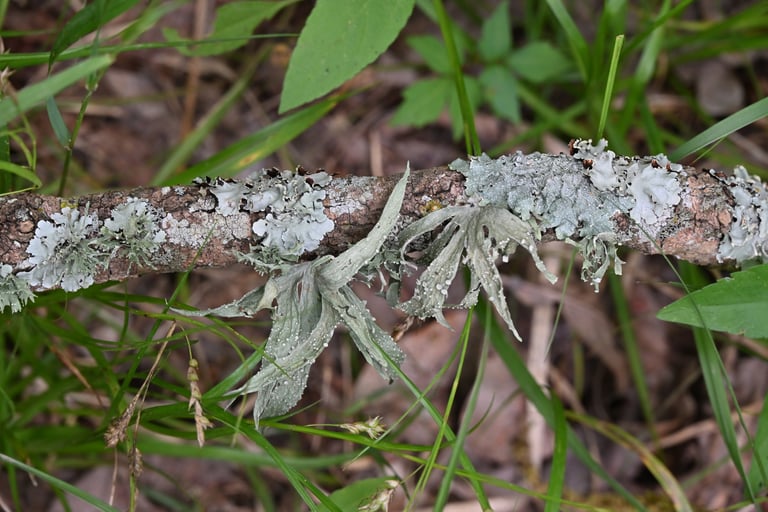
The clearest identifying feature of Ramalina sinensis is its two-toned, flattened thallus: an erect, bushy lichen attached by a narrow holdfast, with broad lobes that are often palmately divided and distinctly greener on the upper surface than on the paler, whitish underside.
The branches are solid rather than hollow, a detail that helps separate it from superficially similar fruticose lichens with hollow branches. The lower surface carries sunken, net-like pseudocyphellae, small pores involved in gas exchange that give the underside a faintly patterned texture.
Apothecia, the lichen's spore-producing fruiting discs, are often produced near the branch tips. Within them, the ascospores are small, only about 5 micrometers long and 2.5 micrometers wide, spindle-shaped and slightly curved, a microscopic feature useful for confirming identification beyond the naked-eye traits.
Distribution and Habitat
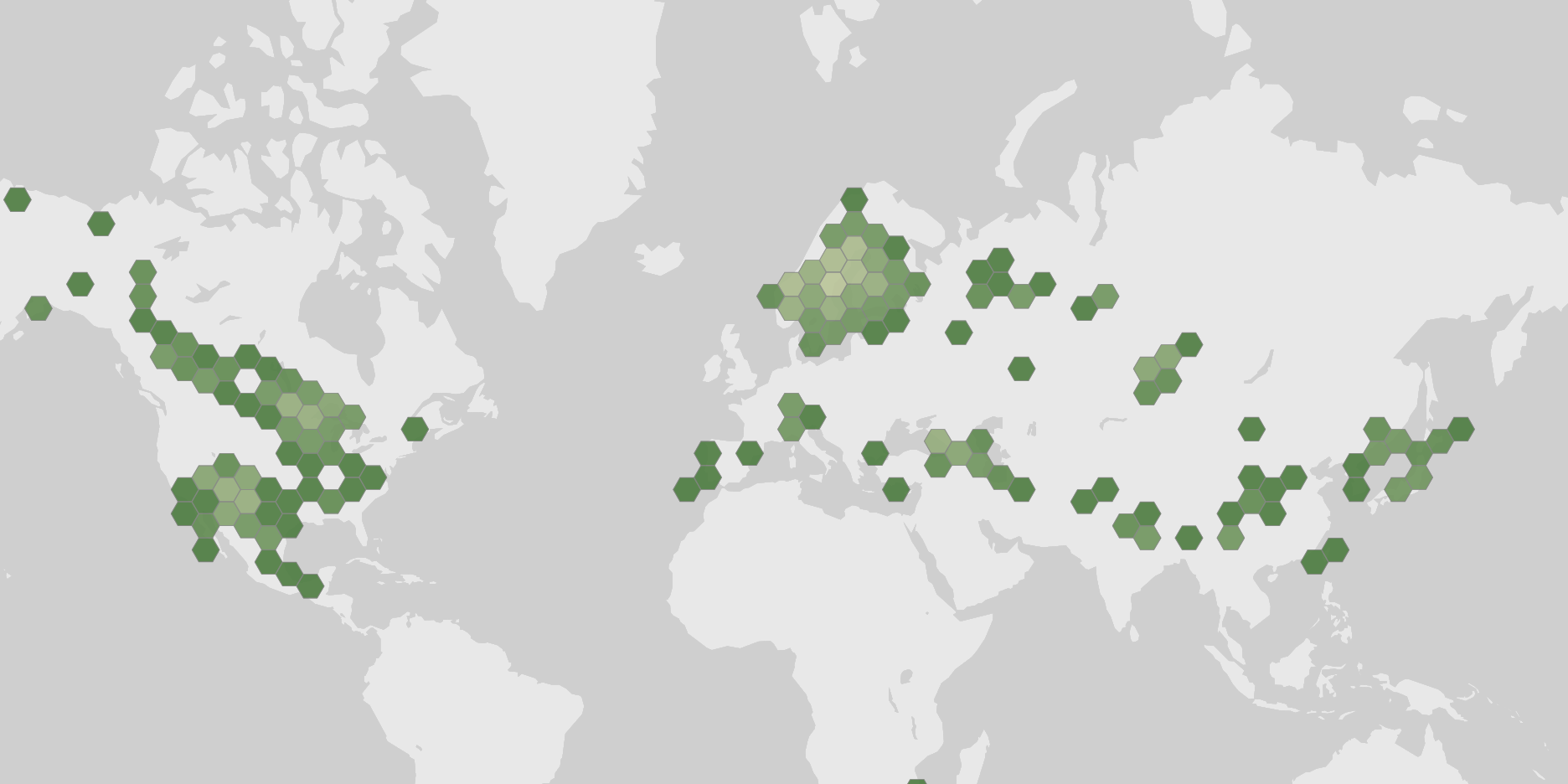
Ramalina sinensis is widespread across the Northern Hemisphere but tends to form small, scattered local populations rather than continuous stands. It has been recorded in North America, China, and Russia, always growing on the bark of trees and shrubs rather than on rock or soil.
In the Canadian prairies it is considered uncommon, particularly in dry sandy habitats. In southern Manitoba, specimens studied in 2012 came from Sandilands Provincial Forest, Spruce Woods Provincial Park, and Whiteshell Provincial Park, where the lichen grew on ash, poplar, oak, spruce, and pincherry shrubs.
In southwestern China it has been recorded from Sichuan, Tibet, and Yunnan, growing on bark in montane habitats at elevations of roughly 1,800 to 4,300 meters, and it is also widespread in the mountainous forests of North China. In Russia's Altai Territory it is considered quite rare on the Salair Ridge, occurring mostly in valley willow forests, Picea obovata forests, and communities dominated by Abies sibirica and Tilia sibirica, where it grows on the bark of poplar, willow, and these conifer and linden species, usually 1 to 5 meters above the ground.
Ecology and Relationships
Ramalina sinensis disperses chiefly through sexual spores rather than vegetative fragments, since it produces apothecia but no vegetative propagules. Each spore that lands must re-associate with a compatible alga before a new thallus can form, a constraint thought to contribute both to the species' broad overall range and to its patchy, locally rare populations, as seen in Manitoba.
The lichen also plays a role as a food source for wildlife. In the Qinling Mountains of Shaanxi, it has been recorded as a seasonal food of the golden snub-nosed monkey (Rhinopithecus roxellana). Along with Parmelia species, it formed an important part of the monkeys' winter diet, when lichen consumption rose sharply compared with summer.
Uses and Cultural History
In Yunnan, Ramalina sinensis has been gathered as an edible lichen by Yi, Dai, Han, and other local communities. In local markets, sellers commonly mixed it with the related species Ramalina conduplicans, generally without distinguishing between the two.
Conservation and Threats
A 2012 study of 23 specimens of Ramalina sinensis from southern Manitoba sequenced the internal transcribed spacer region of both the fungal partner and its algal photobiont. The fungal sequences showed no clear geographic separation among the sampled regions, and the algal partner likewise lacked a consistent regional pattern. The photobiont was most similar to species of Trebouxia, especially T. impressa and T. potteri, with 12 algal haplotypes recognized among the Manitoba collections.
Fun Facts
- Market sellers in Yunnan often mix Ramalina sinensis with the similar species Ramalina conduplicans without distinguishing between them.
- Genetic study of Manitoba specimens turned up 12 different algal haplotypes within the lichen's Trebouxia photobiont population.
- The species was originally described in 1902 from specimens collected on tree trunks and shrubs in the low hills of Fu-Kio, China.
Photos
Photographs from via iNaturalist, licensed under CC0 1.0., by W Rao via iNaturalist, licensed under CC BY 4.0., by Tanner Barnharst via iNaturalist, licensed under CC BY 4.0., by Dave Eslinger via iNaturalist, licensed under CC BY 4.0., by wolfhowl3 via iNaturalist, licensed under CC BY 4.0., by Norma Malinowski via iNaturalist, licensed under CC BY 4.0., by Michelle Orcutt via iNaturalist, licensed under CC BY 4.0., and by Indio Brown via iNaturalist, licensed under CC BY 4.0., credited on each photo.
Ecology and classification
Classification
- Phylum
- Ascomycota
- Class
- Lecanoromycetes
- Order
- Lecanorales
- Family
- Ramalinaceae
- Genus
- Ramalina
- Species
- Ramalina sinensis
Sources
- GBIF Species names and classification
- iNaturalist Photos
- Wikidata Common names and conservation status
- Wikipedia Summary extract