Alectoria sarmentosa drapes conifer branches in curtain-like mats up to 30 centimeters long, persisting on the same limb for years as a long-lived, perennial lichen. Known as witch's-hair lichen, it belongs to the family Parmeliaceae within the order Lecanorales, one of six closely related species in its group. Its fruticose, bushy body is a partnership between a fungus and a photosynthetic partner, not a plant, and it grows without roots, drawing everything it needs from rain and air.
It ranges across northern temperate rainforests, favoring mature and old-growth conifer and hardwood forests with abundant moisture and, critically, clean air.
Its dependence on undisturbed, humid old-growth forest makes it a useful indicator of forest health, and its fragile, wind-scattered strands connect it to the animals and people who have relied on it for generations.
Fruiting Body and Identification
The most reliable way to recognize Alectoria sarmentosa is its extensively branched, stringy thallus, in which each branch typically forks into two to four sections, with the thicker branches exceeding 2.5 millimeters in diameter. As an epiphyte, it has no roots and instead absorbs moisture and nutrients directly from rain and air.
Color is diagnostic within limits: the species ranges from grayish green to yellowish green, sometimes blackening toward the branch tips, with small raised white ridges visible on the surface. These features distinguish it from other hair lichens in its group, though the six related species in its suborder can appear superficially similar.
Mature thalli form extensive mats, 10 to 30 centimeters long, that hang in a pendulous fashion from branches. Where growth is dense, these mats create curtain-like formations draped over limbs. The strands are brittle and prone to fragmentation by wind, which scatters pieces onto the forest floor or snow below.
Distribution and Habitat
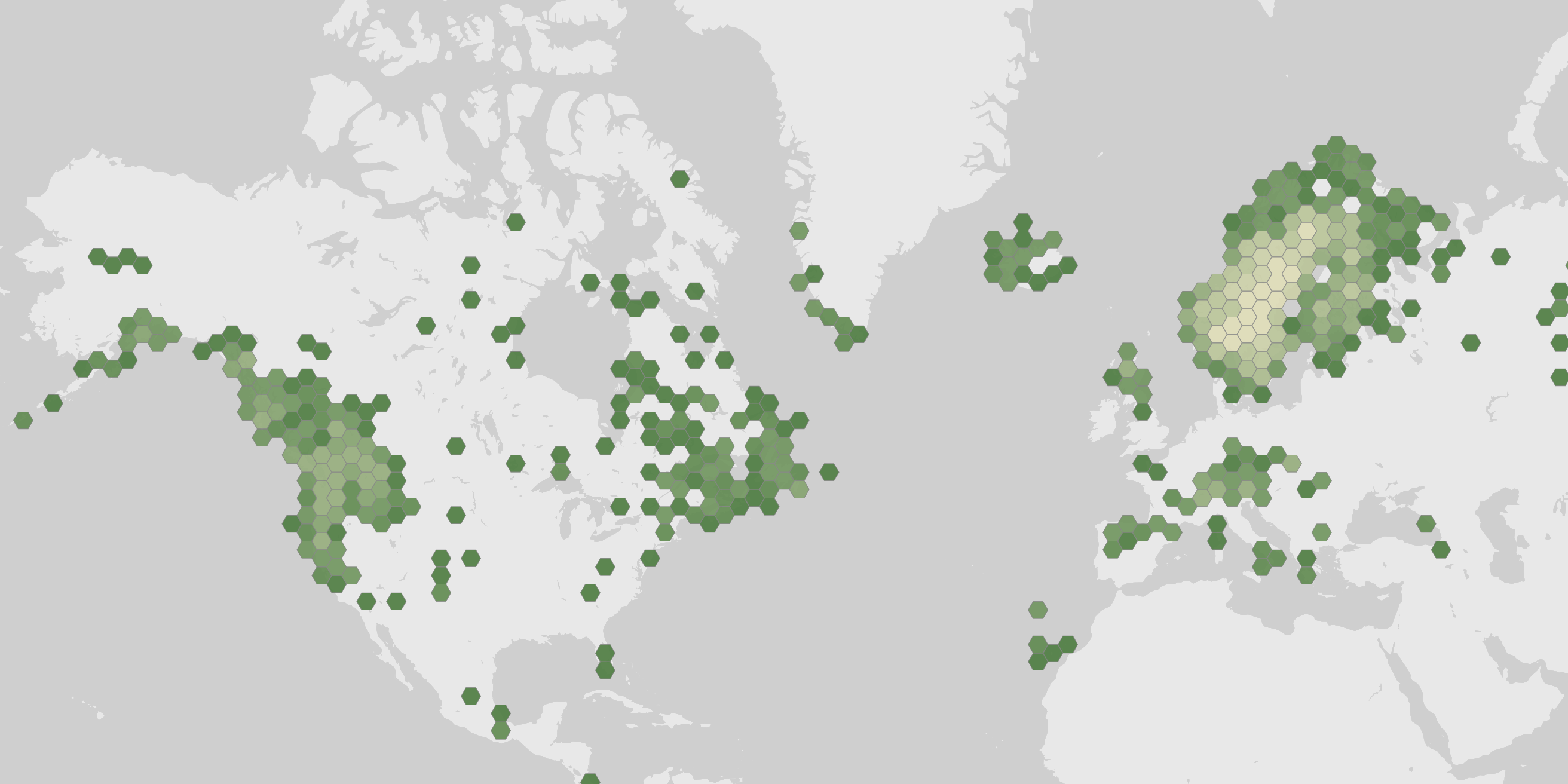
Alectoria sarmentosa occurs across northern hemisphere temperate rainforests that receive heavy rainfall, from 846 millimeters to as much as 5,600 millimeters annually. Its range spans the Pacific Northwest Coast, including Alaska, coastal British Columbia, Oregon, Washington, and northern California, extending east to Alberta and Montana. It also appears in the Appalachian Mountains' temperate rainforest in the eastern United States, boreal rainforests of New Brunswick and Nova Scotia, and coastal conifer forests of Scandinavia.
Within these regions the lichen is common in boreal and taiga forests and in prehumid rainforest zones, typically at low to mid elevations in transitional areas between valley floors and mountain forests. It generally avoids the immediate coastline. It grows on bark and wood, pendulous over conifer and hardwood branches and deciduous shrubs, only rarely on rock, and it sometimes turns up on the ground after being fragmented and blown loose by wind.
Monthly observation counts from GBIF rise sharply from a low of roughly 3,700 in January to a peak near 38,900 in September, before falling again through the winter. These figures reflect when observers recorded the lichen, not its actual abundance or a complete picture of its range, but the late-summer peak suggests it is most often noticed during that period.
Ecology and Relationships
Alectoria sarmentosa grows on bark and wood as an epiphyte, rarely on rock, draped over the branches of conifers, hardwoods, and deciduous shrubs. Its pale yellow-green coloring comes from usnic acid, and this pigmentation, together with a relatively transparent cortex when dry, is suited to shadier, more humid conditions rather than intense light.
Within a forest it reaches its greatest abundance on north-facing slopes and in lower canopy positions where light is moderate, and it concentrates around canopy gap edges where some sunlight reaches the lower and mid canopy. Although it can establish in forests as young as 60 years old, it is generally regarded as an old-growth associate, since its success depends heavily on forest structure: canopy height, cover, composition, and edge characteristics all shape where it can thrive.
Uses and Cultural History
Alectoria sarmentosa is important winter browse for wildlife: Sitka black-tailed deer and caribou eat it from low branches or off the ground after storms blow it down onto the snow, and flying squirrels use it both as food and as nest material.
Many Indigenous peoples of the Pacific Northwest Coast, including the Nuxalk of Canada, used the fibers of Alectoria lichens for practical and decorative purposes, from baby diapers and bandages to false whiskers and hair used to decorate dance masks. Some interior Alaskan and Canadian peoples wove ponchos and footwear from the fibers, though this clothing was considered inferior to material made from hides.
Because the lichen has no roots and draws its nutrients from atmospheric deposition and water running over surfaces, it accumulates airborne pollutants over time. This makes it a frequent subject of tissue element analysis, used to detect changes in air quality.
Fun Facts
- The Nitinaht used Alectoria sarmentosa alongside Usnea species for dressing wounds.
- The Bella Coola applied the same lichens, when found growing on alder, as a poultice for sores and boils.
- Its suborder, Lecanorineae, contains six closely similar hair lichen species, making careful identification important.
- Wind readily fragments its brittle strands, scattering pieces onto the forest floor or onto snow, where deer and caribou then feed on them.
Ecology
Habitat
- Forest
- Woodland
- Mountain