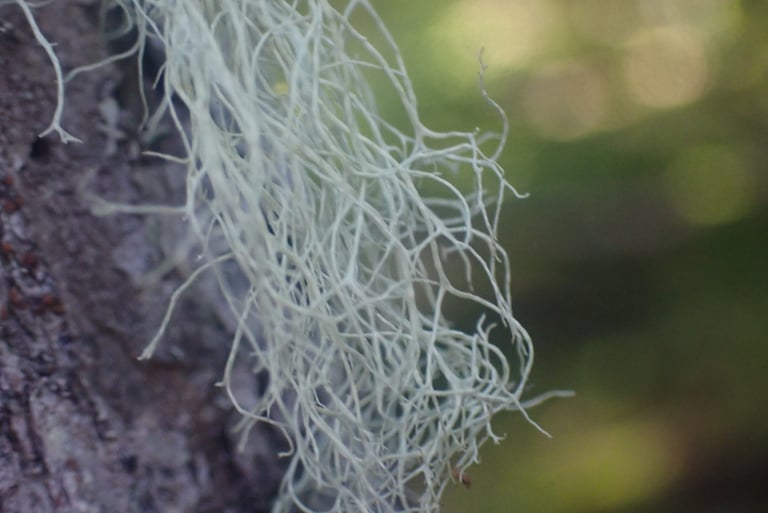
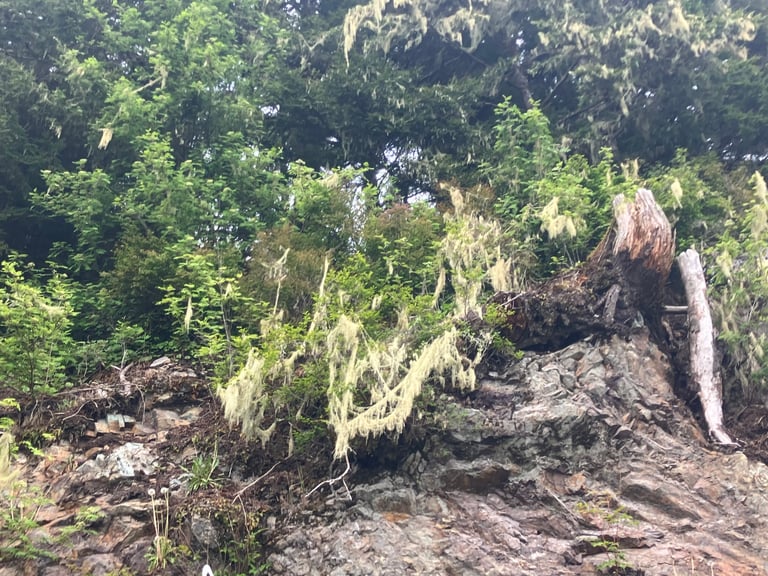
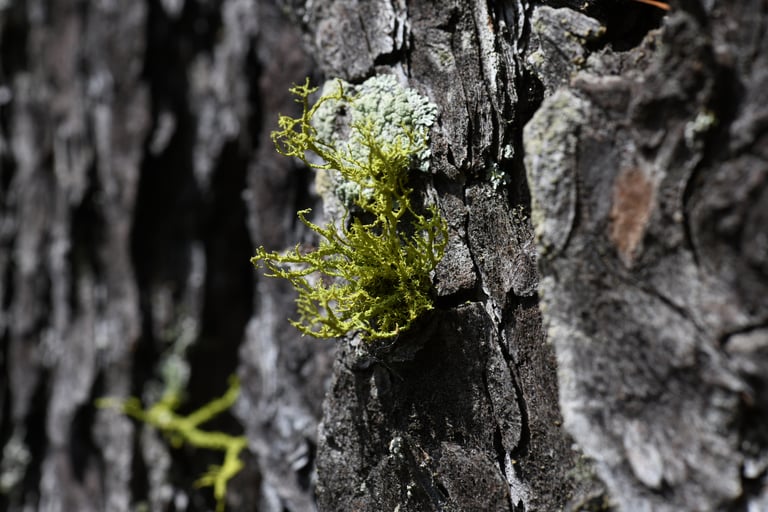
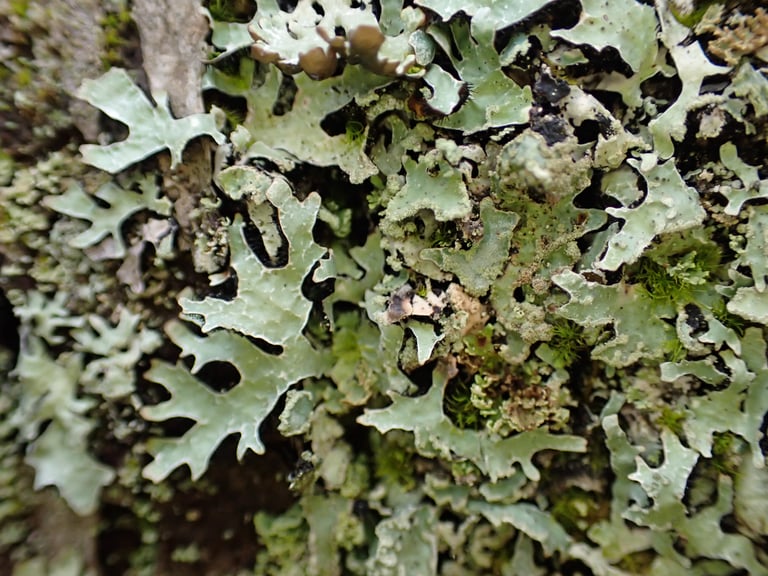
Evernia mesomorpha, commonly known as boreal oakmoss, is a fruticose lichen in the family Parmeliaceae. Its body is shrubby and yellow-green, with angular branches and coarse soredia, which are powdery clusters of algae and fungal threads, along the ridges.
Lichens like this one are partnerships between a fungus and an alga, and Evernia mesomorpha is easy to recognize by its branching, upright form. It is one of the lichens that many people see on trees and shrubs without knowing its name.
Distribution and Habitat
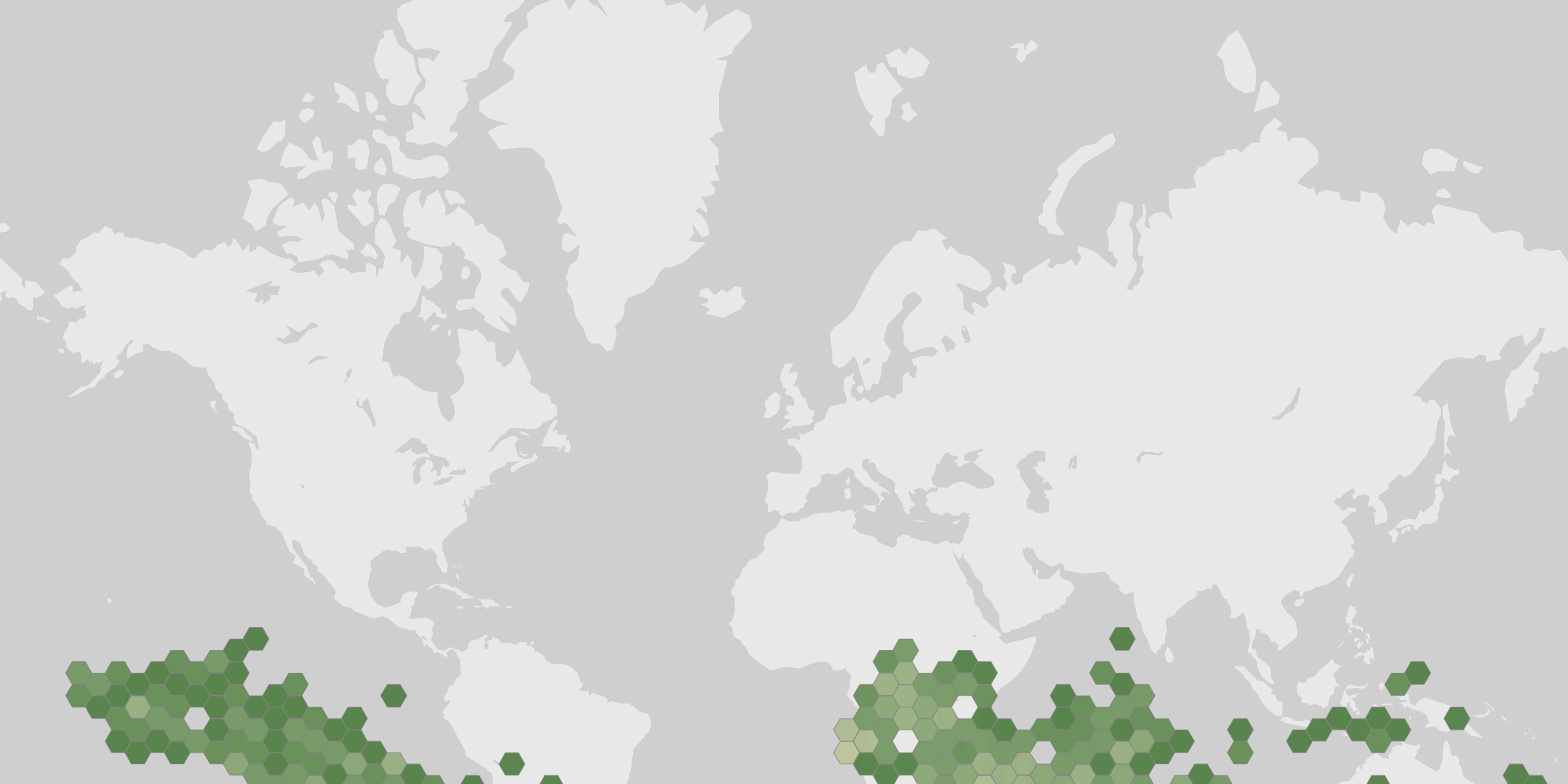
Evernia mesomorpha grows on the bark of shrubs and trees. Its range is cosmopolitan, so it is found across many regions of the world.
The lichen attaches to bark rather than soil, which makes trees and shrubs its main living surfaces.
It is seen most often in midsummer, with the peak in July. This timing reflects when the lichen is noticed, not how many there are, so it should not be read as a measure of abundance.
Ecology and Relationships
Evernia mesomorpha grows on tree and shrub bark, where it is a host for the lichenicolous fungus Tremella everniae. This fungus grows on the lichen itself rather than on the bark beneath it.
Because the lichen is the fungus's host, the two species are linked, and the lichen's own body provides the living tissue that the fungus uses.
Photos
Photographs from via iNaturalist, licensed under CC0 1.0., by Simon Conover via iNaturalist, licensed under CC BY 4.0., by Виктория Билоус via iNaturalist, licensed under CC BY 4.0., by Norma Malinowski via iNaturalist, licensed under CC BY 4.0., by Анна Митрошенкова via iNaturalist, licensed under CC BY 4.0., by Tanner Barnharst via iNaturalist, licensed under CC BY 4.0., and by Полина Полежанкина via iNaturalist, licensed under CC BY 4.0., credited on each photo.
Ecology and classification
Classification
- Phylum
- Ascomycota
- Class
- Lecanoromycetes
- Order
- Lecanorales
- Family
- Parmeliaceae
- Genus
- Evernia
- Species
- Evernia mesomorpha
Sources
- GBIF Species names and classification
- iNaturalist Photos
- Wikidata Common names and conservation status
- Wikipedia Summary extract