Few organisms can survive being dunked in liquid nitrogen and keep functioning, but Cladonia rangiferina can. This pale, tangled lichen tolerates freezing, severe dehydration, intense UV exposure, and even saturated salt conditions, resuming normal activity afterward.
Known as reindeer lichen, reindeer cup lichen, or grey reindeer lichen, it belongs to the family Cladoniaceae within the fungal phylum Ascomycota. It grows across cold and, more surprisingly, hot climates alike, so long as the ground is open and well-drained, and it dominates vast stretches of alpine tundra. Its resilience to fire, freezing, and grazing makes it a foundation species of northern landscapes, and its long, slow-growing history means every mat represents years, sometimes decades, of undisturbed growth.
Fruiting Body and Identification
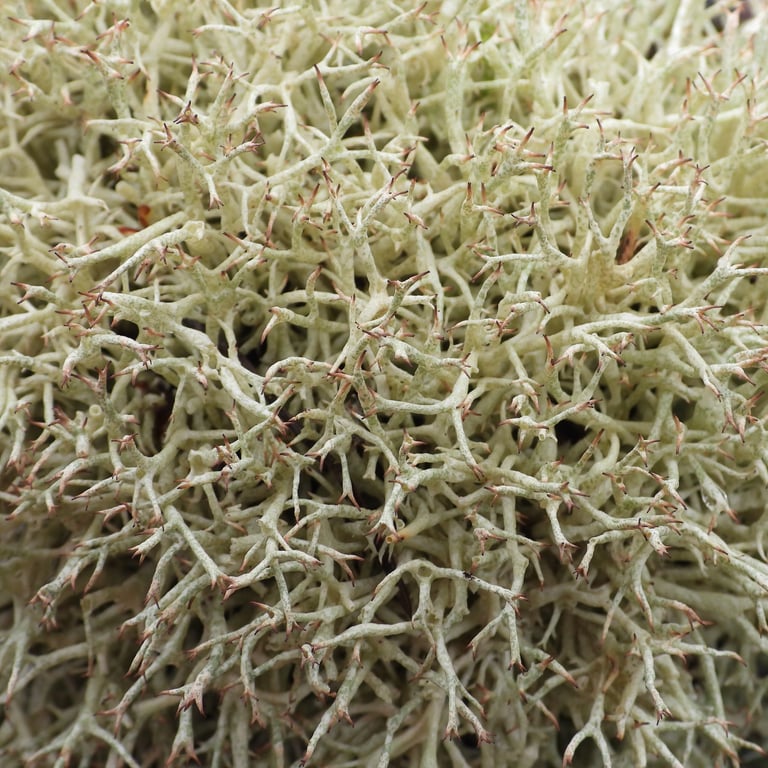
The most reliable way to recognize Cladonia rangiferina is its extensively branched, fruticose thallus, which forms sprawling mats up to 10 centimeters tall. Each branch typically divides into three or four smaller branches, occasionally just two, with the thicker branches measuring 1 to 1.5 millimeters in diameter. Coloration ranges from greyish to whitish to brownish-grey, giving the mats their characteristic pale, antler-like appearance.
Unlike many lichens, this species lacks a well-defined cortex, the protective outer layer comparable to skin in animals. Instead, a loose layer of hyphae simply covers the photobiont beneath, which in this species is the alga Trebouxia irregularis. When fertile, the terminal branches divide into short, umbrella-shaped clusters, and the reproductive structures called apothecia develop just below the actively growing tips, often hidden within the cushion of the mat itself.
Growth is slow, only 3 to 11 millimeters per year, so a mat damaged by overgrazing, fire, or trampling may take decades to recover. A visually similar species also called "reindeer lichen," Cladonia portentosa, can be distinguished by its branching, which occurs at a wider angle than in C. rangiferina.
Chemically, the species produces the depside atranorin and the depsidone fumarprotocetraric acid, along with a range of other compounds such as barbatic acid and several diterpenoids. Some of these have shown mild inhibitory activity against methicillin-resistant Staphylococcus aureus and vancomycin-resistant Enterococci in laboratory settings.
Distribution and Habitat
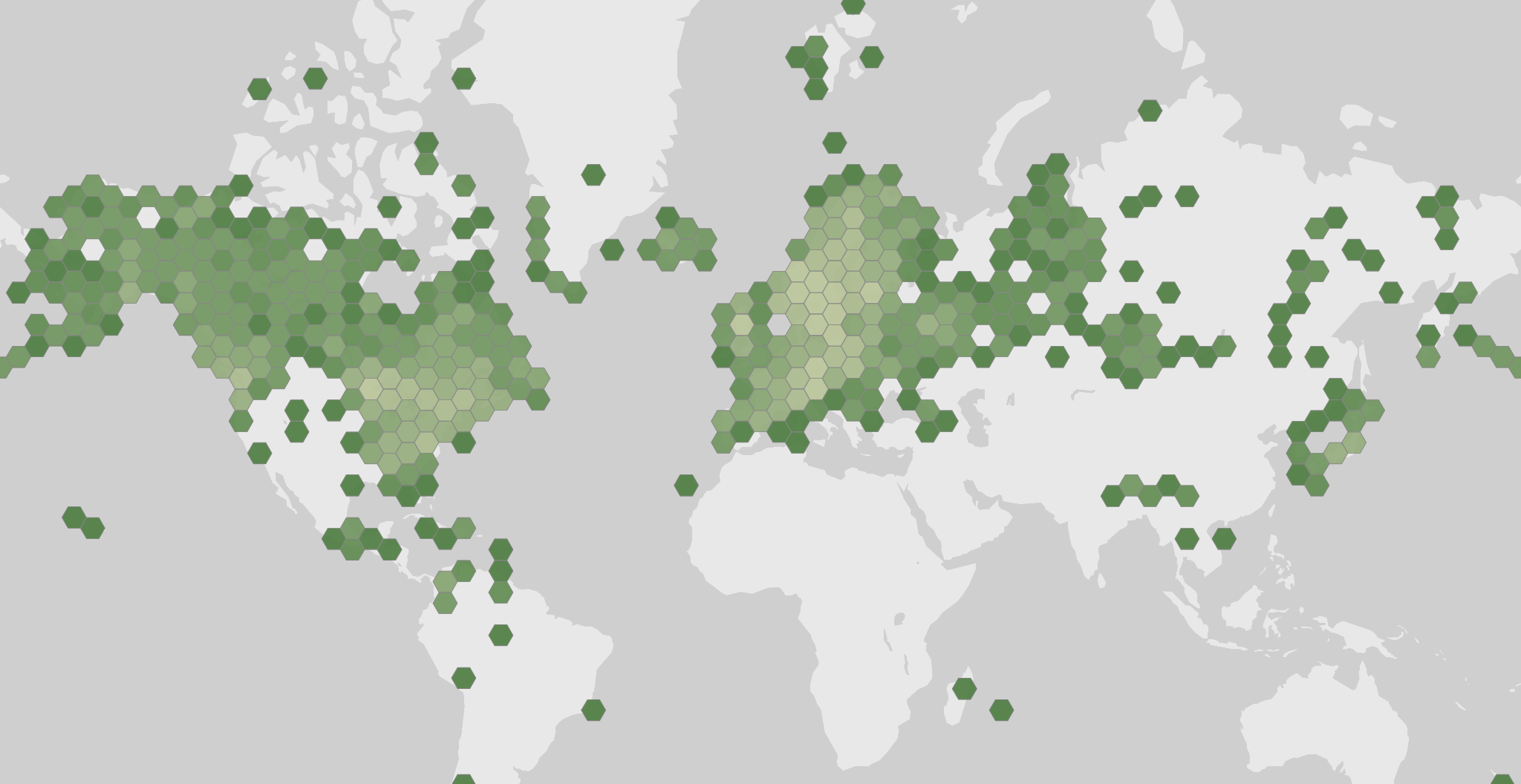
Cladonia rangiferina is most at home in the taiga and tundra, where it often dominates the ground layer of boreal pine forests and open, low-alpine sites. It grows directly on humus or on thin soil over rock, and it turns up across a wide range of settings, from humid open forests to bare heaths and exposed rock. The boreal forests of Canada are one well-documented stronghold of this lichen.
Its elevational range can be considerable: in Nepal, records place it between 3,400 and 4,500 meters, well above the local tree line. This pattern reflects the species' extreme tolerance for environmental stress, including freezing, dehydration, intense UV light, and high salinity, conditions that make high, exposed ground survivable for a lichen but few plants.
Monthly observation counts show a strong seasonal pattern, rising sharply from a low of roughly 686 to 1,006 sightings in winter months to a peak near 8,945 in July and 8,401 in August, before falling off again toward autumn. Because these figures come from presence records rather than population surveys, they most likely reflect when observers are out looking rather than changes in the lichen's actual abundance, but they do suggest that summer is when the species is most visible and accessible in the field.
Ecology and Relationships
Cladonia rangiferina grows as part of a partnership between its fungal structure and the alga Trebouxia irregularis, and its fertility and growth are shaped strongly by local microclimate. In sites with good moisture and high air humidity, cushions often develop many apothecia and taller podetia reaching around 12 centimeters, while in drier locations fertile thalli are scarcer and podetia stay shorter, around 4 to 6 centimeters.
Growth rate itself varies with forest conditions: a Finnish study found the lichen grows 3.9 to 4.4 millimeters per year, fastest in younger, shadier forests under 60 years old, and slowest in older forests over 180 years that have been thinned.
The species also hosts several lichenicolous fungi that live specifically on or alongside it, including Lichenopeltella rangiferinae (named for its host), Lichenoconium pyxidatae, and Lichenopeltella uncialicola, adding another layer of biological interaction within its mats.
Uses and Cultural History
People have eaten Cladonia rangiferina despite its crunchy texture, typically soaking it with wood ashes to remove bitterness before adding it to milk or other dishes; it also serves as a source of vitamin D. The Inland Dena'ina crushed the dried lichen and boiled or soaked it until soft, eating it plain or mixed with berries, fish eggs, or lard, and they also boiled it to drink the resulting juice as a remedy for diarrhea. In the Eastern Himalaya, the Monpa people of West Kameng district have used it as a traditional remedy for removing kidney stones.
Beyond food and medicine, the lichen has industrial and decorative roles: it is used in making aquavit, sometimes appears as decoration in glass windows, and is a popular material in model railroading for shrubbery and miniature trees.
A 2017 study found that reindeer lichen was able to recolonize burnt soil in Northern Sweden within just two years of a forest fire, suggesting that artificial replanting could help restore lichen cover on reindeer pastures damaged by wildfire.
Conservation and Threats
No global conservation status is documented for Cladonia rangiferina, but it is recognized as endangered in certain parts of its range. In the British Duchy of Cornwall, for example, it holds protection under the UK Biodiversity Action Plan, reflecting concern about its local decline even where the species remains common elsewhere.
Fun Facts
- Despite its common name "reindeer moss," Cladonia rangiferina is not a moss at all but a lichen, a partnership between a fungus and an alga.
- Researchers have performed "resynthesis" experiments, isolating and culturing the fungal and algal partners of this lichen separately in the lab, then reuniting them to study how lichenization begins.
- The lichen produces usnic acid, a compound also found in many other lichen species.
- Among some northern communities, reindeer lichen carries symbolic meaning, representing resilience and sustenance tied to seasonal cycles and animal husbandry.
Ecology
Habitat
- Forest
- Shrubland
- Mountain
- Tundra