The radish's taproot can be white, pink, red, purple, yellow, green, or black, with its color coming from pigments called anthocyanins — pelargonidin for red varieties and cyanidin for purple ones.
Raphanus sativus is a flowering plant in the mustard family, Brassicaceae, grown worldwide as a root vegetable, though the entire plant is edible. Domesticated in Asia, it is now cultivated and eaten across the globe.
Its rapid growth, striking color variation, and surprisingly wide edibility make the radish more interesting than its humble reputation suggests.
Identification and Appearance
The swollen taproot is the radish's most recognizable feature, varying in shape from globular to tapering or cylindrical. Root skin color spans white, pink, red, purple, yellow, and green to black, though the flesh is usually white.
Smaller types have a few leaves about 13 centimeters long, with round roots up to 2.5 centimeters across or more slender roots up to 7 centimeters long. Longer forms, including the oriental daikon or mooli and winter radishes, grow taproots up to 60 centimeters long, with foliage reaching a similar height and a spread of 45 centimeters.
Leaves form a rosette and have a lyrate shape — divided pinnately with an enlarged terminal lobe and smaller lateral lobes. White flowers are borne on a racemose inflorescence, and the small fruit pods can be eaten while young.
Radishes harvested at the right time are crisp and mild, but become bitter and tough if left too long in the ground.
Distribution and Habitat
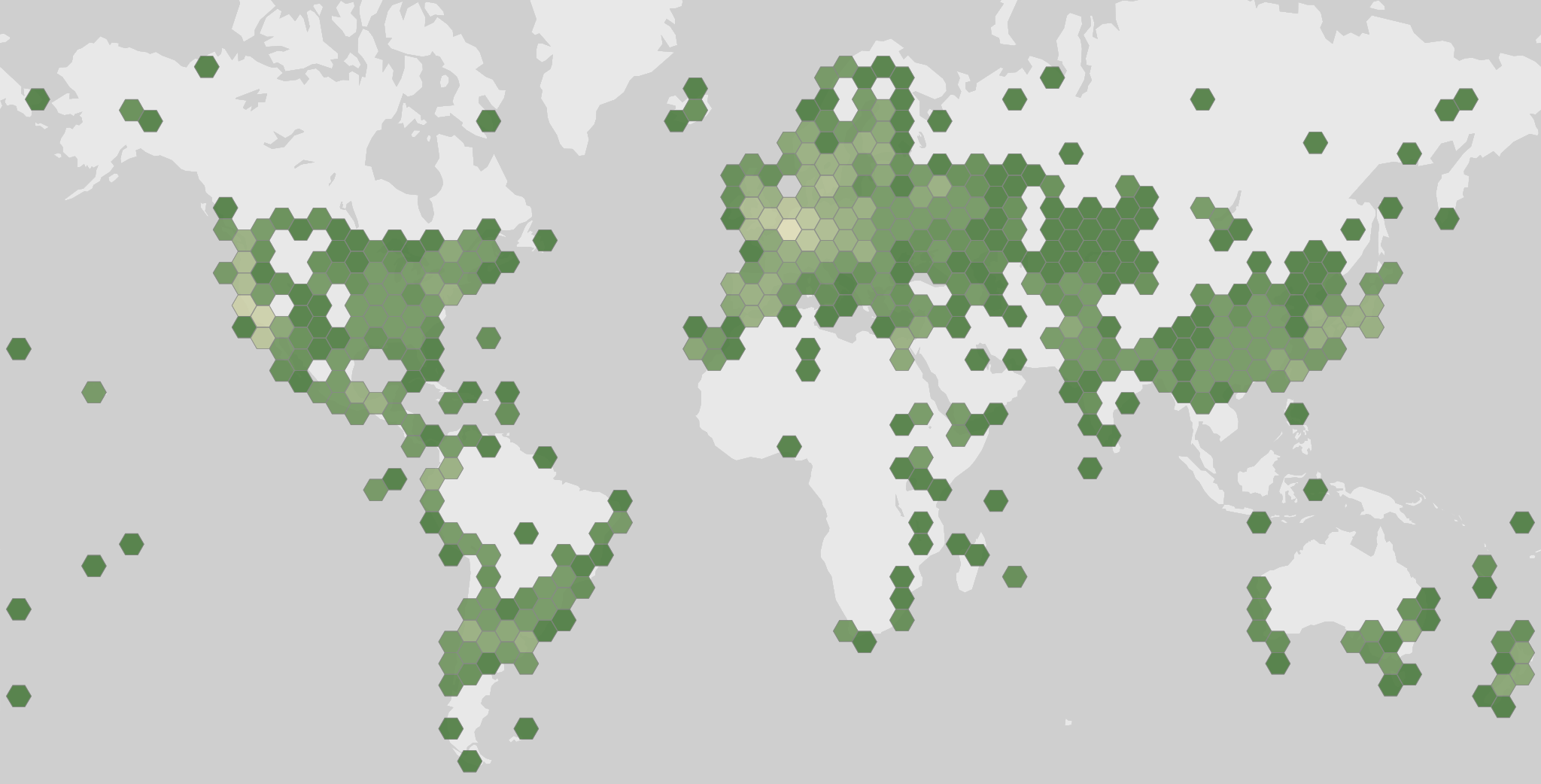
Raphanus sativus is native across a broad temperate belt stretching from Europe through the Mediterranean into Central Asia, with recorded native range spanning countries from Great Britain and Ireland to Iran, Pakistan, and Uzbekistan.
Human cultivation has carried the species far beyond this native range, and it is now recorded as introduced on every inhabited continent, from Alaska and Hawaii to New Zealand, South Africa, and throughout South America.
Monthly observation counts rise sharply from a low in December and January toward a peak in May, before declining again through the second half of the year. This pattern likely reflects seasonal planting and growing cycles rather than a fixed natural rhythm, since the radish is a widely cultivated crop.
Growth and Form
The radish grows as an annual or biennial, completing much of its lifecycle within a single growing season before setting seed.
Ecology and Relationships
Radish flowers attract a range of bees, with bumblebees such as Bombus lucorum, Bombus lapidarius, and Bombus pascuorum the most frequently recorded visitors, alongside smaller solitary bees like Andrena and Hylaeus species. A flower visit alone does not confirm pollination.
The plant is fed on by a variety of insects, most often cabbage white butterflies (Pieris brassicae, Pieris rapae, Pieris napi) and aphids such as Brevicoryne brassicae and Myzus persicae, with weevils and other butterflies like Vanessa cardui also recorded.
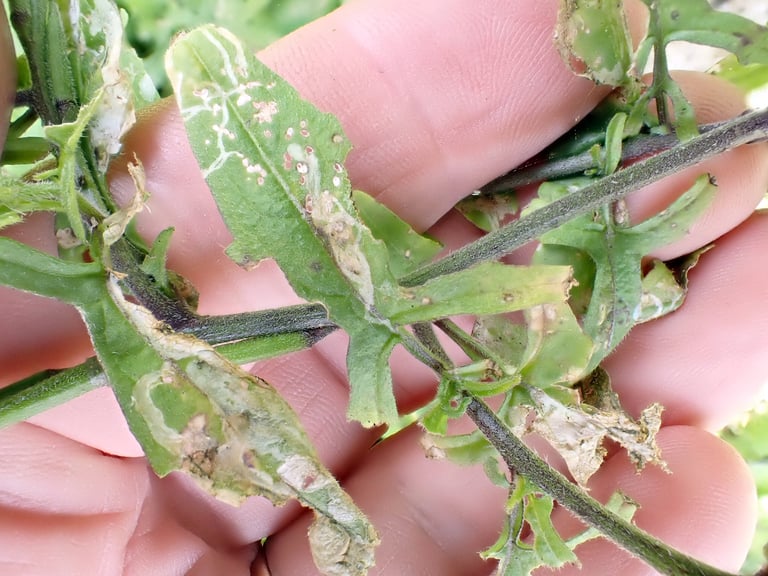
Among recorded parasites and pathogens, the bacterium Xanthomonas campestris stands out as the most frequently reported, alongside other bacteria and the thrips Frankliniella occidentalis.
Uses and Human Relationships
Radishes are grown as a fast-maturing, cool-season crop, with seeds germinating in three to four days and roots ready for harvest in as little as three to four weeks under favorable conditions, or six to seven weeks in colder weather. World production has been estimated at about 7 million tonnes annually, produced mainly by China, Japan, and South Korea.
The taproot is most commonly eaten raw in salads, prized for its crisp texture and peppery flavor from glucosinolates that form allyl isothiocyanates when chewed — the same compounds found in mustard, horseradish, and wasabi. Radishes appear in many European dishes, are paired with butter as an appetizer, and are used sliced as garnish in Mexican dishes such as tostadas, sopes, enchiladas, and pozole.
The entire plant is edible: seeds can be sprouted and eaten raw like mung beans, and the leafy tops, though often discarded, can be sautéed, added to soups, or blended into fruit juices. In the garden, radishes are valued as companion plants, their pungent odor deterring aphids, cucumber beetles, and other pests, and they are sometimes used as a trap crop to lure insects away from other vegetables.
Fun Facts
- The radish is a diploid species with 18 chromosomes, and its genome is estimated to span between 526 and 574 megabases.
- Radishes grow well alongside cucumbers, chervil, lettuce, peas, and nasturtiums, but react poorly when planted near hyssop.
- Harvested radishes can be stored for two or three days at room temperature, or about two months at freezing temperatures with high humidity.
Photos
Photographs from by NASA via Wikimedia Commons, licensed under Public Domain., by No machine-readable author provided. Alfredobi assumed (based on copyright claims). via Wikimedia Commons, licensed under Public Domain., by Kazuo Hishiki via Wikimedia Commons, licensed under Public Domain., by Lewis Hine via Wikimedia Commons, licensed under Public Domain., by Agende Meurisse via Wikimedia Commons, licensed under Public Domain., by AnRo0002 via Wikimedia Commons, licensed under CC0 1.0., by Benoît Prieur via Wikimedia Commons, licensed under CC0 1.0., by No machine-readable author provided. N yotarou assumed (based on copyright claims). via Wikimedia Commons, licensed under CC BY 4.0., by Alandmanson via Wikimedia Commons, licensed under CC BY 4.0., by Dguendel via Wikimedia Commons, licensed under CC BY 4.0., by Conall from Downpatrick, Northern Ireland via Wikimedia Commons, licensed under CC BY 4.0., by Bhaskaranaidu via Wikimedia Commons, licensed under CC BY 4.0., by Tauralbus via Wikimedia Commons, licensed under CC BY 4.0., by cyclonebill via Wikimedia Commons, licensed under CC BY-SA 4.0., by Andrés Nieto Porras from Palma de Mallorca, España via Wikimedia Commons, licensed under CC BY-SA 4.0., by Izham Alias via Wikimedia Commons, licensed under CC BY-SA 4.0., by MOs810 via Wikimedia Commons, licensed under CC BY-SA 4.0., by Alpsdake via Wikimedia Commons, licensed under CC BY-SA 4.0., and by David Arqueas via Wikimedia Commons, licensed under CC BY-SA 4.0., credited on each photo.
Ecology and classification
Habitat
Growth habit
- Herb
Classification
- Phylum
- Tracheophyta
- Class
- Magnoliopsida
- Order
- Brassicales
- Family
- Brassicaceae
- Genus
- Raphanus
- Species
- Raphanus sativus
Sources
- GBIF Species names and classification
- Wikidata Common names and conservation status
- Wikipedia Summary extract
- Plants of the World Online Native range, life form and climate (WCVP)
- Wikimedia Commons Photos
- GloBI What it eats, what eats it, parasites and pollinators
- trophiCH
- Wardeh et al. 2015 (EID2)
- DoPI