A single inflorescence of Paphiopedilum rothschildianum can carry up to six flowers, each spanning 5 to 13 inches (roughly 13 to 33 centimeters) across, making it one of the largest-flowered orchids in its genus.
Known as Rothschild's slipper orchid or the Gold of Kinabalu orchid, it is a large, clear-leafed member of the orchid family (Orchidaceae). It grows only in the rainforests surrounding Mount Kinabalu in northern Borneo and is listed as Critically Endangered.
Few orchids combine such enormous flowers with such a narrow, threatened range, which is part of why collectors and conservationists alike have long been drawn to this species.
Identification and Appearance
The clearest way to recognize Paphiopedilum rothschildianum is by its petals: unlike other members of the Corypetalum group, it holds its two lateral petals out almost horizontally, giving the flower a wide, winged look rather than the drooping or twisted petals typical of related slipper orchids.
The flowers themselves are large, reaching 5 to 13 inches (about 13 to 33 centimeters) across, and are arranged in an upright inflorescence that carries as many as six blooms at once, an unusually high count for a Paphiopedilum. The petals and dorsal sepal show a pattern of green ground color overlaid with red spotting and striping, a combination that also plays a role in how the flower attracts pollinators.
The plant is described as clear-leafed, meaning its strap-shaped foliage lacks the mottled patterning seen in some other slipper orchid species, giving the leaves a plain green appearance that contrasts with the boldly marked flowers above them.
Peak flowering occurs from April to May, so plants seen in bloom outside this window are less typical of the species' natural cycle.
Distribution and Habitat
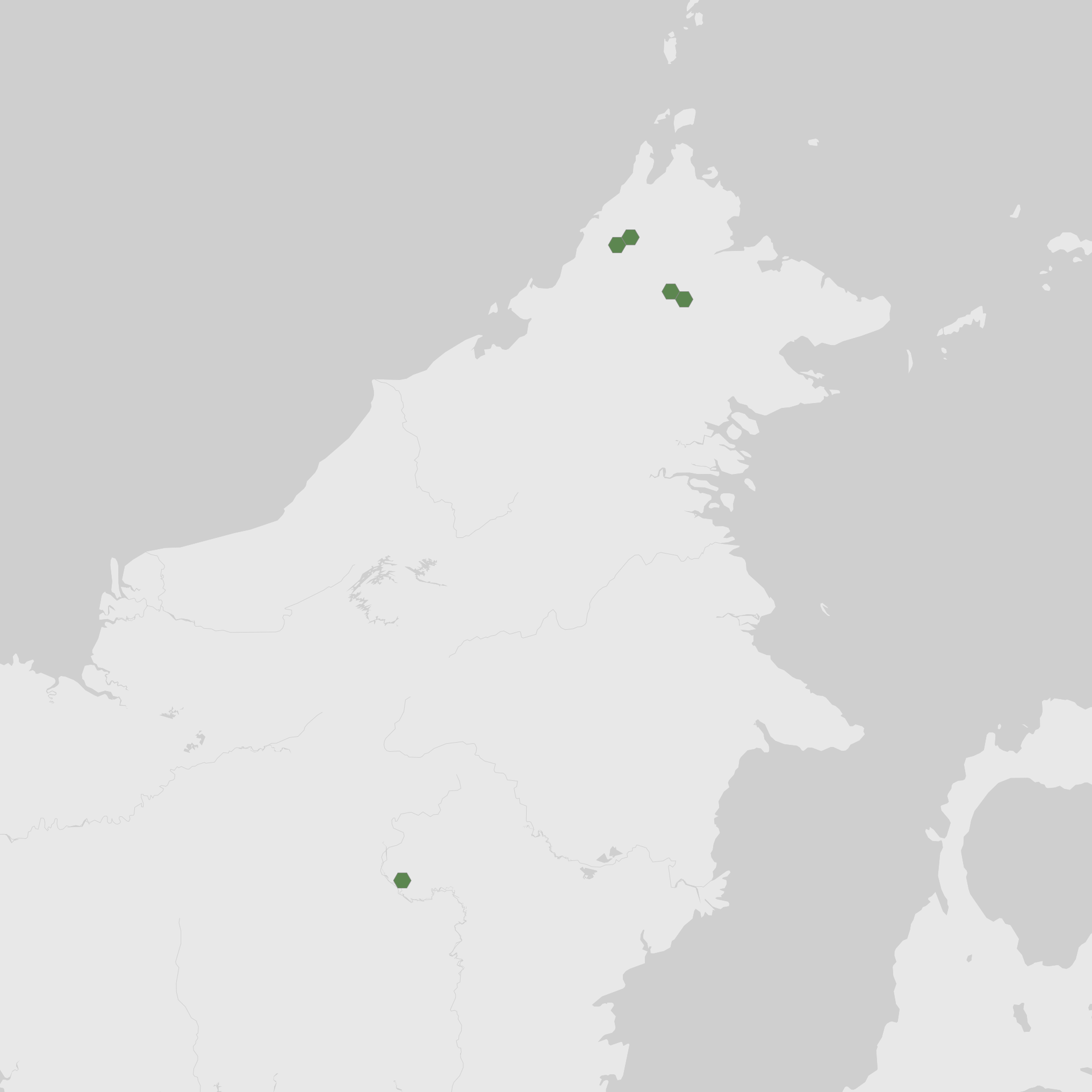
Paphiopedilum rothschildianum is found only in the rainforests around Mount Kinabalu in northern Borneo, at elevations between 500 and 1,200 meters above sea level. This narrow endemism places it among a large number of orchid species restricted to Kinabalu Park.
The species grows most often as a terrestrial plant rooted in ultramafic soil, soil derived from rock rich in elements such as chromium, cobalt, and nickel. It is also found as a lithophyte, rooting directly into leaf litter accumulated on ultramafic cliffs, typically near rivers. While it is not strictly confined to ultramafic substrates, this soil type appears closely linked to its success on the island.
Monthly observation data show records concentrated in a handful of months, with a pronounced peak in May and a smaller rise in April, consistent with the species' known April-to-May flowering peak. These figures come from presence records rather than population counts, so they indicate when the orchid is most often noticed in bloom rather than its overall abundance or full range.
Growth and Form
Paphiopedilum rothschildianum grows as a terrestrial or, less commonly, lithophytic plant adapted to warm-to-cool conditions. Under cultivation it is considered relatively easy to grow but slow to mature, typically taking 4 to 5 years to produce its first flowers, a period that can stretch even longer if the plant is kept in heavy shade.
The species thrives on a marked temperature swing between day and night. In summer, favorable conditions run between 28 and 29°C during the day, dropping to 16-17°C at night; in winter, daytime temperatures of 26-27°C give way to nighttime lows of 15-17°C. This daily fluctuation mirrors conditions on Mount Kinabalu, where noticeable temperature drops are a regular feature of the habitat and appear to have shaped the orchid's physiology.
High humidity is another requirement tied to its natural setting, since wild plants are usually found growing 6 to 12 meters above flowing streams.
Reproduction and Life Cycle
Pollination in Paphiopedilum rothschildianum relies on deception rather than reward. The flower's green petals, marked with red spots, closely resemble the aphids that certain parasitic flies use as egg-laying sites, and this resemblance draws the flies in.
As a fly brushes against the flower's stigma while investigating the false aphid pattern, it deposits any pollen it is already carrying from a previous flower. In the same visit, fresh pollen from the anther is transferred onto the fly's body, ready to be carried to the next bloom it is fooled into visiting.
Fun Facts
- The flower's green-and-red spotted petals are a visual decoy: they mimic the appearance of aphids to lure in parasitic flies that unwittingly pollinate the plant.
- In parts of Peninsular Malaysian orchid folklore, the rarity of Paphiopedilum rothschildianum has led some communities to treat its presence as a sign of protective forest spirits.
- Because the species is rare and slow-growing from seed, researchers have investigated in vitro multiplication techniques as a way to propagate it without depleting wild populations, as documented in a 2010 study published in the African Journal of Biotechnology.
- Growers new to the genus often report that young plants show little visible growth for months at a time, reflecting the long, multi-year path this orchid takes before it first flowers.
Photos
Photographs from by Gold eagle Kroll via iNaturalist, licensed under CC BY 4.0., by Dr. Alexey Yakovlev via iNaturalist, licensed under CC BY 4.0., by Ong Jyh Seng via iNaturalist, licensed under CC BY-SA 4.0., by Felix González via Wikimedia Commons, licensed under CC0 1.0., by Dick Culbert from Gibsons, B.C., Canada via Wikimedia Commons, licensed under CC BY 4.0., by sunoochi from Sapporo, Hokkaido, Japan via Wikimedia Commons, licensed under CC BY 4.0., by Motohiro Sunouchi via Wikimedia Commons, licensed under CC BY 4.0., by No machine-readable author provided. Gaurav1146 assumed (based on copyright claims). via Wikimedia Commons, licensed under CC BY-SA 4.0., by Orchi via Wikimedia Commons, licensed under CC BY-SA 4.0., by Silk666 via Wikimedia Commons, licensed under CC BY-SA 4.0., by Bernard DUPONT from FRANCE via Wikimedia Commons, licensed under CC BY-SA 4.0., by Naoki Takebayashi from Fairbanks, AK, USA via Wikimedia Commons, licensed under CC BY-SA 4.0., by 阿橋 HQ via Wikimedia Commons, licensed under CC BY-SA 4.0., by Krzysztof Ziarnek, Kenraiz via Wikimedia Commons, licensed under CC BY-SA 4.0., and by Sdkb via Wikimedia Commons, licensed under CC BY-SA 4.0., credited on each photo.
Ecology and classification
Classification
- Phylum
- Tracheophyta
- Class
- Liliopsida
- Order
- Asparagales
- Family
- Orchidaceae
- Genus
- Paphiopedilum
- Species
- Paphiopedilum rothschildianum
Sources
- GBIF Species names and classification
- iNaturalist Photos
- Wikidata Common names and conservation status
- Wikipedia Summary extract
- Wikimedia Commons Photos