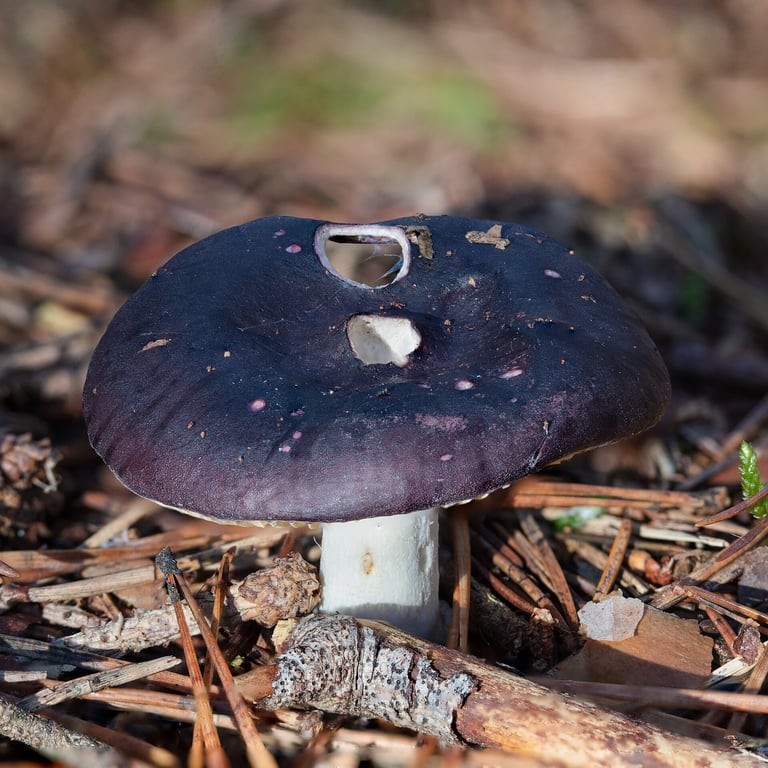
The short-stemmed russula, Russula brevipes, forms fruiting bodies so large and so often half-buried that they resemble low mounds on the forest floor, earning them the nickname "shrumps." Caps can stretch from 7 to 30 cm (3 to 12 in) across, making this one of the bulkier members of the Russulaceae found in temperate woods.
This species belongs to the fungal kingdom, in the order Russulales and family Russulaceae. It grows across temperate forest ecosystems, forming partnerships with conifer trees. Beyond its size, the species is notable for its genetic structure, with populations separated by distance showing marked differentiation, and for a distinctive variety that develops a bluish-green band on its stem.
Fruiting Body and Identification
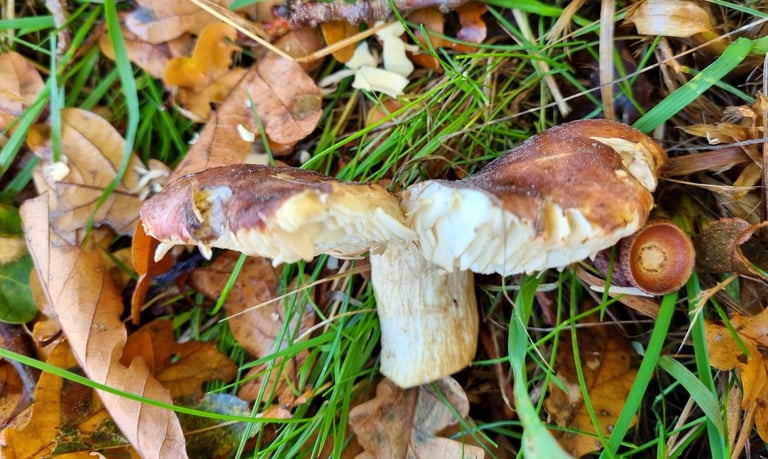
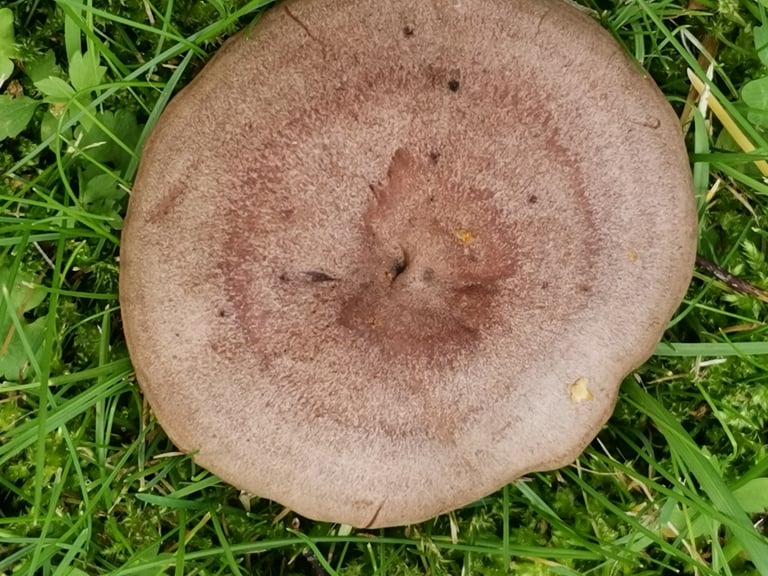
The most useful identifying features of Russula brevipes are its size, its funnel shape, and its white-to-dull-yellow coloring. Fully grown caps reach 7 to 30 cm across and develop a central depression as they mature, giving the whole mushroom a deep funnel form.
The gills are narrow, thin, and decurrent, running down the stipe. They start nearly white and shift to pale yellow or buff with age, sometimes forking near the stem. The stipe itself is thick and short, measuring 3 to 8 cm long and 2.5 to 4 cm thick, starting white before developing yellowish-brown discoloration with age; some specimens show a pale green band near the top of the stipe. The spore print is white to light cream, and the spores are egg-shaped to nearly spherical, 7.5–10 by 6.5–8.5 μm, with a partially network-like surface studded with warts up to 1 μm high.
Two named varieties exist: R. brevipes var. acrior, with a greenish-blue band at the stipe apex and on the gills, and var. megaspora, distinguished by larger spores measuring 9–14 by 8–12 μm.
Distribution and Habitat
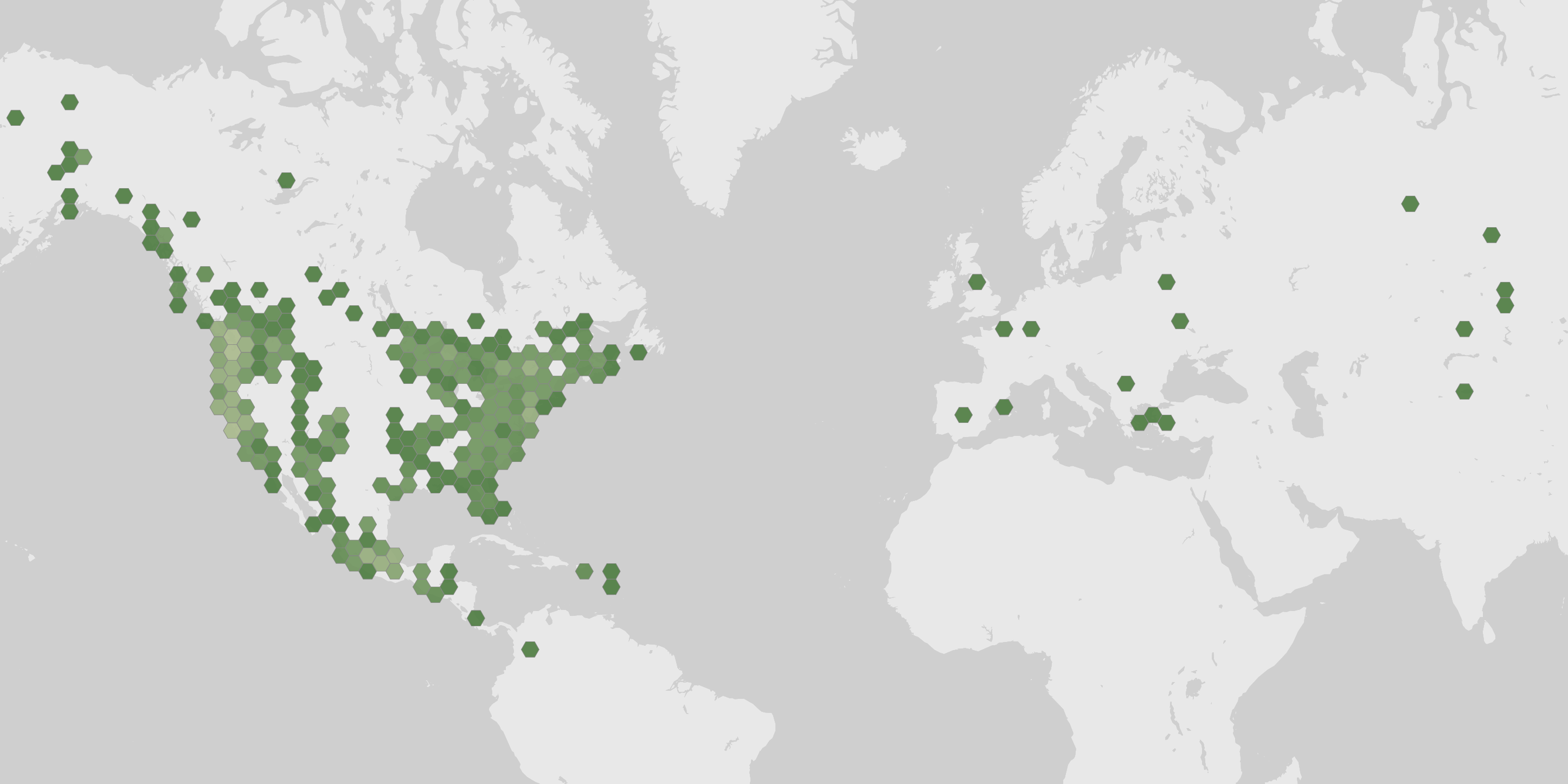
Russula brevipes is a common ectomycorrhizal fungus across temperate forest ecosystems, forming partnerships with conifer hosts including fir (Abies), spruce (Picea), Douglas-fir (Pseudotsuga), and hemlock (Tsuga). It has also been documented in Pakistan's Himalayan moist temperate forests, associated with Pinus wallichiana.
Fruiting bodies appear singly or in groups, typically low and partly emerged from the forest floor. Timing differs by region: fruiting runs from July to October in eastern North America, while in western North America it occurs from October to January, with the greatest abundance in late autumn. Observation data collected across the year show fruiting activity building through late summer and peaking in autumn months, consistent with this seasonal pattern, though such records only reflect where and when the species has been noted, not its overall abundance.
The species also associates with the myco-heterotrophic orchid Limodorum abortivum, one of several Russula species known to do so. Genetic studies show that populations separated by large distances, whether across continents or within them, show significant differentiation, suggesting limited gene flow over those scales, while populations within about 1,000 meters of each other show little genetic difference.
Fun Facts
- The mushroom's varieties, acrior and megaspora, were both defined by Shaffer in 1964 from Californian specimens, though Index Fungorum does not treat them as taxonomically distinct today.
- North American and European field guides disagree sharply on the genus Russula: American guides tend to list most species as non-edible and urge caution, while European guides take a more favorable view and recognize more edible species.
- In the Pacific Northwest, general foraging advice for the genus is to avoid any specimens that taste acrid or peppery, since heat-producing species are the ones most associated with poisoning risk within Russula.
Photos
Photographs from via iNaturalist, licensed under CC0 1.0., by Caleb Catto via iNaturalist, licensed under CC BY 4.0., by Chline River via iNaturalist, licensed under CC BY 4.0., by Sharon Squazzo via iNaturalist, licensed under CC BY 4.0., by sylbobaggins via iNaturalist, licensed under CC BY 4.0., by Andrew Lai via iNaturalist, licensed under CC BY 4.0., by Shirley Zundell via iNaturalist, licensed under CC BY 4.0., by Em Marg via iNaturalist, licensed under CC BY 4.0., and by Jeff via iNaturalist, licensed under CC BY 4.0., credited on each photo.
Ecology and classification
Habitat
Classification
- Phylum
- Basidiomycota
- Class
- Agaricomycetes
- Order
- Russulales
- Family
- Russulaceae
- Genus
- Russula
- Species
- Russula brevipes
Sources
- GBIF Species names and classification
- iNaturalist Photos
- Wikidata Common names and conservation status
- Wikipedia Summary extract