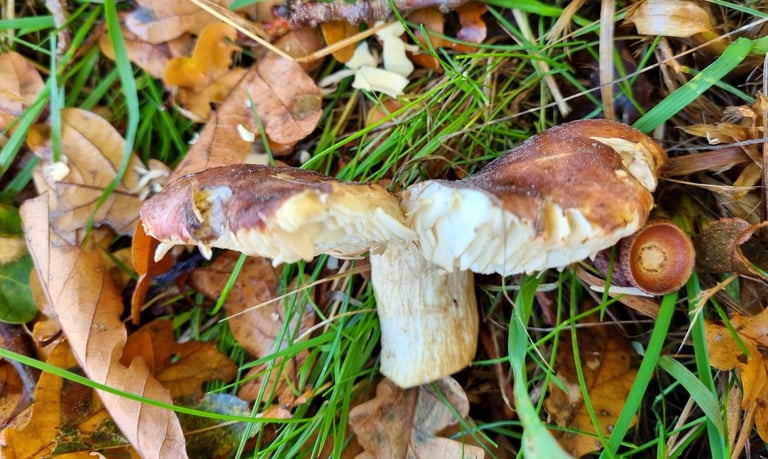
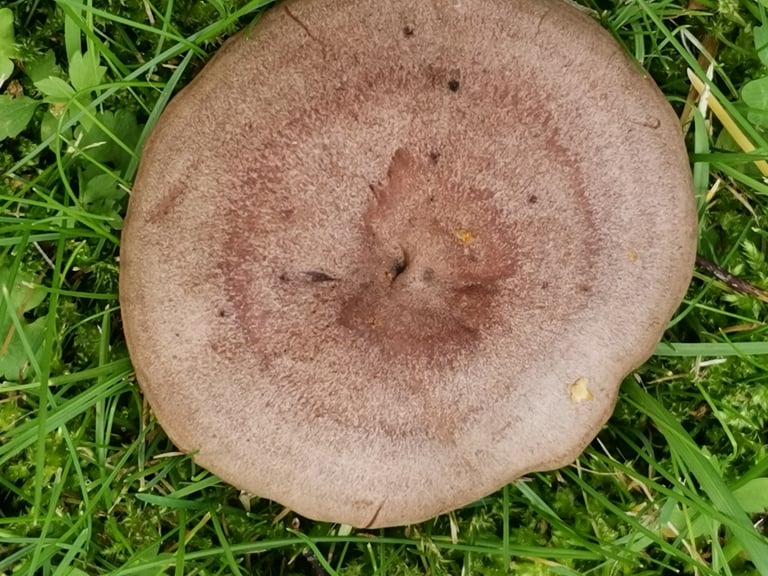
With a dark red-purple to red-brown cap, Russula firmula stands out among the roughly 750 species in the genus Russula, a group distributed worldwide.
This mushroom grows across Europe and parts of Asia, favoring conifer forests. Its combination of coloration and microscopic detail makes it a distinctive subject for anyone studying the diversity of Russula.
Fruiting Body and Identification
The most reliable identifying features of Russula firmula lie in its microscopic detail rather than its outward appearance alone. It produces a yellow spore print, with spores measuring about 8.4 by 7 μm and bearing spines 0.8 to 1.2 μm high.
The pileocystidia, found on the cap surface, measure around 72.5 by 10.3 μm and carry incrustations that respond distinctively to sulphovanillin staining: after about 30 minutes, the incrustations turn bright pink while the rest of the pileocystidia stain black. The terminal cells at the cap margins are cylindrical but taper narrowly at one end, and the basidia measure roughly 46 by 12.8 μm.
These chemical and cellular features, rather than cap color alone, are what separate Russula firmula from its many relatives in a genus known for subtle distinctions between species.
Distribution and Habitat
Russula firmula occurs across Europe and parts of Asia, where it grows in association with conifer forests. Observation records show a strong seasonal pattern, with counts rising sharply through summer and peaking in August and September before dropping off by late autumn.
This pattern suggests the species fruits mainly in the warmer months, consistent with the fruiting season typical of many ectomycorrhizal Russula species, though the observation data reflects presence rather than actual abundance or a complete picture of its range.

Ecology and Relationships
Russula firmula forms an ectomycorrhizal partnership with conifers, particularly spruce trees, exchanging nutrients with its host through a network of fungal threads wrapped around fine roots.
This relationship ties the fungus closely to spruce-dominated forests, where it depends on living trees rather than dead wood for its nutrition. Its bitter taste is a notable trait of the fruiting body, though its ecological significance beyond taxonomy is not detailed further.
Uses and Cultural History
Cultural traditions surrounding mushrooms, including species within the genus Russula, have at times treated them as symbols of fertility and prosperity, inspiring artistic expression in various societies.
Fun Facts
- Humans collect several Russula species for food, but attitudes toward their edibility differ sharply between cultures, with North American field guides tending to advise caution toward the genus as a whole.
- The bitterness reported in some Russula-like mushrooms has been linked by observers to either the age of the specimen or the nature of its cap cuticle.
Photos
Photographs from by Diego Delso via Wikimedia Commons, licensed under CC BY-SA 4.0., credited on each photo.
Ecology and classification
Habitat
Classification
- Phylum
- Basidiomycota
- Class
- Agaricomycetes
- Order
- Russulales
- Family
- Russulaceae
- Genus
- Russula
- Species
- Russula firmula
Sources
- GBIF Species names and classification
- Wikidata Common names and conservation status
- Wikipedia Summary extract
- Wikimedia Commons Photos