Sphagnum palustre can soak up water to 30 times its own dry weight, held within elastic spiral fibers packed into its stems and leaves.
Known as prairie sphagnum or blunt-leaved bogmoss, this species belongs to the peat moss genus Sphagnum within the family Sphagnaceae. It grows almost worldwide, favoring wet forests rather than the open bogs and moors that many of its relatives prefer.
What makes this moss worth attention is its unusual flexibility. While most Sphagnum species are confined to cold regions, S. palustre is among the few that extend into warm-temperate zones, giving it one of the broadest ranges in its genus.
Identification and Appearance
The most useful field mark for Sphagnum palustre is its habit of forming large, sometimes bulge-shaped carpets across the wet ground it colonizes. These mats set it apart from mosses that grow in loose, scattered patches.
Like other peat mosses, its leaves and stems contain elastic spiral fibers that let the plant absorb up to 30 times its own dry weight in water, giving the moss a soft, spongy, waterlogged texture even when handled.
The common name "blunt-leaved bogmoss" points to a rounded, non-pointed leaf tip, a feature that helps separate it from sharper-leaved Sphagnum species growing alongside it.
Distribution and Habitat
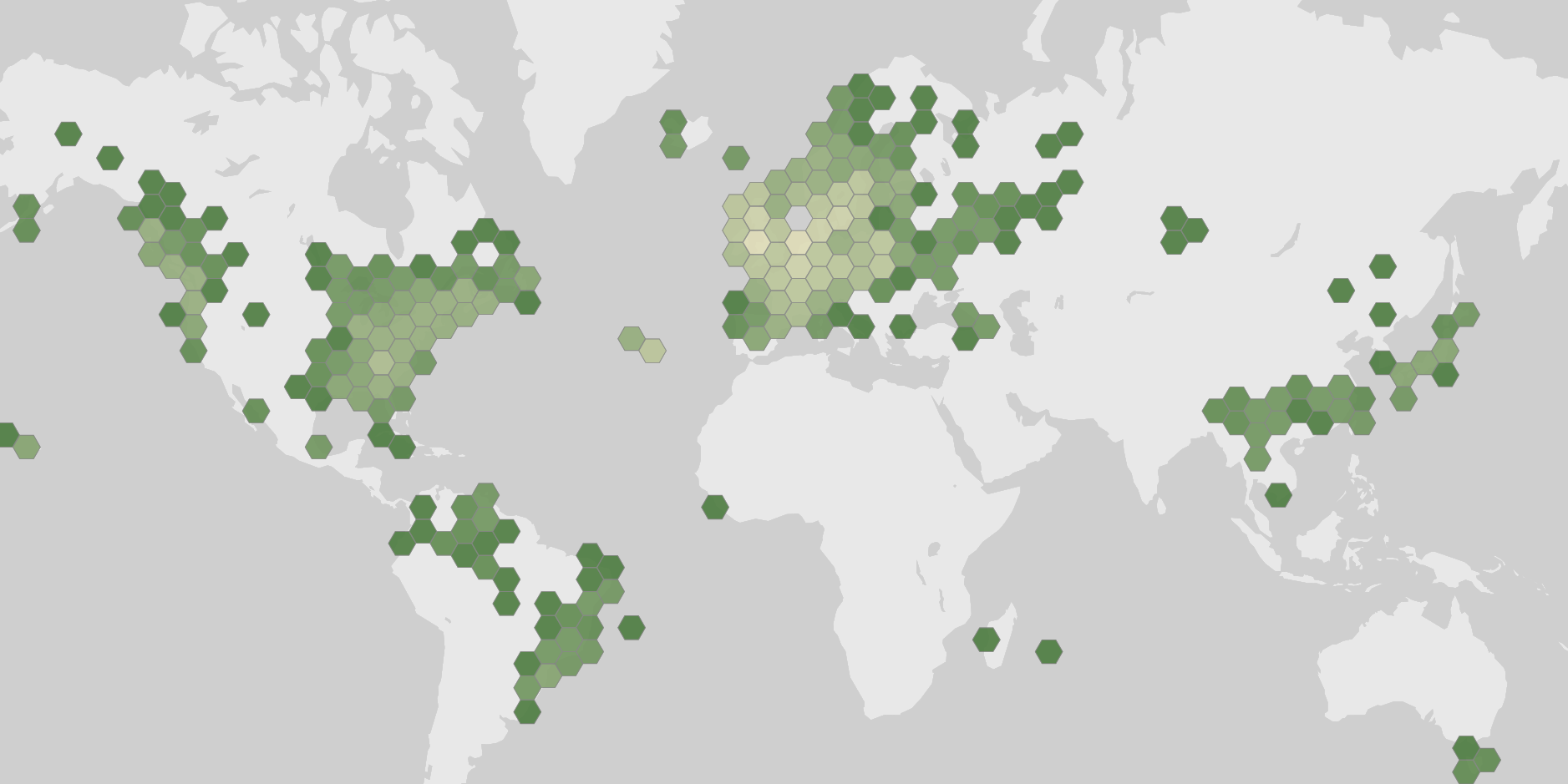
Sphagnum palustre has one of the widest ranges in its genus, spanning Europe, parts of the Americas, Australia, and New Zealand. Unlike most Sphagnum species, which are restricted to cold climates, this one extends into warm-temperate zones, a trait the context specifically singles out as unusual within the genus.
It favors wet forests, often coniferous ones, along with marshy meadows, and only rarely occurs in true moors or bogs. Where established, it frequently forms large carpets, sometimes swelling into bulge-shaped mounds, and is commonly found growing alongside Sphagnum fimbriatum, Sphagnum subnitens, and Sphagnum squarrosum.
In the British Isles the species occurs throughout, though it thins out in a band running just north of London and west to Bristol, with scattered patches in the Republic of Ireland. It remains widespread across Scotland, Wales, Orkney, Shetland, the Isle of Man, and the Scilly Isles.
The species has also become an invasive presence at Ka'ala on the island of O'ahu, Hawai'i, after a botanist introduced a sample there in 1960. Local conditions prevent it from reproducing sexually via spores, but it spreads vegetatively and now occupies an estimated 17.3 acres; coordinated eradication efforts have proved difficult. Monthly observation counts show a strong midyear peak, climbing from around 3,300 in January to over 12,000 in July before falling back below 2,000 by December, though these figures reflect observation activity rather than actual population size or a complete range map.
Uses and Human Relationships
Researchers have put Sphagnum palustre to work as an environmental monitoring tool. Under the EU's Mossclone project, part of the 7th Framework Program, the moss is multiplied in moss bioreactors to create a standardized measuring instrument for tracking air quality across Europe.
This application takes advantage of the moss's biology rather than altering it: its capacity to absorb large volumes of water and, by extension, airborne substances makes it a useful biological indicator once cultivated under controlled conditions.
Conservation and Threats
Sphagnum palustre is not listed on the IUCN Red List of threatened species, meaning it is not currently considered threatened or endangered.
Its wide distribution across Europe, the Americas, Australia, and New Zealand, along with its comparative frequency compared to other Sphagnum species, supports this unthreatened status.
Fun Facts
- Sphagnum palustre can absorb up to 30 times its own dry weight in water, a capacity made possible by elastic spiral fibers in its cells.
- Unlike most Sphagnum species, which stay confined to cold regions, this moss extends into warm-temperate zones, giving it an unusually broad global range.
- A single sample introduced to Ka'ala, O'ahu, in 1960 has spread vegetatively to cover an estimated 17.3 acres, even though local conditions prevent it from reproducing by spores.
Photos
Photographs from via iNaturalist, licensed under CC0 1.0., by Scott Shanks via iNaturalist, licensed under CC BY 4.0., by Mark Partington via iNaturalist, licensed under CC BY 4.0., by considerthelilies via iNaturalist, licensed under CC BY 4.0., by willingarden via iNaturalist, licensed under CC BY 4.0., by Petr Harant via iNaturalist, licensed under CC BY 4.0., by arthur_haendler via iNaturalist, licensed under CC BY 4.0., by anguspritchard via iNaturalist, licensed under CC BY 4.0., by FloraJenensis via iNaturalist, licensed under CC BY 4.0., and by Bryan Vroom via iNaturalist, licensed under CC BY 4.0., credited on each photo.
Ecology and classification
Classification
- Phylum
- Bryophyta
- Class
- Sphagnopsida
- Order
- Sphagnales
- Family
- Sphagnaceae
- Genus
- Sphagnum
- Species
- Sphagnum palustre
Sources
- GBIF Species names and classification
- iNaturalist Photos
- Wikidata Common names and conservation status
- Wikipedia Summary extract