Tuberous comfrey reproduces both by seed and vegetatively, spreading from rhizomes that let clonal offshoots colonize new ground even as the parent plant's leaves rot down in autumn.
Symphytum tuberosum is a flowering plant in the borage family (Boraginaceae), found across Europe and into northwestern Türkiye. It grows as a hardy, rhizomatous perennial in woodlands, grasslands, and disturbed ground.
Its unusual dormancy pattern, going dormant in mid-summer only to resume growth in early autumn, then again in winter, makes it a plant worth watching through the seasons rather than just in spring.
Identification and Appearance
The pale creamy-yellow flowers are the clearest way to tell tuberous comfrey apart from the purple-flowered Russian comfrey, a close relative it is often confused with. Flowering runs from April to June.
Both stems and leaves are softly hairy, and the leaves show deep, distinct veining that reduces in size from the top of the plant to the base. The stem usually remains unbranched.
The plant's usual pollinators include the common carder bumblebee, the honey bee, and the red mason bee. Beyond flowering, the species can be recognized in autumn by young clonal plants appearing around a parent plant whose own leaves are already rotting down, a sign of its vegetative spread by rhizome.
Distribution and Habitat
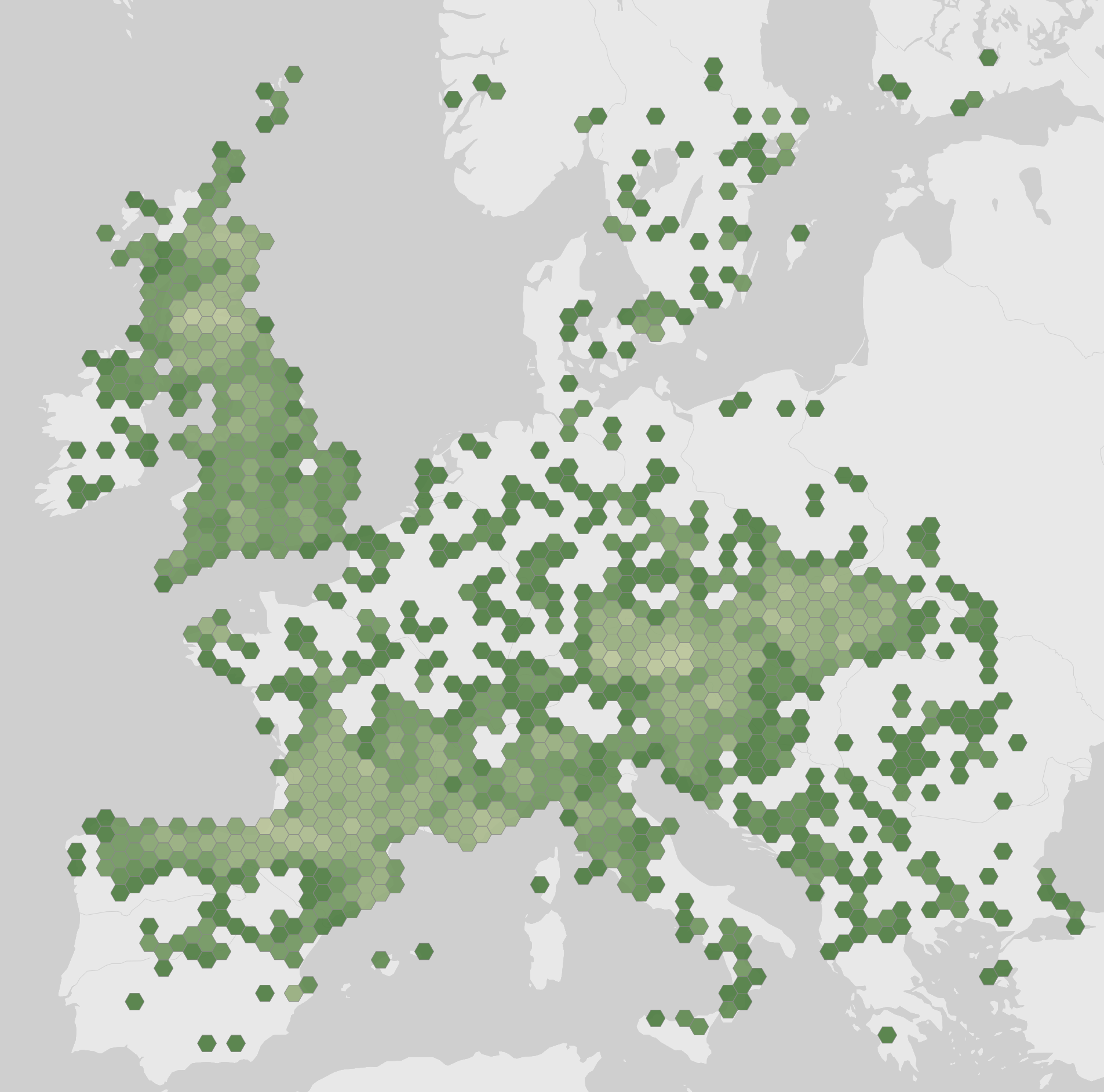
Tuberous comfrey occurs throughout Europe, from Spain and Portugal east to Ukraine and northwestern Türkiye, favoring temperate climates. In Great Britain it is naturally less common in the south, being common in Scotland and present but uncommon across much of England and Wales.
On the Isle of Skye and in Ireland, the species now has a well-established, wide distribution thanks to deliberate planting rather than natural spread. It has also been introduced to parts of the North American west coast and to Connecticut, Maine, and Massachusetts.
The plant grows in woodland, grassland, and disturbed ground settings. Observation records peak sharply in spring, consistent with its active growing and flowering season before summer dormancy sets in.
Growth and Form
Tuberous comfrey is a rhizomatous geophyte, storing energy underground and spreading through rhizomes rather than relying solely on seed. This underground growth habit lets it colonize new ground gradually as clonal offshoots emerge around the parent plant.
The species is very hardy and well suited to surviving northern winters, going through a distinctive cycle of dormancy: it slows in midsummer, resumes growth in early autumn, goes dormant again over winter, and starts growing again in late winter or early spring.
Ecology and Relationships
The flowers produce notably high amounts of nectar compared to other UK plants, though their long floral tube means only long-tongued insects can reach it easily. Common carder bumblebees, honey bees, and red mason bees are the main flower visitors, alongside various Lasioglossum bees.
Some bees resort to nectar robbing, biting into the side of the flower to bypass the long tube and reach the nectar directly, a foraging behavior noted for this plant.
A range of birds have been recorded feeding on tuberous comfrey, including finches such as the redpoll and greenfinch, along with skylarks, partridges, mallards, greylag geese, and pigeons such as the stock dove and wood pigeon.
Uses and Human Relationships
The common name "knitbone," used for tuberous comfrey and related comfrey hybrids, reflects its long history in herbal medicine. Traditional preparations made use of both the leaves and the roots.
The leaves were applied directly to minor abrasions under a compress, valued for supporting the healing of damaged skin. The root has also served as a coffee substitute once prepared.
Fun Facts
- The flowers produce significantly more nectar than many other UK plants tested, despite their long floral tube limiting access to long-tongued insects.
- Some bees engage in nectar robbing on this species, biting through the side of the flower rather than entering through the tube opening.
- The common name "knitbone" points to the plant's long-standing place in traditional herbal remedies for skin and bone healing.
Photos
Photographs from via iNaturalist, licensed under CC0 1.0., by Oleksandr Shynder via iNaturalist, licensed under CC BY 4.0., by Barry Stewart via iNaturalist, licensed under CC BY 4.0., by Thomas Dreux via iNaturalist, licensed under CC BY 4.0., by Alan Prather via iNaturalist, licensed under CC BY 4.0., by Johannes S. via iNaturalist, licensed under CC BY 4.0., by Jeff Clark via iNaturalist, licensed under CC BY 4.0., and by Mike Grant via iNaturalist, licensed under CC BY 4.0., credited on each photo.
Ecology and classification
Growth habit
- Herb
Classification
- Phylum
- Tracheophyta
- Class
- Magnoliopsida
- Order
- Boraginales
- Family
- Boraginaceae
- Genus
- Symphytum
- Species
- Symphytum tuberosum
Sources
- GBIF Species names and classification
- iNaturalist Photos
- Wikidata Common names and conservation status
- Wikipedia Summary extract
- Plants of the World Online Native range, life form and climate (WCVP)
- GloBI What it eats, what eats it, parasites and pollinators
- trophiCH