Few insects travel as far as the painted lady. Some individuals complete a round trip of roughly 15,000 kilometers between tropical Africa and the Arctic Circle, relayed across as many as six successive generations.
Vanessa cardui, commonly called the painted lady, is a member of the brush-footed butterfly family Nymphalidae. It is found on every continent except Antarctica, making it the most widespread butterfly species on Earth, and it carries an IUCN status of Least Concern. Its combination of extreme mobility, rapid breeding, and tolerance for almost any open habitat makes it a favorite subject for citizen science and migration research alike.
Identification and Appearance
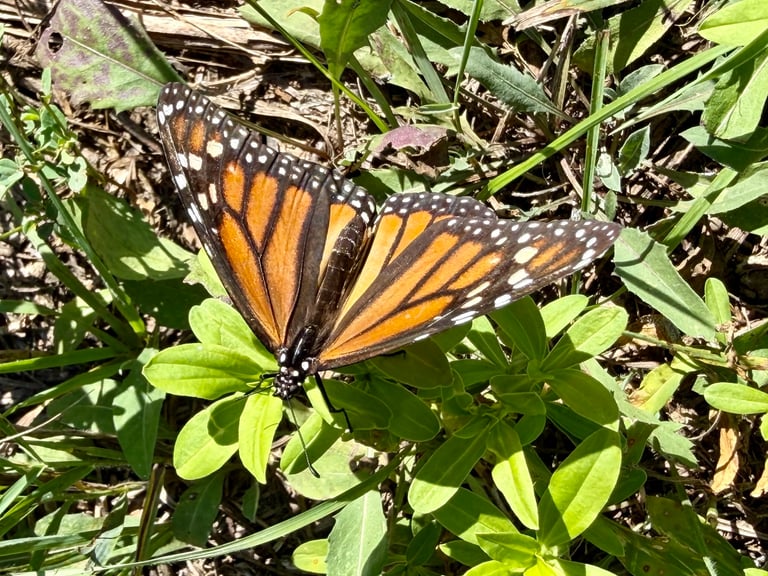
The clearest field mark is the wing pattern: reddish-ochreous forewings crossed by an irregular black band running from the middle of the cell to the outer margin, tipped with a short white streak and a curved row of four round spots near the apex. The wing edges are black with alternating black-and-white fringes, and a pale lunular line traces the margin.
The hindwing carries a blackish patch near the costal vein, a partly joined black discal band, and a row of five round black spots between that band and a submarginal row of lunules. On the underside, the hindwing is marbled with olive-brown and speckled with black scales, crossed by pale sinuous bands and white veins, and marked with five ocelli—small eyespots—the fourth of which has a black center flecked with blue and ringed in yellow. The body is olive-brown with ochreous bands on the abdomen, and the antennae are black above with reddish tips.
The description available does not indicate visible differences between males and females; both sexes share this pattern. The species is distinguished from its close relatives mainly by range: the Australian painted lady (V. kershawi), the American painted lady (V. virginiensis), and the West Coast lady (V. annabella) occupy overlapping but geographically distinct territories and are sometimes treated as separate species or subspecies.
Distribution and Habitat
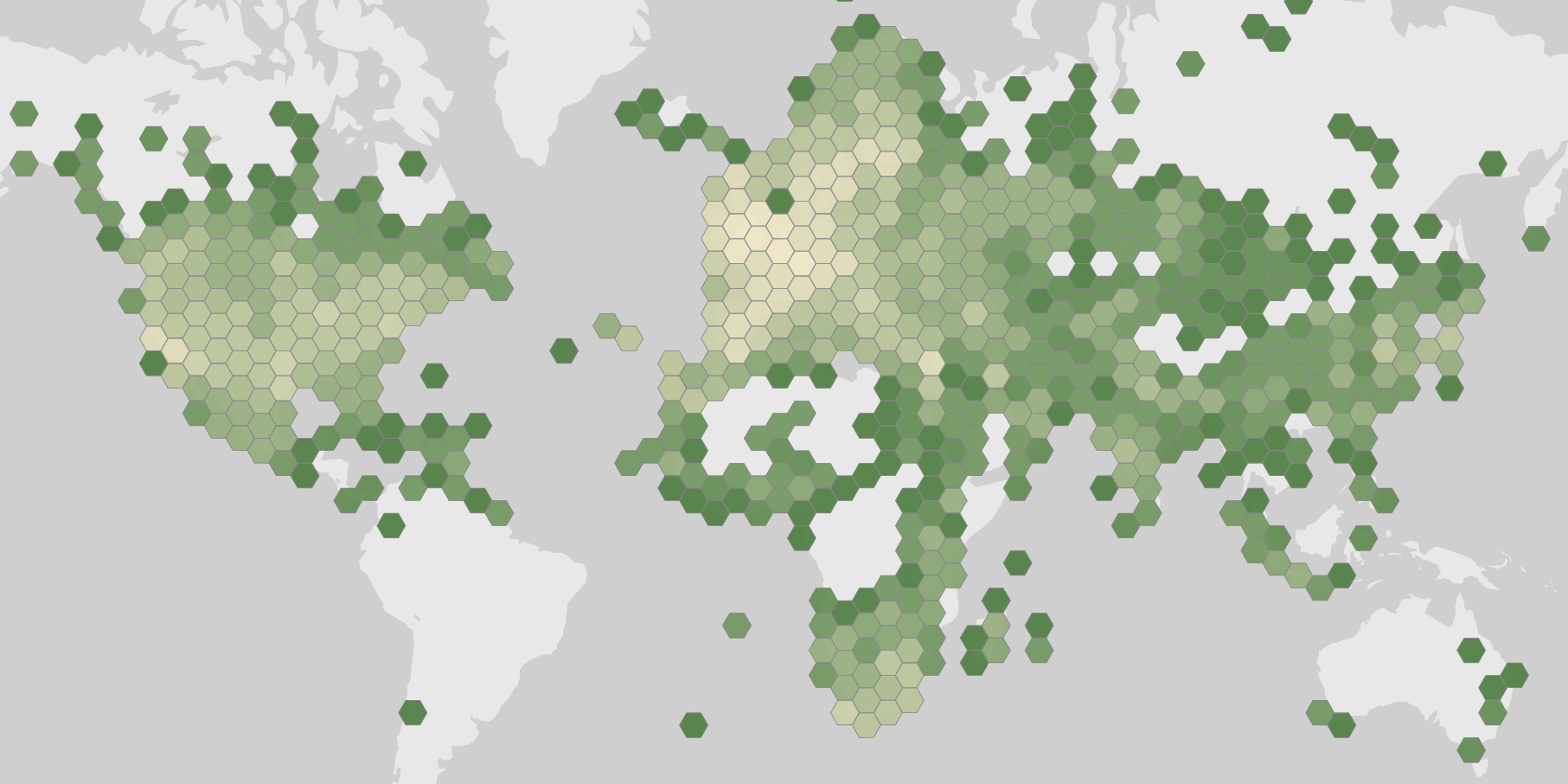
Painted ladies occur on every continent except Antarctica, making them one of the most broadly distributed butterflies known. They are rare or vagrant in South America, and in Australia their range is limited to areas around Bunbury, Fremantle, and Rottnest Island, while the closely related Australian painted lady covers roughly half that continent.
The species uses an unusually wide range of habitats: open fields and meadows are typical, but populations also turn up in suburban and agricultural land, swamps, bogs, marshes, tundra, taiga, desert and dune systems, chaparral, forest, rainforest, scrub forest, and mountain environments. This tolerance lets it establish wherever its host and nectar plants grow, from sea level up to high elevations during migratory movements.
Monthly observation counts rise sharply from a low of under 5,000 in January to a peak above 417,000 in August, with elevated numbers from May through September. Treated cautiously as presence data rather than a population count, this pattern is consistent with a strong seasonal pulse of sightings through the Northern Hemisphere summer, tapering off by late autumn.
Behavior and Lifestyle
Painted ladies are diurnal, highly mobile fliers whose defining behavior is mass, multi-generational migration. Each year they move northward out of overwintering grounds in Africa, through the Mediterranean and into much of Europe, riding favorable high-altitude winds to cross continents quickly; the same pattern plays out in the Americas, where populations shift between Mexico and the northern United States and Canada.
Migration begins in March and April, with local generations appearing by May and June as the butterflies breed along the way; migrants do not reach northern Europe until late May or June. By late August the population turns south again, breeding further during the return leg in September and October, though breeding slows considerably in winter. The scale varies year to year: an estimated one billion individuals crossed Israel in a single surge at the end of March 2019, apparently triggered by heavy winter rains that produced unusually abundant larval food plants in desert regions.
Orientation during migration depends on a solar compass. Laboratory studies found that autumn-generation butterflies isolated from a view of the sky lost the ability to orient in a consistent direction, while those with sky access oriented reliably southward for the return flight. Radar studies have shown that these long-distance movements happen at high altitude, which is why the migration is rarely witnessed directly despite involving millions of individuals.
Males are territorial in a limited sense: rather than defending fixed ground, they establish themselves at particular perches, hilltops, or forest-meadow edges and wait for females to pass, a strategy suited to a species that rarely occupies the same breeding ground twice.
Communication
Painted ladies rely on visual, chemical, and acoustic channels, though vision and chemical cues appear to matter most. Adults have compound eyes built from thousands of ommatidia, letting them distinguish potential mates from rivals and pick out suitable host plants by sight.
Larvae have much more limited vision, able to detect light across the red-to-ultraviolet range but without the fine discrimination adults use. This gap between larval and adult perception reflects their different needs: larvae mainly need to sense light and shadow while feeding and hiding, while adults must locate both mates and specific plants across open landscapes.
Diet and Feeding Habits
Adult painted ladies feed on nectar, favoring composite flowers standing 3 to 6 feet tall such as aster, cosmos, blazing star, ironweed, joe-pye weed, red clover, buttonbush, privet, milkweed, and thistles. They will also take honeydew, the sugary byproduct left behind by aphids, when flowers are scarce.
The species is polyphagous, recorded feeding from more than 100 different plant species overall. Larvae feed on foliage rather than nectar, chewing leaves of cheeseweed, thistles, dwarf nettle, lupine, fiddleneck, and numerous other members of the daisy family, Compositae.
By visiting flowers for nectar, adults pick up and transfer pollen, giving host and nectar plants a pollination benefit in exchange for the food and fragrance they provide, a relationship that runs both ways between the butterfly and the plants it depends on.
Reproduction and Life Cycle
Mating is polygynous: males court whichever females cross their path at a chosen perch or landmark and will mate with several females across a season to maximize their offspring. Breeding continues year-round wherever the climate stays warm, only slowing in autumn and winter in cooler regions, and reproduction happens on the move—migrating adults mate and lay eggs throughout their journey rather than waiting for a fixed breeding ground.
Males and females both reach sexual maturity just 5 to 7 days after emerging from the pupal stage. A female lays roughly 500 eggs in a season, depositing them singly on host plants rather than in clusters. Development from egg through larval stages takes about 20 to 25 days under favorable conditions, and laboratory colonies have produced as many as 8 generations in a single year.
Parental care ends at egg-laying: the female's only investment is choosing a suitable host plant and provisioning the egg itself, after which the larva is entirely independent. Rainfall appears to influence reproductive success, with heavier rains linked to more larval food plant growth and possibly to improved egg activation and larval development.
Population and Ecological Role
Painted ladies fluctuate widely in number from year to year, with migratory surges sometimes involving millions of individuals and other years passing with far fewer. No long-term population figures are available, but the species' role in its ecosystem is well documented on both ends of the food chain.
As adults, painted ladies pollinate more than 100 recorded host and nectar plant species, including thistles, hollyhock, mallow, milkweed, aster, and various legumes, in a mutualistic exchange for nectar and fragrance. As prey, they support birds, bats, and other insects, while their larvae and pupae host a range of parasitoids, including the tachinid flies Exorista segregata and Sturmia bella, ichneumonid wasps such as Cotesia vanessae and Dolichogenidea sicaria, and the chalcid wasp Pteromalus puparum.
Conservation and Threats
Vanessa cardui carries an IUCN status of Least Concern and is not considered at risk. It holds no special protection under the U.S. Federal List, CITES, or Michigan state listings, and no conservation efforts are currently directed at the species.
This stability likely reflects the same traits that make the butterfly notable elsewhere: its extremely broad range, its ability to use dozens of habitat types, and its rapid, high-output breeding cycle. Year-to-year swings in migration size appear driven by weather, particularly rainfall that boosts larval food plants in desert regions, rather than by any identified threat to the species as a whole.
Conservation status
- LC
- NT
- VU
- EN
- CR
Least Concern
Cultural Significance
The genus Vanessa traces its name to a literary origin—it was coined for the muse of the writer Jonathan Swift—and the butterflies carry associations with ephemerality and romance in art and folklore. Common names tied to related species, such as "admiral," echo naval heritage and appear frequently in Victorian-era lepidoptery writing.
Painted ladies are widely used in education and ceremony: schools breed them for classroom life-cycle programs, and captive-raised adults are released at hospices, memorials, and weddings as symbols of transformation and renewal. Beyond direct human use, their pollination work supports the wider plant communities people rely on, and shifts in their numbers are sometimes read by researchers as an indicator of ecosystem health.
Fun Facts
- A 2024 study found painted lady specimens on a beach in French Guiana carrying pollen from West African shrubs, the first confirmed case of an insect crossing an ocean under its own power.
- The genus name Vanessa comes from a literary source: it was coined for the muse of the writer Jonathan Swift.
- In a single surge at the end of March 2019, an estimated one billion painted ladies migrated across Israel after unusually heavy winter rains.
- Laboratory colonies have produced up to 8 generations of painted ladies in a single year.
- The butterflies navigate migration using a solar compass; without a direct view of the sky, they lose the ability to hold a consistent flight direction.
- Larvae can perceive light across the red-to-ultraviolet range, even though their vision is otherwise limited compared to the compound eyes of adults.
- Common names tied to the genus, like "admiral," reflect naval heritage that became popular in Victorian-era butterfly writing.
Ecology
Habitat
- Wetland
- Mountain
- Grassland
- Desert
Behavior
- Territorial
- Diurnal
- Migratory
Diet
- Nectarivore