Nearly every bottle of natural vanilla extract on store shelves traces back to a single orchid species: Vanilla planifolia, prized above its relatives for its unusually high vanillin content.
It is an evergreen vine in the orchid family (Orchidaceae), native to southern Mexico, Central America, Colombia, and the northern reaches of Brazil. The IUCN formally assessed it as Endangered in 2017, a status published in 2020, reflecting the shrinking and fragmented forests it depends on.
Few plants connect ancient Mesoamerican ritual to a modern global spice trade the way this vine does. First given its scientific name in 1808, it had already been cultivated and revered for generations before Western science took notice.
Identification and Appearance
The clearest field mark is the vine's zig-zagging stem, bending about 120° at each node, with a single flat, fleshy leaf opposite thick aerial roots that cling to bark as the plant climbs.
In the wild, Vanilla planifolia commonly reaches 15 meters in length and can stretch as far as 30 meters. Grown in full shade it stays largely unbranched, but in sunlight it produces multiple side branches. Leaves are glossy, bright green, lanceolate to oval with a pointed tip, measuring 8–25 cm long and 2–8 cm wide, and each leaf can persist for three to four years if undamaged. Older, unsupported sections of the vine hang down through the canopy toward the forest floor, while younger, climbing portions grow the fleshy support roots.
Flowers emerge from clusters of 12 to 20 buds and are greenish-yellow, about 5 cm across, with only a faint scent. Each flower opens in the morning and fades by afternoon of the same day, though the overall flowering period stretches across roughly two months, typically April and May at the end of the dry season in its native lowland forests. The flowers are self-fertile but have a structure that blocks pollen from reaching the stigma without help, which is why natural pollination succeeds in only about 1% of flowers.
Fruit forms only on mature plants, taking two to three years to appear from meter-long cuttings or three to four years from shorter cuttings and tissue-cultured plants. The pods are 15–23 cm long, resemble small bananas, and ripen over eight to nine months.
Distribution and Habitat
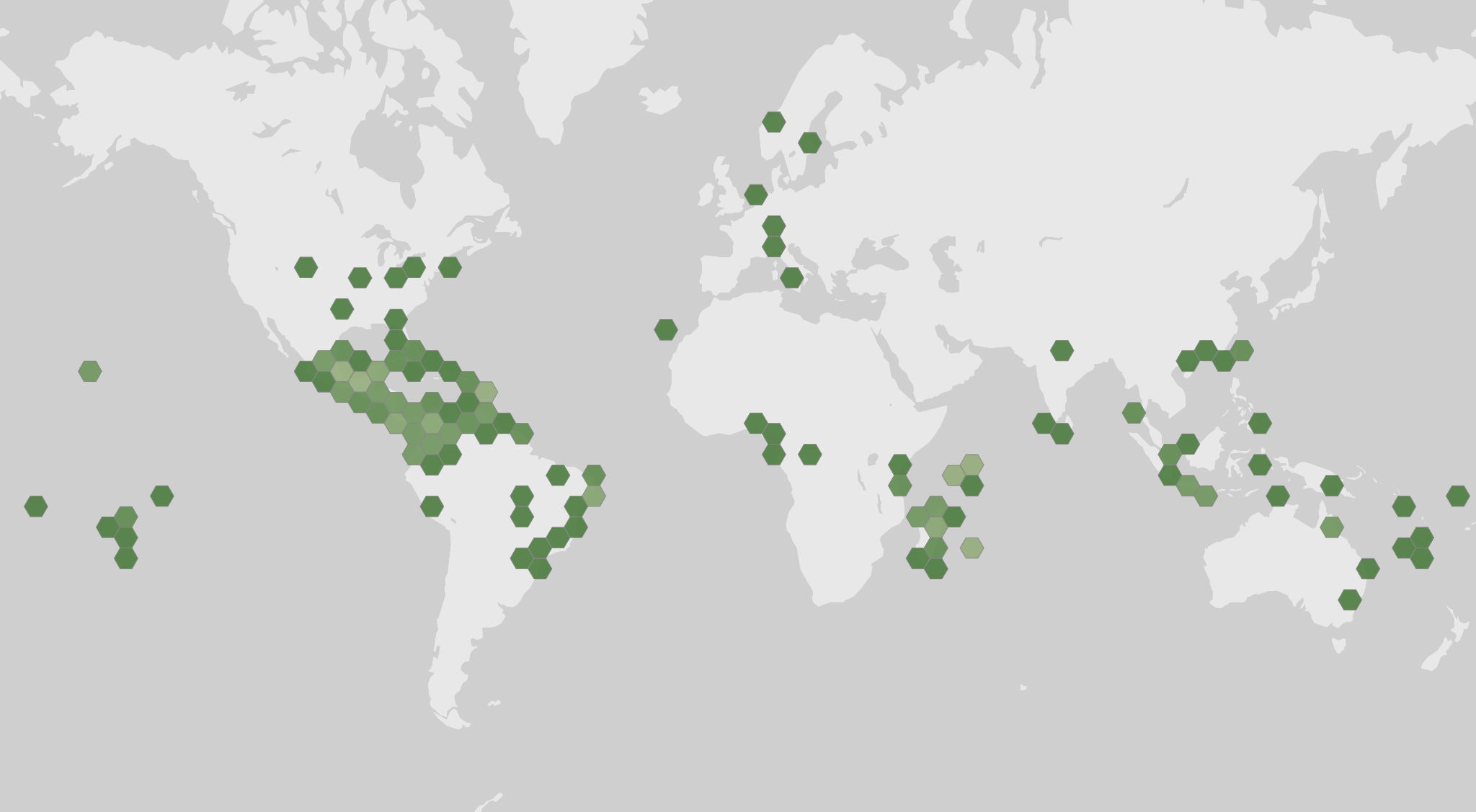
Vanilla planifolia is native to the neotropical realm, ranging from southern Mexico through Central America, Colombia, and northern Brazil. Earlier accounts had restricted its native range to just southern Mexico and Belize, but this has since been broadened.
Centered on cypress swamps and hammocks at low elevations of 0 to 20 meters, its natural habitat sits within a broader altitude range of 150 to 900 meters. Centuries of cultivation have carried the vine far beyond this native range, into south Florida, the Cayman Islands, the Dominican Republic, Jamaica, Puerto Rico, tropical Peru, Ecuador, Venezuela, French Guiana, Suriname, and Guyana, as well as the Democratic Republic of the Congo, Madagascar, Comoros, Bangladesh, the Malay Peninsula, Java, the Chagos Archipelago, the Cook Islands, New Guinea, and New Caledonia.
The species needs a humid, warm tropical climate, growing best between 20 and 30 °C and tolerating a range of only 10 to 33 °C. It requires at least 2000 mm of rainfall a year, well-drained soil with a pH of 6.0 to 7.0, and ample calcium and potassium, along with a dry spell in spring to trigger flowering.
Monthly observation counts show a peak in May, with a secondary rise in September, patterns that align loosely with the species' April–May flowering season in its native range. These figures reflect where the plant has been recorded, not its abundance or full range, so they should be read only as a rough indicator of seasonal presence.
Ecology and Relationships
The identity of Vanilla planifolia's natural pollinator remains unresolved. Several euglossine bees, including species of Euglossa and Eulaema, along with the stingless bee Melipona beecheii, have been proposed, but no pollination event has ever been definitively observed. M. beecheii in particular seems an unlikely candidate given its size, and field studies in Mexico's Yucatán Peninsula failed to record any visits by stingless bees or orchid bees at all.
Seed dispersal follows an unusual path for an orchid: the seeds are too large to travel on the wind, so animals do the work instead. Male orchid bees such as Euglossa bursigera, Euglossa ignita, Euglossa tridentata, and Eulaema cingulata collect fragrance from the fruit and remove seeds in the process, while female stingless bees, including Eulaema polychroma and Scaptotrigona subobscuripennis, strip out the pulp for nest-building. This kind of bee-mediated seed dispersal is so rare that it had previously been documented in only three tropical tree species.
On the forest floor, fallen pods are eaten by Tome's spiny rat (Proechimys semispinosus) and the common opossum (Didelphis marsupialis). Research led by Dr. Adam Karremans found that seeds remain viable after passing through these mammals' guts, though gut passage neither significantly boosts nor harms germination rates.
Uses and Human Relationships
Totonac mythology traces the vanilla orchid's origin to Xanat, daughter of a fertility goddess, who is said to have transformed herself into the vine out of love for a mortal youth; a related version tells of a forbidden princess whose spilled blood gave rise to the first vanilla vine. The Aztecs later mixed vanilla with cacao to create a sacred drink believed to bestow strength and vitality, and folk tradition has long assigned the plant contradictory powers, calling it both a sedative for hysteria and a stimulant that promotes wakefulness, along with a lasting reputation as an aphrodisiac.
Commercially, vanilla extract comes from the cured pods. Once a cluster of pods turns yellow and ripe it is harvested whole, then cured through fermentation and drying to develop the characteristic flavor while preserving the essential oils. Because natural pollinators are rare or absent outside its native range, farms rely on hand pollination of every flower. Cultivation and harvest are centered in Veracruz, Mexico, along with Tahiti, Indonesia, and Madagascar. The crop is propagated almost entirely by cuttings rather than seed; as of 2023 only one cultivar, "Handa," is patented, with "Mansa" types being the most commercially significant and two variegated forms grown ornamentally.
This reliance on cloned cuttings has created a genetic bottleneck: of five attempted introductions to Réunion Island between 1793 and 1875, only the 1822 introduction succeeded, and genetic research suggests nearly all vanilla grown around the Indian Ocean descends from that single planting. Growing the vine indoors or in a greenhouse is possible but demands precise conditions, and is generally attempted only by experienced orchid growers.
Fun Facts
- Vanilla planifolia was not given its scientific name until 1808, long after it had already been cultivated for generations.
- Beyond simply being called vanilla, the species also carries the common names "flat-leaved vanilla" and "West Indian vanilla."
- Its seeds are unusually large for an orchid, too heavy to be carried by wind, an adaptation almost unheard of among the tens of thousands of orchid species.
- Bee-mediated seed dispersal, as documented in this vine, has previously been recorded in only three tropical tree species worldwide.
- Folk tradition assigns vanilla contradictory powers: some call it a sedative for hysteria, others say it "promotes wakefulness" and boosts muscular energy, and it has long carried a reputation as an aphrodisiac.
Photos
Photographs from via iNaturalist, licensed under CC0 1.0., by Michel Langeveld via iNaturalist, licensed under CC BY 4.0., by Kevin Faccenda via iNaturalist, licensed under CC BY 4.0., by Dave Shenton via iNaturalist, licensed under CC BY 4.0., by Rosalinda Melendrez via iNaturalist, licensed under CC BY 4.0., by Antoine MARNAT via iNaturalist, licensed under CC BY 4.0., by amantedarmanin via iNaturalist, licensed under CC BY 4.0., by zaneotic via iNaturalist, licensed under CC BY 4.0., by chrisdt via iNaturalist, licensed under CC BY 4.0., by Samuel GUIRAUDOU via iNaturalist, licensed under CC BY 4.0., by Gabriel Jovêncio Ribeiro via iNaturalist, licensed under CC BY 4.0., by Paulmathi Vinod via iNaturalist, licensed under CC BY 4.0., by Denis Bastianelli via iNaturalist, licensed under CC BY 4.0., and by Lexi Amico via iNaturalist, licensed under CC BY 4.0., credited on each photo.
Ecology and classification
Classification
- Phylum
- Tracheophyta
- Class
- Liliopsida
- Order
- Asparagales
- Family
- Orchidaceae
- Genus
- Vanilla
- Species
- Vanilla planifolia
Sources
- GBIF Species names and classification
- iNaturalist Photos
- Wikidata Common names and conservation status
- Wikipedia Summary extract
- Encyclopedia of Life Habitat, diet and behavior traits