The welcome swallow is a small, fast-flying bird whose looping, darting flight over open fields is a familiar sight across Australia and New Zealand.
A member of the swallow family Hirundinidae, it is native to Australia and nearby islands and is currently listed as Least Concern. Its close resemblance to the Pacific swallow, with which it is often considered the same species, adds an interesting wrinkle to its story.
Identification and Appearance
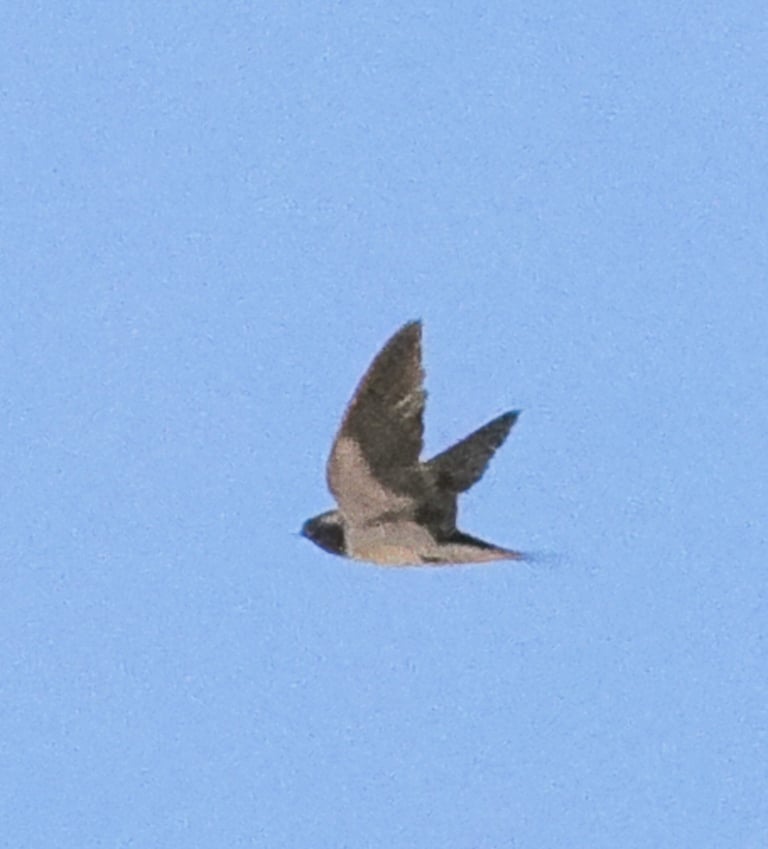
The welcome swallow's most useful field mark is its combination of a rusty forehead and throat with metallic blue-black upperparts and a long, deeply forked tail marked with a row of white spots.
The birds measure about 15 cm long, including the outer tail feathers, which are slightly shorter in females. A male specimen from the Gould collection in Tasmania had a wing of 11.1 cm, a tail of 7.4 cm, and a culmen of 0.7 cm, while a female measured 10.9 cm in the wing, 6.25 cm in the tail, with the same culmen length. Below, the grey breast and belly contrast with the rusty throat and forehead.
Its flight style is distinctive: circular patterns mixed with swift darting motions, often performed singly, in pairs, or in loose clusters. The call is a quiet mix of twittering and soft warbling, with a sharper whistle given in alarm, though the sound rarely carries far.
Young birds differ from adults by having buffy white rather than rufous coloring on the forehead and throat, along with shorter tail streamers. In winter range areas of northern Australia, the welcome swallow can be told apart from the wintering barn swallow by the barn swallow's blue breast band, which the welcome swallow lacks.
Distribution and Habitat
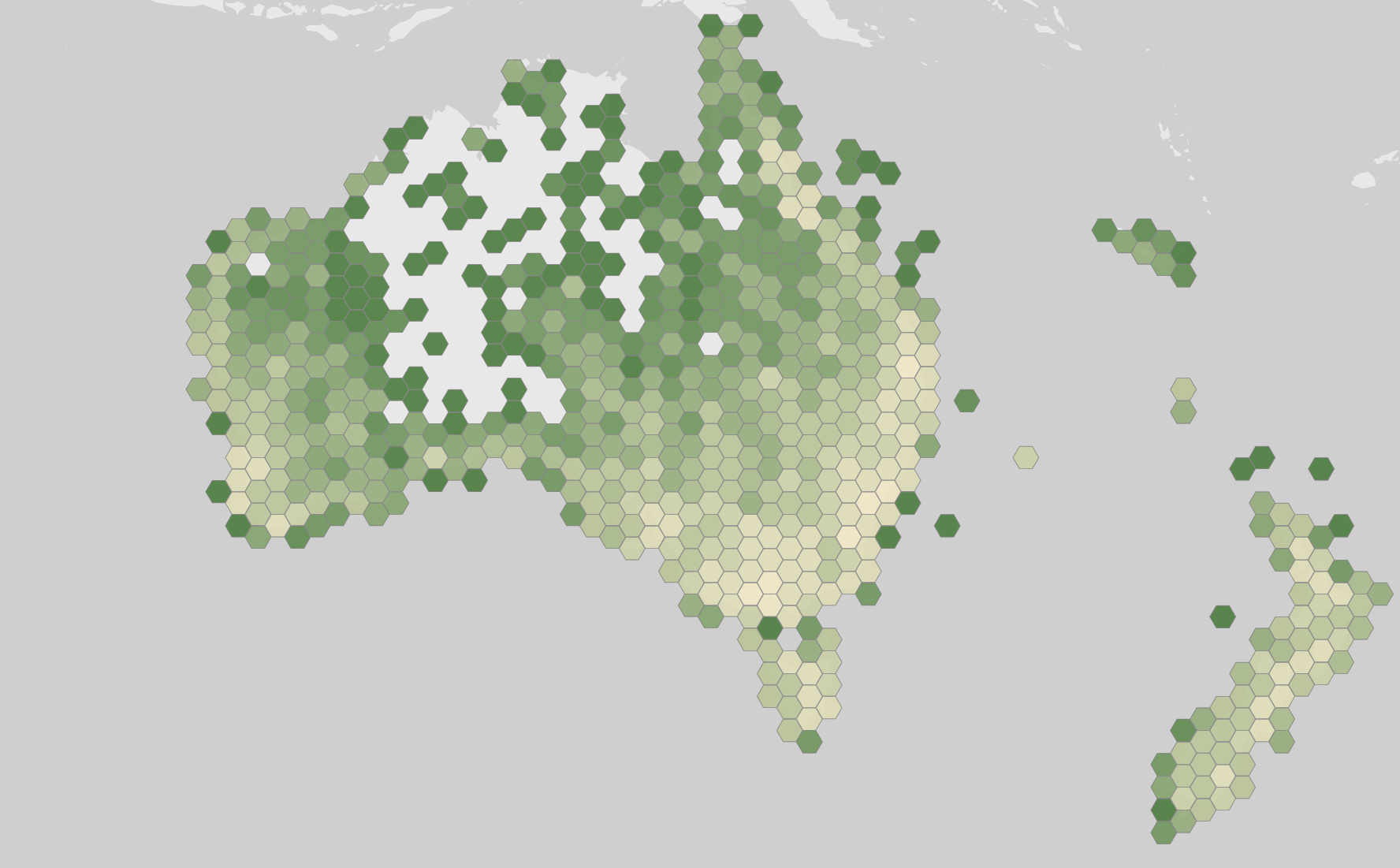
The welcome swallow holds a very large distributional range across Australia, New Zealand, and nearby islands, favoring open habitats over dense forest or alpine zones.
It occurs throughout eastern, western, southern, and central Australia, with eastern populations moving north toward the equator in winter before returning south each spring to breed. Birds in Western Australia and New Zealand are mostly non-migratory. The species has been recorded nesting across most of New Zealand, though it remains rare in Fiordland; it also reaches the Chatham and Kermadec Islands, with occasional sightings on Campbell Island, Auckland Island, and the Snares. Beyond Australasia, it has been recorded in New Guinea and New Caledonia.
Welcome swallows favor coastal and wetland areas but adapt readily to farmlands, grasslands, partly wooded clearings, and land near lakes or reservoirs. They thrive in urban and suburban settings as well, often nesting close to human habitation and taking advantage of nesting materials people provide, even at higher altitudes.
Hunting and Diet
The welcome swallow hunts insects entirely on the wing, flying fast and low over open fields in circles or figure-eight patterns and often swooping close to people or grazing animals to catch disturbed prey.
Pairs typically forage together during the breeding season, continuing even after fledglings occupy the nest. The birds also cooperate with other individuals to drive insects together for easier capture, and they can remember insects' activity routines, making their foraging more efficient over time.
Welcome swallows need to drink frequently and do so by scooping water from the surface of lakes and ponds while flying, a habit that doubles as a hunting opportunity since insects also gather near the water.
Their growth strategy reflects this reliance on variable insect supply: wing growth proceeds at a slow, steady rate that is not affected by food intake unless the bird is starving, suggesting wing development is prioritized even through fasts of up to six hours. The birds also accumulate fat reserves to survive periods when food is scarce, allowing rapid growth when conditions are good and stable growth when they are not.
Nesting and Breeding
Welcome swallows are monogamous and breed from August until March, building open cup nests of mud and grass that both sexes construct together, typically attached to vertical rock walls or buildings.
Nests are lined with feathers and fur and take 8 to 23 days to build; the same nest is often reused across consecutive breeding seasons. Clutches usually hold three to five eggs, though the range can run from two to seven, averaging around four, with larger clutches early in the season and smaller ones later. Eggs are laid at 24- to 48-hour intervals, measure about 18 mm by 13 mm, and are pink with brown speckles. Nests built higher up tend to have greater fledgling success, likely because mammals cannot reach them as easily.
The female alone incubates the eggs, which hatch after two to three weeks, while the male forages and sometimes watches the nest or accompanies her. Both parents feed the young, which remain in the nest for 18 to 23 days and become fully independent around 35 days old. Males have even been observed removing fecal sacs from the nest. Pairs often raise two broods a season, occasionally three, and breeding pairs work within small loose groups to defend their nest and territory, especially against predatory birds.
Young welcome swallows do not begin breeding themselves until 8 to 14 months of age.
Population and Ecological Role
The welcome swallow faces predation from hawks, snakes, and feral cats, with snakes considered the most dangerous threat in Australia since they can climb to nests and eat eggs or chicks.
In New Zealand, nest failures have been linked mainly to disturbance during incubation, caused by humans, mustelids, and blackbirds preying on eggs. As colonial breeders, welcome swallows face elevated parasite risk within their nests, which may lower breeding success even as it boosts immune responsiveness. Their excreta can carry bacteria and parasites responsible for diseases such as histoplasmosis, encephalitis, salmonella, meningitis, and toxoplasmosis, and the birds are also susceptible to fowlpox, a virus with a mild cutaneous form and a more dangerous diphtheritic form.
Fun Facts
- The welcome swallow was first described by English ornithologist John Gould in 1842, in the Proceedings of the Zoological Society of London, with its type locality set on the southern coast of Australia and Van Diemen's Land, now known as Tasmania.
- Its range overlaps with the barn swallow in parts of Australasia, and the two are told apart by the barn swallow's red face and blue breast band, features the welcome swallow lacks.
- The welcome swallow's close relationship with the Pacific swallow is so strong that the two are often considered to belong to the same species.
Photos
Photographs from via iNaturalist, licensed under CC0 1.0., by gwynmwilliams via iNaturalist, licensed under CC BY 4.0., by liam1294 via iNaturalist, licensed under CC BY 4.0., by koalabi via iNaturalist, licensed under CC BY 4.0., by Sofia Zvolanek via iNaturalist, licensed under CC BY 4.0., by Liadan Dickie via iNaturalist, licensed under CC BY 4.0., by zemlya via iNaturalist, licensed under CC BY 4.0., by Jeremy James via iNaturalist, licensed under CC BY 4.0., by smathichong via iNaturalist, licensed under CC BY 4.0., and by Zac Lucarelli via iNaturalist, licensed under CC BY 4.0., credited on each photo.
Ecology and classification
Classification
- Phylum
- Chordata
- Class
- Aves
- Order
- Passeriformes
- Family
- Hirundinidae
- Genus
- Hirundo
- Species
- Hirundo neoxena