Some individual Welwitschia mirabilis plants alive today may have germinated around the time of the Roman Empire, with age estimates reaching 2,000 years based on radiocarbon dating. That kind of longevity, combined with a body plan unlike almost anything else in the plant kingdom, has made this desert survivor a botanical curiosity since its discovery.
The species is the sole member of its genus, family Welwitschiaceae, and order Welwitschiales, and it is one of just three living genera of gnetophytes, alongside Gnetum and Ephedra. It grows only in the Namib Desert of Angola and Namibia, tolerating conditions of extreme heat and near-zero rainfall. Its wild population is currently considered reasonably stable, but the story of how it survives, reproduces, and ages in one of the driest places on Earth is what makes it worth a closer look.
Identification and Appearance
The single clearest way to recognize Welwitschia mirabilis is by its leaves: after germination it produces just one permanent pair, growing opposite each other from a woody crown, and these two leaves persist and keep growing for the plant's entire life. They are long and ribbon-shaped, with parallel veins running their length, and over decades they split into frayed, tattered strips from constant desert weathering, often giving mature plants a shredded, tangled appearance rather than a neat leaf pair.
In size, the crown is disc-shaped and widens with age, reaching up to a meter in diameter, while the plant itself rarely stands more than 1.5 m (4.9 ft) tall above ground. The leaves, however, can grow up to 4 m (13 ft) long, and where they sprawl across the sand their combined circumference may exceed 8 m (26 ft); the largest known individual measures 2.77 m (9.1 ft) in diameter and 8.7 m (29 ft) in circumference.
Welwitschia is dioecious, meaning individual plants are either male or female, each bearing its own cones that emerge from the crown, often in the hundreds. The cones range in color from green to salmon and various shades of brown, and they produce a sugary nectar that attracts pollinating flies and, less often, wasps and bees. The Welwitschia bug (Probergrothius angolensis) is commonly seen on the leaves but appears to play little role in pollination.
Because the plant seems to consist of little more than two giant leaves on a woody base, it was once thought to be a permanently juvenile, or neotenic, seedling. Its anatomy does not support that idea; instead, botanists now understand its odd form as the result of the apical meristem dying off early in the plant's development, after which growth shifts permanently to the crown's periphery.
Distribution and Habitat
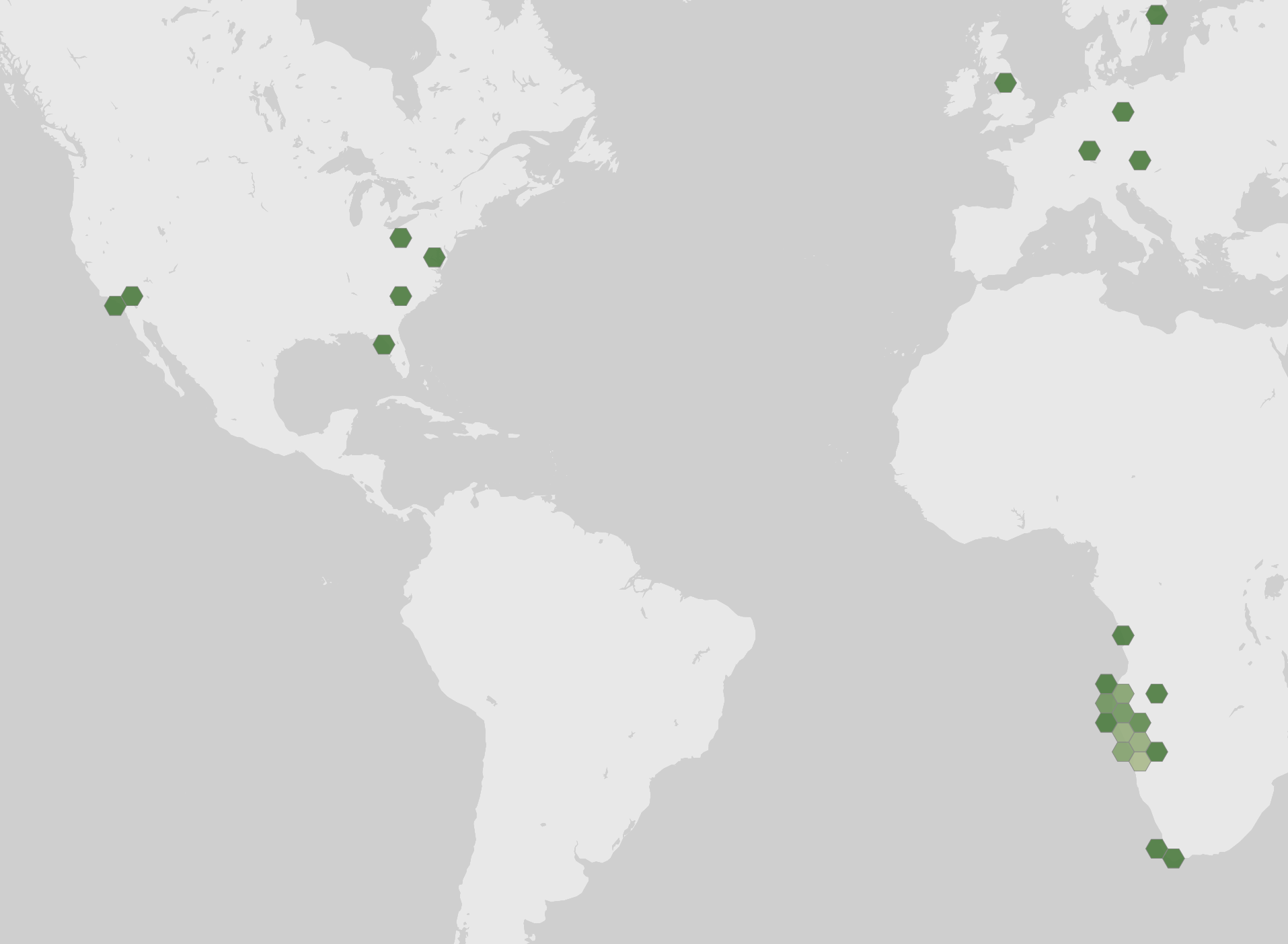
Welwitschia mirabilis is endemic to a narrow strip of the Namib Desert, with a range stretching over 1,000 km (620 mi) along the coast of Angola and Namibia, roughly between the 14th and 24th southern parallels. Rainfall in this zone is extremely scarce: the coast itself receives almost none, while areas below the escarpment get less than 100 mm (3.9 in) annually, concentrated in a wet season running from February to April.
Populations tend to cluster around ephemeral water sources, a pattern that points to a reliance on groundwater as well as fog moisture in addition to the sparse seasonal rain. This dependence on hidden or intermittent water, rather than reliable surface rainfall, largely explains why the species is confined to such a specific and limited stretch of desert.
Monthly observation records for the species show counts ranging from around 62 to 120 sightings, with a peak in December and comparatively lower numbers from January through April. Since these figures represent presence observations rather than measures of abundance or population size, the pattern is best read cautiously as a hint of seasonal visibility or survey activity rather than proof of a true seasonal cycle in the plant itself.
Uses and Human Relationships
Among the Herero people of Namibia, Welwitschia carries the name onyanga, meaning "onion of the desert," and the plant is regarded as a symbol of resilience and longevity, an emblem of endurance in an unforgiving landscape. Its cultural weight is visible well beyond botany: it is a persistent, gnarled presence in local identity, tied to the plant's ability to thrive on fog and sparse rain rather than dependable rainfall.
Indigenous communities have also used the plant directly for food, occasionally eating its cones raw or baking them in hot ashes. Beyond subsistence use, Welwitschia holds national symbolic status, appearing on the coat of arms of Namibia growing out of a sand dune.
The species also has a presence in horticulture and seed trade. Its seeds are known to be "orthodox," meaning they tolerate long-term storage across extreme conditions, surviving temperatures as high as 80 degrees Celsius (176 degrees Fahrenheit) and as low as minus 20 degrees Celsius (minus 4 degrees Fahrenheit), which makes them viable for specialty seed dealers to collect, store, and sell to growers.
Conservation and Threats
The wild population of Welwitschia mirabilis is described as reasonably stable, and the species is not considered immediately threatened, with abundant populations spread across a large area. International trade in the plant is regulated under CITES, reflecting concern over collection pressure even where wild numbers remain healthy.
Despite this relative stability, the species' long-term security is far from guaranteed. Its recruitment and growth rates are naturally low, and its entire range, though wide, is confined to a single, ecologically narrow and vulnerable desert belt. The plant's remarkable longevity helps it ride out periods unfavorable for reproduction, but that same longevity offers no defense against direct threats such as overgrazing.
The most serious threats, in rough order of severity, include fungal infection of female cones by Aspergillus niger, which sharply reduces seed viability and compounds the species' already low recruitment; overgrazing by zebras, rhinos, and domestic livestock; damage from off-road vehicles; and the collection of wild plants. Interestingly, populations in Angola tend to be better protected than those in Namibia, largely because a high concentration of land mines left over from the Angolan Civil War has restricted human access to the area.
Fun Facts
- The species was documented in 1859 by the Austrian botanist Friedrich Welwitsch, who was reportedly so struck by his discovery in the Namib Desert that he knelt beside the plant and simply stared at it.
- One book on the species is literally titled The Ugliest Plant in the World: The Story of Welwitschia mirabilis, a nod to its bizarre, tangled appearance.
- The Welwitschia bug (Probergrothius angolensis) is a frequent visitor to the plant but is not particularly drawn to its nectar and likely does not act as a pollinator.
- Pollination is carried out mainly by flies attracted to nectar produced by the cones, with wasps and bees occasionally playing a minor role.
- Welwitschia is the only living genus in its family and order, and it is one of just three surviving genera of gnetophytes worldwide, alongside Gnetum and Ephedra.
Photos
Photographs from via iNaturalist, licensed under CC0 1.0., by Michel Langeveld via iNaturalist, licensed under CC BY 4.0., by Vladislav Isaev via iNaturalist, licensed under CC BY 4.0., by timharris via iNaturalist, licensed under CC BY 4.0., by Clive Freedman via iNaturalist, licensed under CC BY 4.0., by Alain Le Magueresse via iNaturalist, licensed under CC BY 4.0., and by Kristof Zyskowski via iNaturalist, licensed under CC BY 4.0., credited on each photo.
Ecology and classification
Classification
- Phylum
- Tracheophyta
- Class
- Gnetopsida
- Order
- Welwitschiales
- Family
- Welwitschiaceae
- Genus
- Welwitschia
- Species
- Welwitschia mirabilis
Sources
- GBIF Species names and classification
- iNaturalist Photos
- Wikidata Common names and conservation status
- Wikipedia Summary extract