First described by Carl Linnaeus in 1753, Hydnum repandum is the type species of an entire genus, making it something of a botanical namesake for all the toothed fungi that followed. Known by a cluster of common names, including sweet tooth, pig's trotter, and wood hedgehog, this mushroom belongs to the family Hydnaceae within the order Cantharellales.
The wood hedgehog carries an IUCN status of Least Concern globally, though it grows in oak, coniferous, and deciduous forests across Europe and parts of North America. Its unassuming cap and stem hide an easy identifying trick underneath, one that separates it from nearly every gilled mushroom or bolete sharing the forest floor.
Fruiting Body and Identification
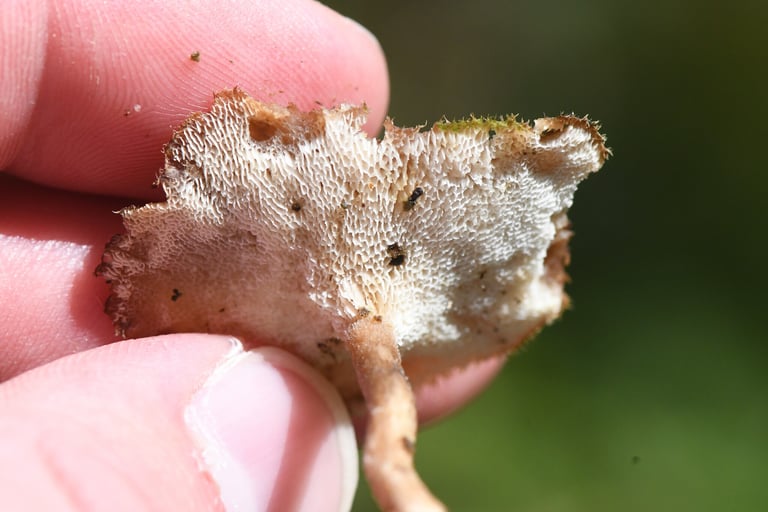
The single most reliable identifying feature of Hydnum repandum lies on its underside: instead of gills or pores, it bears dense, slender whitish spines measuring 2 to 7 millimeters long, sometimes running partway down the stipe. This spined surface, easy to miss unless the mushroom is turned over, is what separates it from the gilled mushrooms and boletes it often grows alongside.
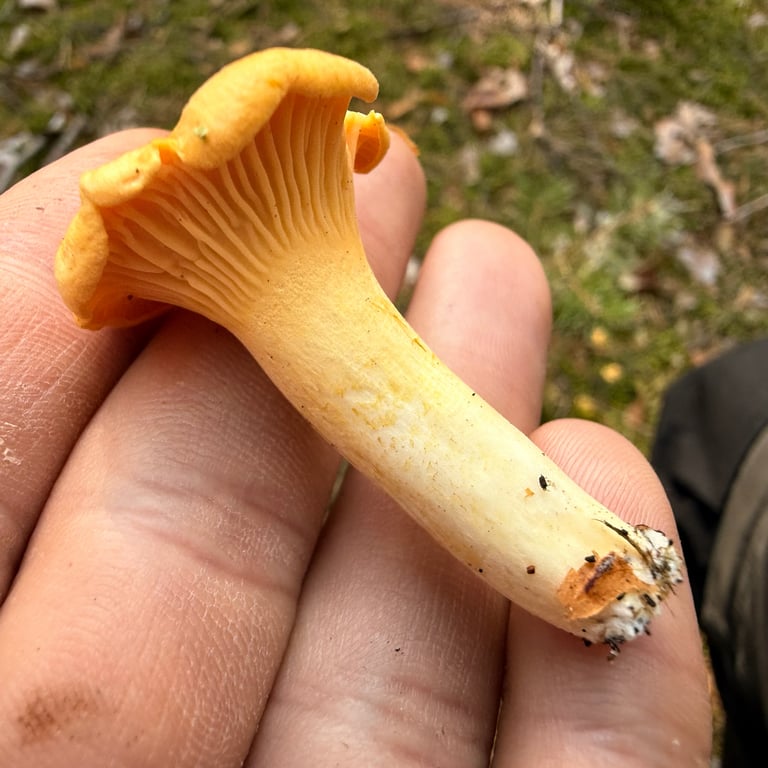
The cap, colored orange, yellow, or tan, reaches up to 17 centimeters wide, with exceptional specimens documented at 25 centimeters. It is irregular in shape, convex or concave at maturity, with a wavy margin rolled inward when young; crowded clusters produce distorted caps that can resemble chanterelles when viewed from above. The surface is typically dry and smooth, though older caps may crack. Beneath it, the flesh is thick, white, firm, and brittle, bruising yellow to orange-brown where damaged.
The stipe measures 3 to 10 centimeters long and 1 to 3 centimeters thick, colored white or matching the cap, and is sometimes off-center. A pure white variety, H. repandum var. album, is notably smaller, with a cap only 2 to 7 centimeters wide. The spore print is pale cream, and the spherical to broadly egg-shaped spores measure 5.5 to 7.5 by 4.5 to 5.5 micrometers, usually containing a single large oil droplet. The fruity aroma comes from eight-carbon compounds such as 1-octen-3-ol.
Distribution and Habitat
Hydnum repandum forms mycorrhizal partnerships with tree roots, most notably oaks, which shapes where it can grow. Fruit bodies appear singly, scattered, or in groups on the ground and in leaf litter of both coniferous and deciduous forests, occasionally arranged in fairy rings, with fruiting occurring from summer to autumn.
The species is widely distributed across Europe, where conservation assessments vary by country: it is listed as vulnerable in the Netherlands, Belgium, and Germany, but of Least Concern in Sweden. In North America, it occurs in the Pacific Northwest, the Rocky Mountains, and alongside oaks in eastern regions, though it is absent from Canada, where two related species, H. washingtonianum and H. subolympicum, take its place.
Monthly observation data show a pronounced late-summer to early-autumn peak, with counts climbing sharply from July through September before tapering off by November. As presence records rather than abundance measures, these figures point to a strong seasonal fruiting window rather than year-round activity.

Uses and Cultural History
Hydnum repandum has a long-standing place at the table, particularly in French and Germanic culinary traditions, where it is sold under the French name pied-de-mouton, meaning sheep's foot. Its sweet, nutty taste and crunchy texture have earned comparisons to the chanterelle, and mycologist Michael Kuo rates it as "great," citing the absence of poisonous lookalikes and its low likelihood of maggot infestation.
Cooks prepare it by pickling, simmering in milk or stock, or sautéing, methods that bring out a tender, meaty texture and mild flavor reminiscent of watercress or oysters. The mushroom absorbs added flavors well and holds its firm texture after freezing, though older specimens or those found under conifers can taste bitter or unpleasantly strong; boiling reportedly removes bitterness in most cases. A locally common form in Slovakia, forma amarum, is considered inedible because of a bitterness present throughout its development.
Commercially, the species is frequently sold alongside chanterelles in Italian markets and is one of the officially recognized edible mushrooms sold in French markets. Beyond human use, the mushroom also serves as a food source for the red squirrel (Sciurus vulgaris).
Fun Facts
- Hydnum repandum has a documented history in European gastronomy, especially in French and Germanic food culture, where it has been eaten under the name Pied de Mouton for centuries.
- Its regular appearance in seasonal meals reflects how pre-modern forest communities relied on wild fungi for sustenance, even without any mystical significance attached to the species.
- Among the Zapotec people of Ixtlán, Hydnum repandum is one of eighteen folk fungal categories recognized as deeply rooted in local mycological traditional knowledge, alongside species like Cantharellus cibarius and Laccaria vinaceobrunnea.
Conservation status
- LC
- NT
- VU
- EN
- CR
Least Concern
Ecology
Habitat
- Forest