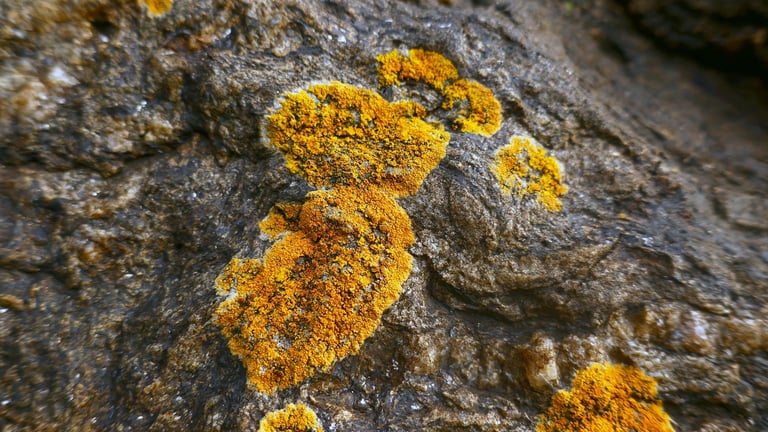
Most lichens vanish from polluted, nitrogen-rich air, but Xanthoria parietina does the opposite: it flourishes on gravestones, city walls, and roadside trees precisely where pollution and nutrient runoff are heaviest. This tolerance has made the species, commonly called the yellow wall lichen, common orange lichen, or maritime sunburst lichen, one of the most conspicuous lichens in the world.
It belongs to the fungal family Teloschistaceae, within the class Lecanoromycetes, and forms the classic lichen partnership between a fungus and a photosynthetic alga. First described by Carl Linnaeus in 1753, it has since become one of the most intensively studied lichens on Earth, serving as a model organism for research into lichen genetics, physiology, and pollution tolerance. Its bright, variable coloring and its ability to colonize almost any hard surface make it a familiar and rewarding species to observe up close.
Fruiting Body and Identification
The most reliable field mark is the thallus itself: a foliose (leafy), rosette-forming body usually under 8 centimeters across, built from small, flattened, overlapping lobes 1–4 millimeters wide (occasionally up to 7 millimeters). Color is highly variable and environmentally driven, ranging from bright orange in full sun to greenish-yellow in shade, since the cortex thins in shaded sites to protect the light-sensitive algal partner beneath it. The lower surface is white, corticate, and anchored by sparse pale rhizines or hapters rather than a dense root-like network.
Xanthoria parietina lacks the soredia or isidia (powdery or knob-like vegetative propagules) that many lichens use for asexual spread, relying instead on sexual reproduction through apothecia, disc-shaped fruiting bodies. These form 2–4 millimeters behind the growing edge of the thallus and take 12–18 months to mature, eventually reaching 1.5–2.6 millimeters across (rarely up to 4.3 millimeters). In humid conditions a mature apothecium can release spores at rates of up to 50 per minute. The ascospores are colorless, ellipsoid, 13–16 by 7–9 micrometers, and polarilocular, meaning each spore is split into two chambers by a central, perforated septum 3–8 micrometers wide.
Two closely related species are easily confused with it. Xanthoria aureola, once treated as the same species, has a thicker thallus, narrower lobes, and a rough, crystal-studded surface, and it favors seashore rock rather than the varied substrates X. parietina colonizes. Xanthoria calcicola is duller orange-yellow, also rough and crystalline, bears coarse isidia-like projections, produces fewer apothecia, and sticks to calcareous stone rather than bark. In both lookalikes, the presence of surface crystals and a rougher texture are the clearest distinguishing features from the smoother, brighter X. parietina.
Distribution and Habitat
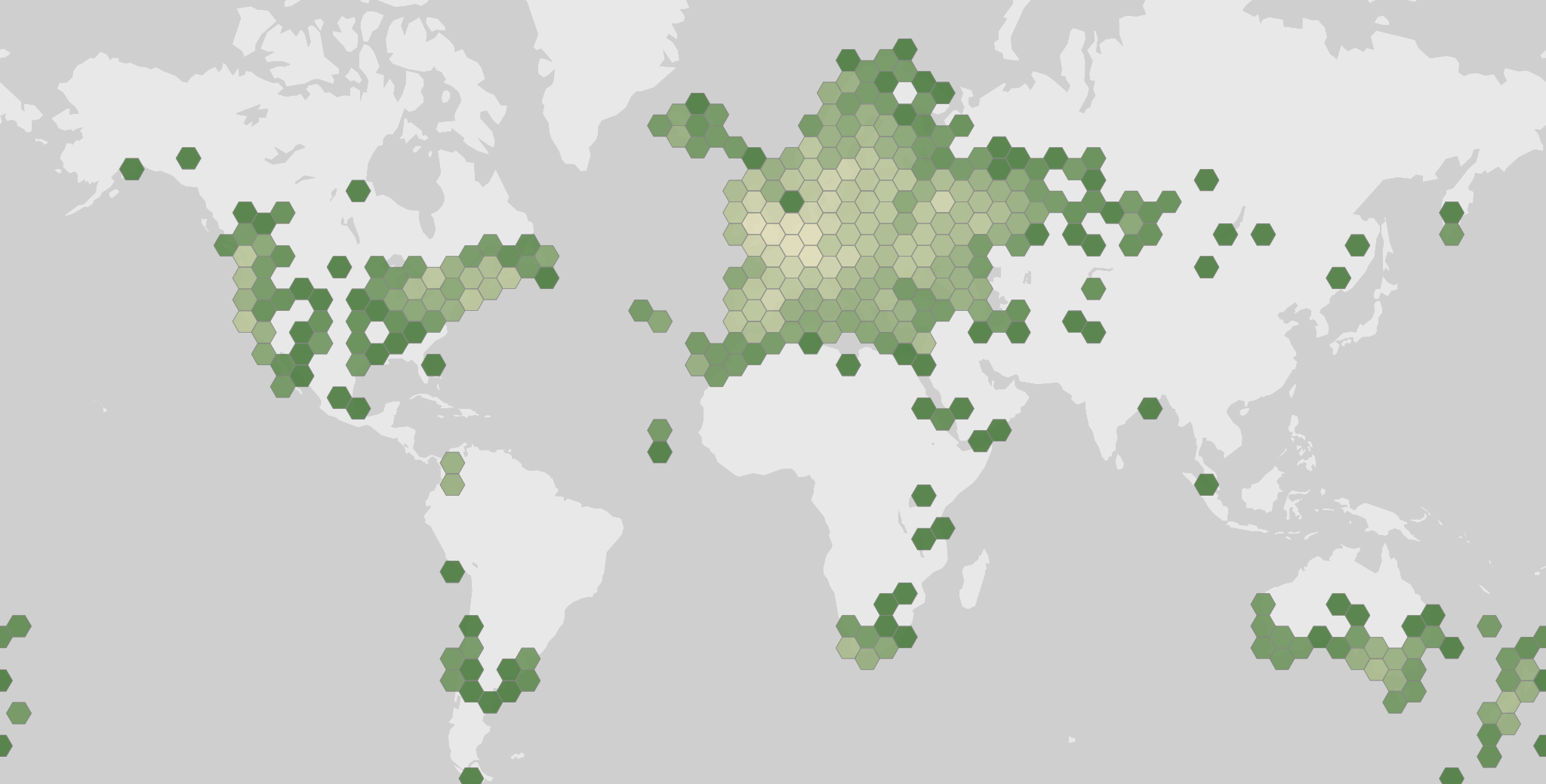
Xanthoria parietina is cosmopolitan, recorded across Australia, Africa, Asia, North America, and much of Europe, and it shows a strong preference for coastal habitats where marine aerosols supply chloride and sodium. In Maine, for example, it is abundant on gravestones near the ocean but becomes rare beyond 40 kilometers inland in the southwest and 130 kilometers inland in the east, with open, wind-exposed cemeteries hosting far more of the lichen than sheltered, wooded ones.
In North America the species was historically confined to coastal strips: the Atlantic coast from Newfoundland to Pennsylvania, the Pacific coast from California to the Pacific Northwest, and a small Gulf coast pocket in Texas. Since the early 2000s it has also turned up in inland cities in Idaho, Washington, and western Montana, almost always on planted ornamental trees in arboretums and parks, pointing to human-assisted spread through the nursery trade rather than natural dispersal. A similar inland resurgence has been documented in southern Ontario, where increased agricultural nitrate runoff and decades of roadside salt use may mimic the chemistry of a coastal environment.
Beyond coastlines, the lichen also grows in hardwood forests within low-elevation valleys and on Populus and other hardwoods along riparian corridors in farmed and populated land. Monthly presence observations peak in spring, from roughly 22,000 in January to nearly 28,000 in April, before declining through summer into a lower, steadier level from September onward; as presence records rather than abundance counts, this pattern most likely reflects seasonal detectability and observer activity rather than the lichen's true population size.
Ecology and Relationships
Xanthoria parietina is a poikilohydric organism, meaning it has no roots or stomata and instead absorbs ambient moisture directly through its thallus. When humidity falls, it suspends photosynthesis and enters dormancy, resuming activity only when moisture returns; this explains why growth and reproduction are concentrated in humid periods and why continuously wet climates support faster thallus expansion. Its physical form shifts with conditions: thalli in moist stream beds grow semi-erect and orange-yellow, while those on dry, sun-exposed rock are compact and darker, an environmentally induced plasticity rather than a genetic difference.
As a nitrophilous species, it thrives on nutrient enrichment, becoming especially abundant near bird perches, agricultural runoff, and atmospheric nitrogen deposition. Moderate nutrient input boosts growth, though very high levels eventually suppress it; in areas where several nitrogen-loving lichens compete, X. parietina often starts as a co-dominant colonizer before its greater pollution tolerance lets it become dominant as habitats become more altered.
On rock, the lichen anchors itself with hyphae from its lower cortex rather than rhizines, penetrating fissures in soft, calcareous stone such as calcarenite to a depth of 1–2 millimeters and contributing to mineral breakdown, while on harder andesite it stays surface-bound and causes mostly mechanical rather than chemical weathering.
Uses and Cultural History
People have used Xanthoria parietina medicinally for centuries, though these are historical folk remedies rather than treatments with modern clinical support. In Andalucia, Spain, it was known as flor de piedra ("stone flower") or rompepiedra ("stone breaker") and prepared as a wine decoction for menstrual complaints, as water decoctions for kidney disorders and toothaches, as a general analgesic, and mixed into cough syrups. In early modern Europe it was boiled with milk, alongside Polycauliona candelaria, to treat jaundice, following the Doctrine of Signatures, the belief that a plant's yellow-orange color signaled its power against the skin's yellowing. In Traditional Chinese medicine it was called shí huáng yī ("stone yellow clothes") and used for its supposed antibacterial properties. By around 1800, most such medicinal uses of lichens, including this one, had fallen out of practice.
Its longer-lasting legacy is as a dye source. Ancient Assyrian texts, analyzed by Reginald Campbell Thompson in 1934, describe the "yellow wall lichen" as giving "a good yellow or orange colour, if fixed with alum," suggesting the alum-mordant technique was known in ancient Mesopotamia. The pigment responsible, parietin, produces different colors depending on extraction method: boiling water yields golden-brown, yellow, and caramel tones, 10% ammonia fermentation yields purplish-pink, orange, and pink shades, and sunlight-driven photo-oxidation in an alkaline solution can extract blue or purple. Alum remains the most effective mordant, chemically bonding the dye to fibers for lasting, wash-resistant color.
More recently, research has turned to parietin itself, which acts as a natural photoprotective compound shielding the lichen from intense light. Scientists have also explored its use in the green synthesis of silver nanoparticles with antimicrobial properties, extending this lichen's practical history from ancient dye vats to modern nanotechnology.
Conservation and Threats
No IUCN conservation status has been established for Xanthoria parietina, and the available evidence points to a species that is stable or expanding rather than declining. Genetic studies show high diversity within local populations, with up to 90% of genetic variation occurring within rather than between populations, giving the species a broad genetic toolkit for adapting to pollution, climate shifts, and new substrates.
At larger scales, a global RAPD-PCR study found only two major genetic clusters worldwide: one confined to southwestern Europe (Iberian Peninsula, Balearics, Canary Islands) and another spanning Europe, North America, Australia, and New Zealand. The close genetic similarity between European and Southern Hemisphere populations indicates the species was carried there by human activity, possibly via grapevine transport or ship ballast stones, and a similar human-assisted introduction has been proposed for populations in Oregon's Willamette Valley and inland Ontario, where the lichen may have arrived on nursery trees.
Rather than facing habitat loss, X. parietina appears to be actively colonizing new territory through horticultural trade, making it one of the few lichens documented as demonstrably invasive outside its native range. Its genetic structure also differs markedly from that of its algal partner, Trebouxia decolorans, hinting that pairing with locally adapted algae helps the fungus establish in varied environments. No dedicated conservation programs are described for this species, consistent with its wide range and apparent resilience.
Fun Facts
- Xanthoria parietina was first described by Carl Linnaeus in 1753 and has since become one of the most thoroughly studied lichens in science.
- Although it is homothallic (self-fertile), genetic studies show it frequently mates with other individuals anyway, a reproductive pattern researchers call "unisexuality."
- A single apothecium can release up to 50 spores per minute under humid conditions, but takes 12 to 18 months to mature in the first place.
- Ancient Assyrian tablets analyzed in 1934 describe using this lichen with alum to dye cloth yellow or orange, suggesting the technique was known in Mesopotamia thousands of years ago.
- Early modern European healers boiled it with milk to treat jaundice, reasoning that its yellow-orange color must cure the yellowing of jaundiced skin.
- Genetic evidence suggests the lichen reached Australia and New Zealand from Europe through human activity, possibly hitching a ride on grapevines or ship ballast stones.
- Despite sharing a strikingly similar look, its close relatives Xanthoria aureola and Xanthoria calcicola can be told apart by their rougher, crystal-flecked surfaces and different rock or shoreline preferences.
Photos
Photographs from by Xavier JAPIOT via iNaturalist, licensed under CC BY 4.0. and via iNaturalist, licensed under CC0 1.0., credited on each photo.
Ecology and classification
Classification
- Phylum
- Ascomycota
- Class
- Lecanoromycetes
- Order
- Teloschistales
- Family
- Teloschistaceae
- Genus
- Xanthoria
- Species
- Xanthoria parietina
Sources
- GBIF Species names and classification
- iNaturalist Photos
- Wikidata Common names and conservation status
- Wikipedia Summary extract