Xylaria hypoxylon glows faintly in the dark, one of the relatively few fungi known to be bioluminescent. This trait, combined with its odd, branching shape, has earned it a long list of common names: candlestick fungus, candlesnuff fungus, carbon antlers, and stag's horn fungus.
It belongs to the family Xylariaceae, within the order Xylariales and the phylum Ascomycota, placing it among the sac fungi rather than the mushroom-forming Basidiomycota. Its blackened, upright fruiting bodies make it one of the more recognizable small fungi found on rotting wood, and its unusual combination of antler-like form and glow-in-the-dark biology makes it a rewarding species to look for at ground level in any wooded area.
Fruiting Body and Identification
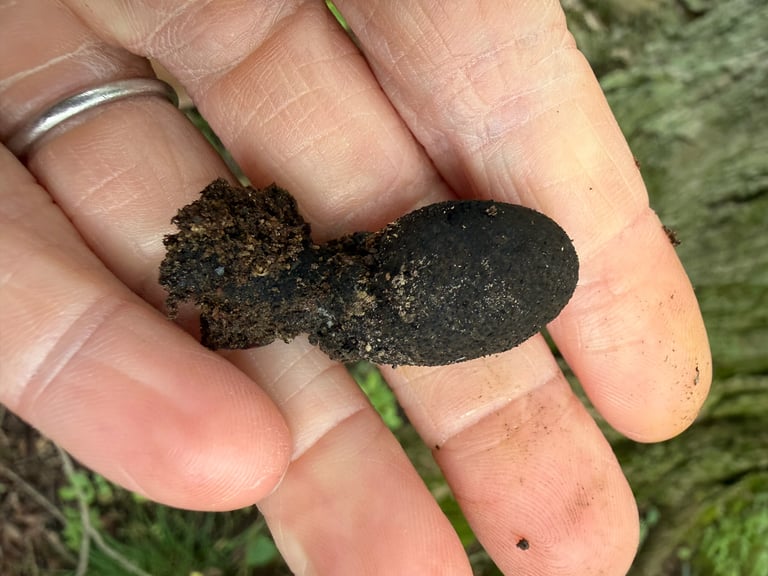
The fruiting bodies (ascocarps) are the most reliable way to recognize Xylaria hypoxylon: erect, cylindrical to flattened structures 3–8 centimeters tall and only 2–8 millimeters thick, often twisted or bent and sparsely branched into a shape resembling a stag's antlers.
Appearance changes markedly with the season. Specimens collected in spring may be covered entirely in a white to grayish powdery coating, made up of asexual spores called conidia. Later in the year the mature ascocarp turns charcoal-black and develops minute pimple-like bumps called perithecia across its surface. These are tiny spore-producing chambers, each with a small pore, or ostiole, through which sexual spores (ascospores) are released. The perithecia sit embedded in the stroma, the tough, elastic, white internal flesh of the fruiting body.
Microscopically, the asci measure about 100 by 8 micrometers. The ascospores themselves are kidney-shaped, black, and smooth, measuring 10–14 by 4–6 micrometers, while the asexual mitospores are smooth, ellipsoid, and colorless (hyaline).
Several related Xylaria species can be mistaken for this one, most notably Xylaria polymorpha, which is thicker-bodied and branches far less than X. hypoxylon.
Distribution and Habitat
Xylaria hypoxylon grows in clusters on decaying hardwood, appearing directly on rotting logs, stumps, and buried wood debris. It is also known to cause root rot in living hawthorn and gooseberry plants, showing that it can act beyond simple deadwood decay in some hosts.
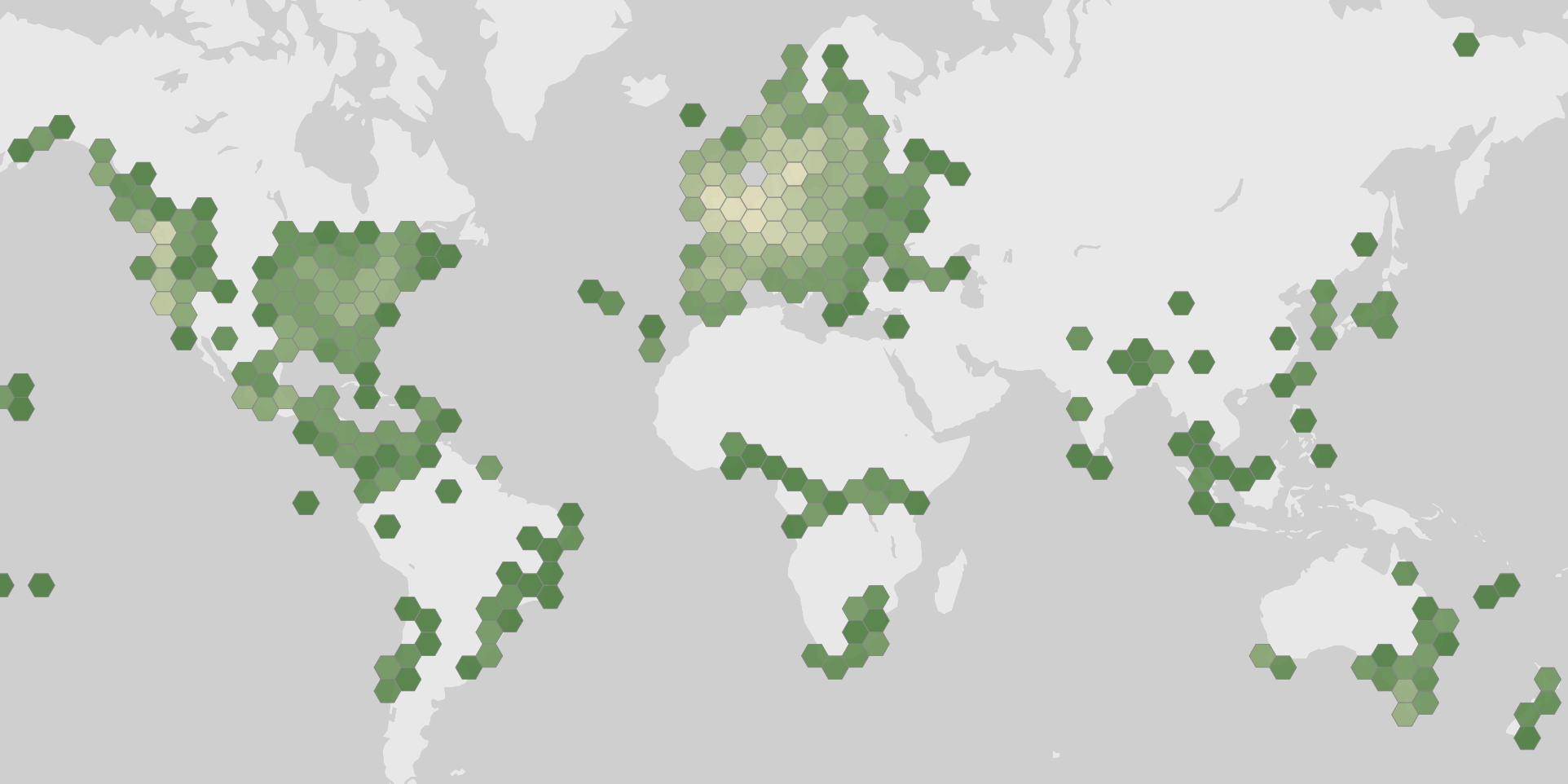
Observation records show a strong seasonal pattern, with reported sightings rising sharply from a late-summer low in July and August to a pronounced peak in September through November, before tapering off again in winter. This pattern likely reflects when the fruiting bodies are most visible and actively producing spores, rather than year-round abundance. As the accompanying data are presence records rather than population counts, they indicate where and when the fungus has been noticed, not how common it is or the full extent of its range.
Fun Facts
- Xylaria hypoxylon is bioluminescent, one of a limited number of fungi known to glow.
- Its many common names — candlestick fungus, candlesnuff fungus, carbon antlers, and stag's horn fungus — all describe the same antler-like, blackened fruiting body.
- Chemical studies of cultures of Xylaria hypoxylon (strain AT-028) have identified new tetralone-derivative compounds produced by the fungus.
- Researchers have compared the cultural characteristics of X. hypoxylon with related species such as X. persicaria, X. magnoliae, and X. carpophila, including collections of X. hypoxylon with unusually small ascospores.
Photos
Photographs from via iNaturalist, licensed under CC0 1.0., by Chline River via iNaturalist, licensed under CC BY 4.0., by Markus Krieger via iNaturalist, licensed under CC BY 4.0., by ncb1221 via iNaturalist, licensed under CC BY 4.0., by Rob Drake via iNaturalist, licensed under CC BY 4.0., by Sean Hartnett via iNaturalist, licensed under CC BY 4.0., by Frank Ashwood via iNaturalist, licensed under CC BY 4.0., by Ondřej Křivan via iNaturalist, licensed under CC BY 4.0., by Cara Ennis via iNaturalist, licensed under CC BY 4.0., and by Noah How via iNaturalist, licensed under CC BY 4.0., credited on each photo.
Ecology and classification
Classification
- Phylum
- Ascomycota
- Class
- Sordariomycetes
- Order
- Xylariales
- Family
- Xylariaceae
- Genus
- Xylaria
- Species
- Xylaria hypoxylon
Sources
- GBIF Species names and classification
- iNaturalist Photos
- Wikidata Common names and conservation status
- Wikipedia Summary extract