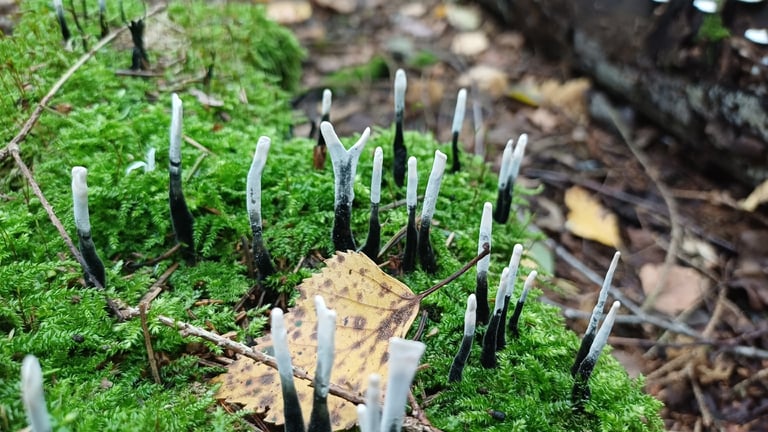
Rising from rotting stumps like blackened, skeletal fingers clawing out of the earth, Xylaria polymorpha earns its common name, dead man's fingers, through sheer visual shock. Its clavate, upright stromata push through soil and wood in clusters, often fused at the base, giving the unsettling impression of a buried hand reaching for the surface.
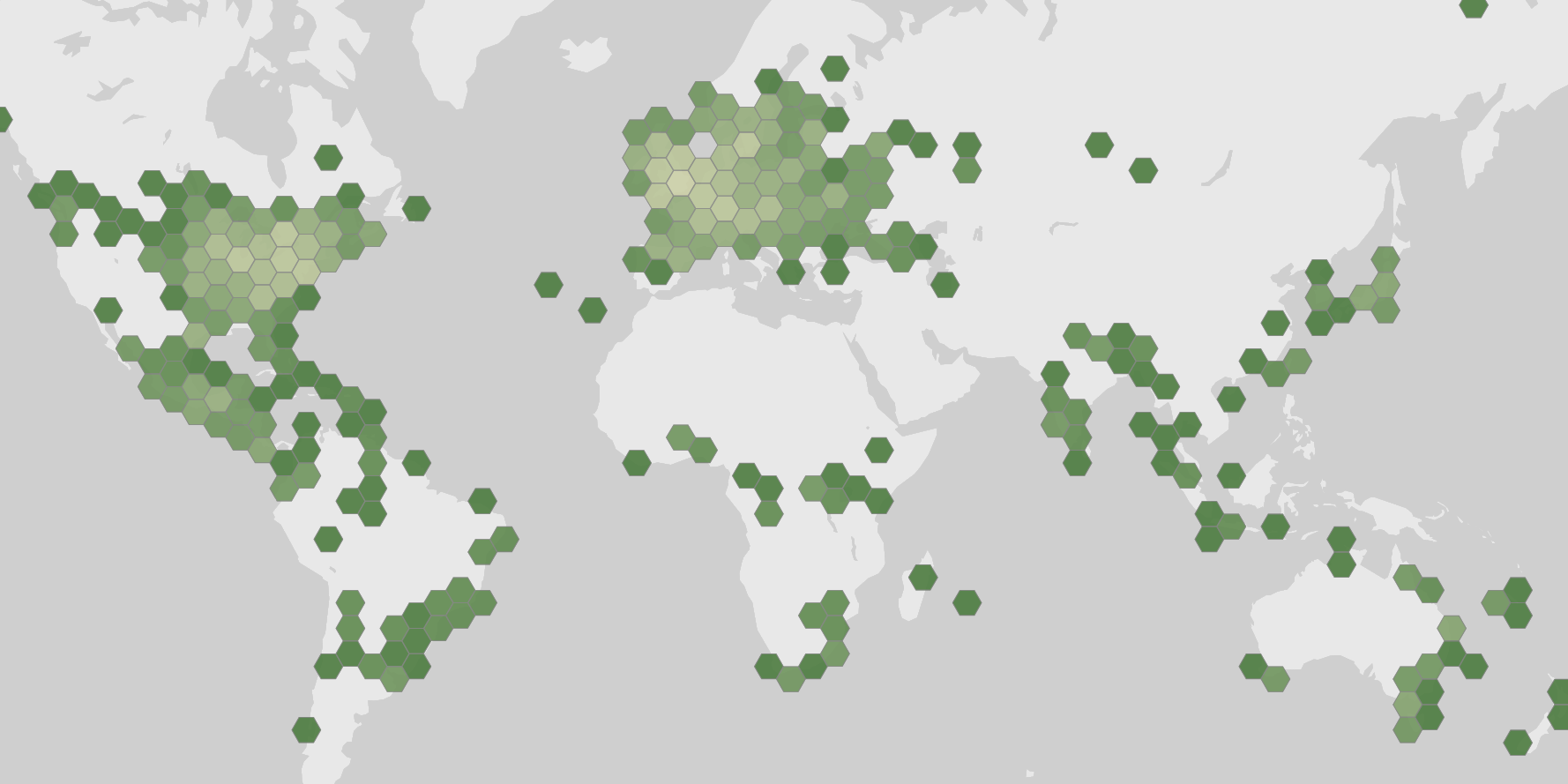
This is a cosmopolitan saprobic fungus in the phylum Ascomycota, found across all six inhabited continents wherever forests and woodlands provide dead or dying wood to break down. No conservation status has been assessed for it, and none is needed: it is common and widespread. What makes it worth a second look is less its biology than its uncanny appearance, an organism that turns the ordinary process of decay into something almost theatrical.
Fruiting Body and Identification
The most reliable way to recognize Xylaria polymorpha is by its stromata: upright, club-shaped or strap-like structures that can grow 3 to 10 centimeters tall, often standing in loose clusters of separate "digits" that sometimes fuse together at their bases. Externally the stromata are black or brown, occasionally tinged with blue or green, while the interior flesh is solid white.
A blackened, dotted zone covers the outer surface, formed by tiny flask-shaped structures called perithecia embedded just beneath the surface. Each perithecium holds a layer of asci, the sac-like cells characteristic of the Ascomycetes, which contain the fungus's ascospores. These asci elongate through a small pore called the ostiole to discharge spores outward, a process that can stretch out over several months rather than happening all at once. The spore print left by mature specimens is black.
In springtime, the fruiting bodies often develop a secondary coating: a layer of white or pale bluish asexual spores called conidia, spread across the surface and surrounding area before the blackened sexual stage takes over. As the stromata age, this pale bloom fades and the surface darkens further, deepening the resemblance to weathered, blackened fingers.
Unlike some of its relatives among the sac fungi, Xylaria polymorpha is inedible, a detail worth knowing even though it plays no role in helping identify the species from its shape alone.
Distribution and Habitat
Xylaria polymorpha occurs on every inhabited continent, making it one of the more widely distributed wood-decay fungi in temperate and subtropical regions alike. It is a common sight in forests and woodlands, almost always growing from the base of rotting or injured tree stumps and other decaying wood.
Beyond typical timber, the species has also been recorded colonizing less obvious substrates, including woody legume pods, petioles, and herbaceous stems, showing some flexibility in what dead plant material it will break down.
Observation records collected through the year show a clear rise from a low base in the winter months toward a pronounced peak in late summer, with counts climbing sharply from June through September before falling off again by November. Because these figures represent presence observations rather than a measure of abundance or the fungus's complete range, they should be read as an indication of when the stromata are most visible and being reported, most likely in late summer and early autumn, rather than as a population count.
Uses and Cultural History
The name "dead man's fingers" itself is the fungus's main cultural legacy, drawn directly from the eerie resemblance between its blackened, upright stromata and decomposing human digits emerging from soil or rotting wood. That imagery has made the species a recurring symbol of death and decay in popular culture.
In contemporary media, Xylaria polymorpha shows up regularly in Halloween-themed content and horror depictions, cast as an eerie, almost zombie-like presence pushing up from the ground. This decorative, symbolic use has outpaced any practical or culinary application, since the fungus itself is not eaten.
Fun Facts
- The common name "dead man's fingers" comes directly from the fungus's resemblance to blackened, skeletal human digits pushing up through soil or rotten wood.
- Folklore surrounding the fungus, sometimes called "witches' fingers," claimed it could summon spirits or grant wishes, and some tales cast its stromata as the wands used by witches to cast spells.
- Its macabre look has made it a recurring prop in Halloween decorations and horror-themed media, where it is often portrayed as an eerie, zombie-like growth.
- Xylaria polymorpha is a cosmopolitan species, turning up on decaying wood across all six inhabited continents.
Photos
Photographs from via iNaturalist, licensed under CC0 1.0., by Kevin via iNaturalist, licensed under CC BY 4.0., by Shaldon Wildlife Trust via iNaturalist, licensed under CC BY 4.0., by Ben Machado via iNaturalist, licensed under CC BY 4.0., by Michele Wiseman via iNaturalist, licensed under CC BY 4.0., by atchalmers via iNaturalist, licensed under CC BY 4.0., by Ondřej Křivan via iNaturalist, licensed under CC BY 4.0., and by Alexander Diaz via iNaturalist, licensed under CC BY 4.0., credited on each photo.
Ecology and classification
Classification
- Phylum
- Ascomycota
- Class
- Sordariomycetes
- Order
- Xylariales
- Family
- Xylariaceae
- Genus
- Xylaria
- Species
- Xylaria polymorpha
Sources
- GBIF Species names and classification
- iNaturalist Photos
- Wikidata Common names and conservation status
- Wikipedia Summary extract