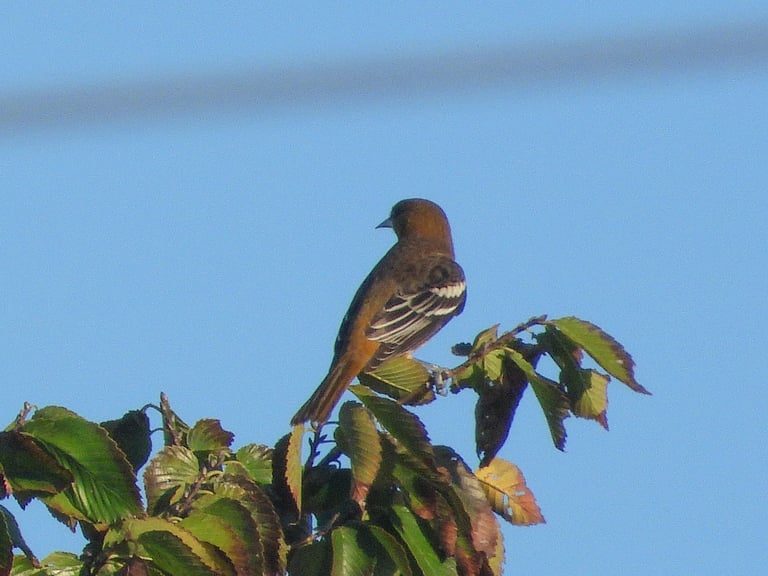
Male yellow-rumped caciques settle disputes over territory and mates not with talons but with song, matching each other's phrases until one contender falls silent and concedes defeat.
The yellow-rumped cacique is a passerine of the New World blackbird family Icteridae, breeding across much of northern South America from Panama and Trinidad south to Peru, Bolivia, and central Brazil, with occasional sightings as far north as Nayarit, Mexico. The IUCN lists it as Least Concern. Beyond its striking plumage, the species stands out for its complex colonial life, where size, song, and nest placement all shape who gets to breed.
Identification and Appearance
The most useful field mark is the combination of glossy black plumage with a bright yellow rump, tail base, lower belly, and wing "epaulets," paired with pale blue eyes and a pointed, pale yellow bill.
Males average 28 centimeters long and weigh about 104 grams, considerably larger than females, which average 23 centimeters and roughly 60 grams. This size difference underlies much of the species' social behavior, since larger males tend to dominate smaller rivals.
Females are duller black than males, while juveniles resemble females but can be told apart by their dark eyes and brown-based bill, contrasting with the blue eyes and yellow bill of adults.
The male's song, a mixture of fluting notes, cackles, wheezes, and sometimes mimicry, is itself a helpful identification aid, and an active colony can be heard from a considerable distance.
Distribution and Habitat
The yellow-rumped cacique favors forest edges rather than deep interior forest, an "edge" species drawn to borders near open fields, lakes, and cultivation. It nests high in tree canopies or in dense shrubbery, typically at elevations from around 400 meters, and ranges across an area of roughly 8,570,000 square kilometers spanning temperate and tropical forest, rainforest, and scrub forest.
Because of its preference for open, disturbed edges, the species is often seen near towns and other areas of human activity, including suburban and estuarine settings.
Monthly presence observations show counts in the tens of thousands nearly every month, with somewhat higher figures in October and May, though these figures reflect observation effort and presence rather than true abundance or a complete picture of its range.

Behavior and Lifestyle
Yellow-rumped caciques live in colonies that can hold anywhere from 2 to 250 nests, with 40 to 100 typically active at once, usually concentrated in just one or two trees. This clustering creates an intensely social, arboreal lifestyle built around diurnal foraging and colony defense.
The species is polygynous, and males are territorial, with mating success tied directly to body size. Larger males win more females, and dominance is settled through counter-singing contests in which rivals match each other's songs until one loses.
Outside of breeding disputes, the birds forage gregariously, taking large insects such as beetles, caterpillars, crickets, grasshoppers, and katydids, along with spiders, nectar, and fruit. They are sedentary, remaining in the same general area year-round rather than migrating.
Communication
Song is the central channel of yellow-rumped cacique communication, used to attract mates, defend territories, and advertise status within the colony's dominance hierarchy. Males counter-sing to settle contests, matching each other's phrases until one fails to keep up and loses.
Songs develop in two stages, beginning with memorization within a few months of hatching and continuing into the first breeding season, but not fully crystallizing until the bird's third year. Colonies maintain 5 to 7 distinct song dialects that differ from those of neighboring colonies and shift over the course of the breeding season, letting members quickly recognize outsiders.
Beyond acoustic signals, the species also relies on visual, tactile, and chemical cues, fitting its highly social, colony-based life.
Recordings
call · Panama · radrat · Public domain
Diet and Nutrition
Yellow-rumped caciques are omnivorous, feeding adults on a mix of large insects and fruit, while nestlings receive a diet built almost entirely on arthropods. Grasshoppers, crickets, and katydids make up the bulk of what parents bring to the nest, supplemented by orb-weaver spiders.
Adults hunt through tree canopies for caterpillars and other invertebrates to meet their own protein needs, but they also turn heavily to fruit and nectar. Chupa-chupa fruit and figs are particular favorites, giving the species an important role as both insect predator and occasional fruit and nectar feeder within its forest-edge habitat.
Nesting and Breeding
Breeding runs for eight months, from July to February, during which males mate polygynously with multiple females while contributing no direct parental care beyond guarding the nest and territory. Access to females depends on male dominance, itself tied to size and success in counter-singing and physical contests that end with a clear winner and loser.
The colony builds its bag-shaped nests high in the canopy, often clustered in the same one or two trees, sometimes alongside an active wasp nest whose sting may deter predators. Females compete fiercely for the best nest sites near this protection, occasionally stealing materials or engaging in aerial grappling, though these female contests do not always end with a clear loser.
Each nest, 30 to 45 centimeters long and widened at the base, hangs from the end of a branch. Females lay a clutch of two dark-blotched pale blue or white eggs, incubating after the second is laid; hatching follows in about 13 to 14 days. Most nests successfully raise only one chick, which fledges after roughly 25 to 40 days, reaching a weight of about 50 to 88 grams before leaving the nest.
Females handle every stage alone, building, incubating, and feeding the young arthropods, while their own body mass fluctuates between 60 and 80 grams over the breeding cycle. Young birds reach sexual maturity at about two years old, by which time they have memorized most of the songs they will need for colony life.
Population and Ecological Role
Within its ecosystem, the yellow-rumped cacique takes part in a web of interactions with neighboring species. Giant cowbirds act as nest parasites, attacking both cacique nests and those of neighboring russet-backed oropendolas, though female cowbirds visit oropendola nests more often than cacique ones, suggesting the two host species may benefit from a mutualistic relationship in deflecting this pressure.
Where caciques nest on islands, their colonies can gain protection from terrestrial predators such as snakes through the presence of black caimans. The wasp species Stelopolybia fuscipennis has also been observed driving monkeys away from cacique nest colonies, offering another layer of defense for breeding birds sharing the same trees.
Conservation and Threats
The yellow-rumped cacique is classified as Least Concern by the IUCN Red List, reflecting its status as an abundant species across its habitat. It carries no special protective status under CITES or the US Federal List.
The species has, if anything, benefited from human activity: forest clearance and ranching have created more of the open, edge habitat it prefers, rather than threatening its numbers.
Cultural Significance
In Peruvian folklore, the yellow-rumped cacique is known as paucar, or specifically paucarcillo, "little paucar." A tale from Moyobamba tells of a rumor-mongering boy who always wore black pants and a yellow jacket; after he falsely accused an old woman who was secretly a fairy, she transformed him into this noisy, wandering bird. Its appearance is traditionally thought to augur good news.
Beyond folklore, the species holds a quieter place in human life along forest edges and towns: it provides no direct economic benefit, but its appetite for pest insects offers a measure of natural pest control, and many people simply enjoy listening to its elaborate songs.
Fun Facts
- Colonies often build their hanging nests in the same tree as an active wasp nest, likely gaining protection from predators in the process.
- Male dominance contests can include aerial grappling and face-to-face "shouting" matches, not just singing duels.
- In Peruvian folklore, the bird's call is considered a good omen, and it is known locally as paucarcillo, "little paucar."
Photos
Photographs from by Martha Lucia Ortiz-Moreno via iNaturalist, licensed under CC BY 4.0., via iNaturalist, licensed under CC0 1.0., by William Stephens via iNaturalist, licensed under CC BY 4.0., by Paulo Nogueira via iNaturalist, licensed under CC BY 4.0., by avocat via iNaturalist, licensed under CC BY 4.0., by Thomaz de Carvalho Callado via iNaturalist, licensed under CC BY 4.0., by Nicolas Olejnik via iNaturalist, licensed under CC BY 4.0., by Conrado Pável de Oliveira via iNaturalist, licensed under CC BY 4.0., and by Viktor via iNaturalist, licensed under CC BY 4.0., credited on each photo.
Ecology and classification
Classification
- Phylum
- Chordata
- Class
- Aves
- Order
- Passeriformes
- Family
- Icteridae
- Genus
- Cacicus
- Species
- Cacicus cela
Sources
- GBIF Species names and classification
- iNaturalist Photos
- Wikidata Common names and conservation status
- Wikipedia Summary extract
- Xeno-canto Audio recordings
- Animal Diversity Web Animal habitat, behavior and diet
- AVONET Bird mass, habitat, migration, diet and range size