
Aves · Cuculiformes
Common Cuckoo
Cuculus canorus
Least ConcernAlso known as: Common/Oriental Cuckoo, Common/oriental Cuckoo, Cuckoo, Cuckoo, Common Cuckoo, Eurasian Cuckoo
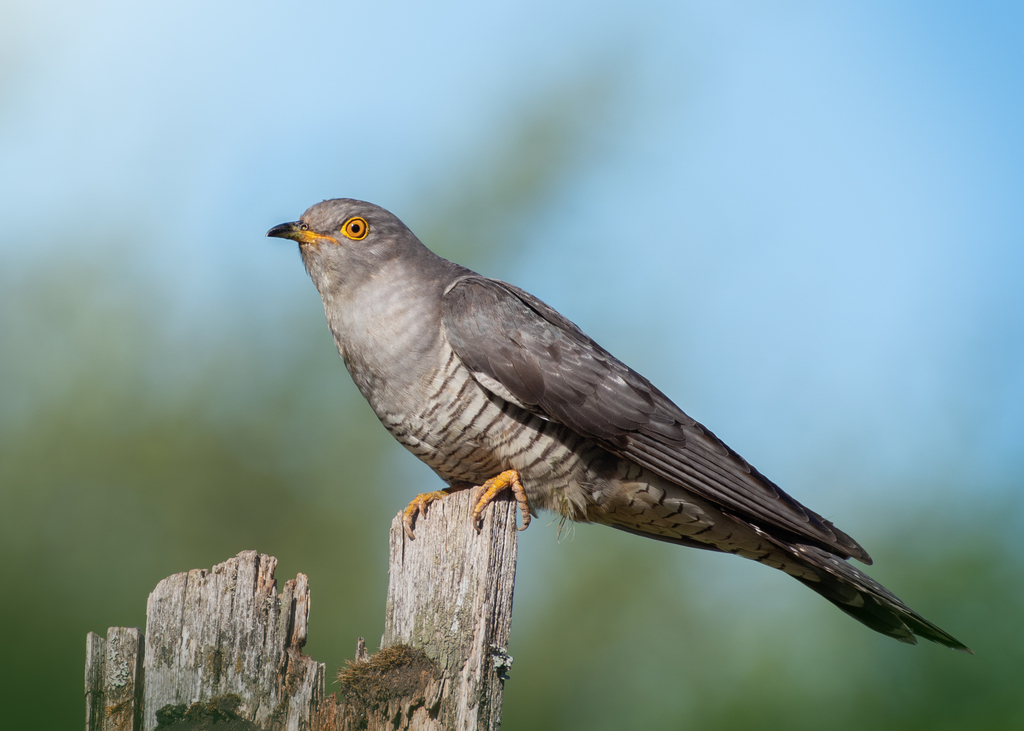
© vyatka · iNaturalist · CC BY-NC 4.0
The Cuculus canorus, or Common Cuckoo, is one of Europe’s most distinctive and enigmatic birds. Found across 18 countries and rated Least Concern by the IUCN, this medium-sized member of the Cuculidae family has captured human imagination for centuries—not through colourful plumage or complex song, but through a reproductive strategy so audacious it borders on the parasitic. The species epitomizes a life lived at the margins of conventional bird behaviour.
This brood-parasitic lifestyle makes the Common Cuckoo a biological anomaly—one that reveals the evolutionary arms race between predator and prey played out not through teeth and claws, but through camouflage, timing, and deception. The species’ success across such a wide range, and its persistence despite centuries of human persecution, speaks to the resilience of an evolutionary strategy refined over millions of years. Understanding the Common Cuckoo requires abandoning conventional notions of parenthood and accepting nature’s most unconventional reproductive tactics.
Identification and Appearance
The Common Cuckoo is a medium-sized bird measuring 32–34 cm from bill to tail, with a tail length of 13–15 cm and a wingspan of 55–60 cm. Despite these moderate proportions, the bird weighs only 110–111 grams, giving it a remarkably slender and lightweight build. The short legs are often concealed by plumage, making the bird appear even more elongated in silhouette.
In typical plumage, the Common Cuckoo has a greyish body with a long tail and pointed wings. Its overall shape and flight profile closely resemble a sparrowhawk, with regular, steady wingbeats that aid in its identification during flight. When perched, breeding birds characteristically adopt a distinctive posture: wings drooped and tail raised, a behavioural display that helps observers identify them in the field.
Colour variation
The species shows notable colour polymorphism, particularly among females. While most individuals display the standard grey morph, a rufous colour morph occurs occasionally in adult females, creating variation within populations that can complicate field identification. This plumage diversity reflects the species’ complex reproductive biology and long evolutionary history.
Distribution and Habitat
Cuculus canorus is found across a broad geographic range spanning Europe, North Africa, the Middle East, and into Asia. The species has been recorded in 18 countries, with the highest concentration of observations in Scandinavia and Western Europe. Finland and Sweden account for the majority of records, with 94 and 87 observations respectively, reflecting the species’ strong presence in northern European breeding grounds. Spain, France, Israel, and South Africa also host significant populations, while smaller numbers occur in Portugal, Albania, Morocco, India, and other regions.
The species exhibits a highly seasonal pattern of occurrence, with a marked peak in March when birds arrive on their breeding grounds in northern Europe. Records show 186 observations in March alone, compared to 26 in January and 88 in February, indicating rapid spring migration through February and into early March. After March, observations drop dramatically, suggesting the breeding season is concentrated in late spring and summer months when the birds occupy breeding territories away from major migration corridors where they are typically observed.
No elevation range data is currently available for this species. Cuculus canorus occupies diverse habitats across its range, from open woodlands and scrubland to cultivated areas and gardens, wherever suitable host birds for parasitism are present. The species’ distribution is determined largely by the presence of appropriate host species rather than specific habitat requirements, allowing it to exploit a wide variety of ecosystems across its continental range.
Biology and Behavior
Behavior
The common cuckoo is a solitary and secretive bird, spending much of its time perched quietly in trees or in dense vegetation. Males are highly vocal during breeding season, producing their distinctive two-note “cuckoo” call that echoes across open countryside and woodland edges. This call functions as territorial advertisement and is often repeated persistently from dawn through the day. Outside the breeding season, the birds are considerably quieter and more elusive.
Common cuckoos are strong, agile fliers adapted for long-distance migration. They winter in sub-Saharan Africa and migrate northward to breeding grounds across Europe, temperate Asia, and North Africa, covering thousands of kilometers each year. Males establish territories and remain relatively mobile within them, while females spend more time searching for suitable host nests in which to lay their eggs.
Diet
Common cuckoos feed primarily on insects, with a strong preference for caterpillars, especially those of lepidopterans (butterflies and moths). They also consume other invertebrates including beetles, grasshoppers, and occasionally small birds’ eggs. The birds forage by gleaning food from vegetation or catching prey in flight, moving methodically through shrubs and trees. Their diet becomes more diverse during migration and winter when they supplement with berries and other fruits.
Reproduction
The common cuckoo is an obligate brood parasite—it does not build nests or rear its own young. Instead, females lay single eggs in the nests of other bird species, primarily selecting smaller passerines such as reed warblers, dunnocks, and meadow pipits. A female may lay 12–25 eggs over a breeding season, each targeted at a different host nest. The cuckoo chick hatches before the host chicks and typically ejects them from the nest, monopolizing all parental care and food from the host pair.
Incubation of the cuckoo egg takes approximately 11–13 days, slightly shorter than many host species. The cuckoo chick remains in the nest for 17–21 days before fledging, during which time the foster parents work intensively to satisfy its enormous appetite. Fledged cuckoos remain dependent on their foster parents for a further 2–3 weeks. The entire system has evolved over millennia: host birds have developed egg-rejection behaviors and mimicry resistance, while cuckoos have evolved increasingly convincing egg mimicry and aggressive chick strategies to overcome these defenses.
Conservation and Threats
The Common Cuckoo is classified as Least Concern on the IUCN Red List, indicating that the species faces no immediate risk of extinction across its global range. This status reflects a population that remains viable and widespread, despite regional fluctuations in abundance. Encouragingly, the species shows an increasing population trend, suggesting that current conditions support population growth in many parts of its range.
Threats
Although no major threats have been formally documented across the species’ entire range, Common Cuckoos face localized pressures. Changes in habitat quality and the availability of suitable host species for parasitism can impact breeding success in specific regions. Pesticide use and agricultural intensification reduce insect abundance, which forms a key part of the cuckoo’s diet during breeding season. In some areas, persecution by people who view the species as a threat to game birds or smaller songbirds may limit populations, though such impacts are generally limited to localized populations rather than affecting the species globally.
Conservation Efforts
The Common Cuckoo benefits from legal protection across much of Europe and Asia, where it is listed under the EU Birds Directive and similar national legislation. These protections prohibit hunting, trapping, and egg collection, helping ensure populations can breed unmolested. The species’ migratory nature means that conservation requires international cooperation between breeding grounds in Europe and wintering grounds in Africa, a challenge that is increasingly being addressed through tracking studies and cross-border habitat management initiatives.
Cultural Significance
The Common Cuckoo has held a prominent place in European culture since classical antiquity, particularly as a symbol of seasonal change. The 13th-century Middle English round “Sumer is icumen in” celebrates the cuckoo’s call as a herald of spring and the arrival of summer, marking the bird’s return from migration and its association with renewal and warmth.
Ancient Greek and Roman naturalists debated the cuckoo’s biology in ways that reveal both careful observation and persistent myth. Aristotle recorded an old tale claiming that cuckoos transformed into hawks during winter—a folk explanation for their seasonal disappearance. Pliny the Elder later accepted this claim in his Natural History. However, Aristotle himself rejected the transformation myth, noting in his History of Animals that cuckoos lack the talons and hooked bills characteristic of raptors. This classical skepticism toward folklore, grounded in anatomical evidence, was known to Early Modern English naturalists such as William Turner, who drew on these ancient sources as they developed more rigorous approaches to natural history.
The cuckoo’s cultural significance thus bridges myth and empirical knowledge: simultaneously a poetic symbol of spring’s arrival in medieval literature and a subject of rational inquiry in natural philosophy.
Fun Facts
- Common cuckoos are obligate brood parasites, meaning they never build nests or raise their own chicks. Instead, females lay their eggs in the nests of other bird species—particularly reed warblers, dunnocks, and meadow pipits—leaving the host parents to incubate and feed the impostor chick.
- A female cuckoo can lay up to 25 eggs across multiple host nests during a single breeding season, timing each egg to match the clutch composition of the target nest. This extreme reproductive strategy compensates for the fact that many host birds will reject or eject the parasitic egg if it looks too different from their own.
- Cuckoo chicks possess a remarkable innate behavior: they eject all other eggs and chicks from the nest within days of hatching, even though they have never seen their biological parents perform this action. This ensures they monopolize all food brought by the unwitting foster parents.
- The species is famous for its distinctive two-note call—”cuckoo”—which gives the bird its name across many languages and cultures. Males use this loud, far-carrying call to establish territory and attract mates during the breeding season.
- Common cuckoos are extraordinary long-distance migrants, breeding across Europe and western Asia before flying to sub-Saharan Africa for winter. Individual birds make journeys of over 10,000 kilometers annually, crossing multiple countries and the Sahara Desert on their seasonal migrations.
- Cuckoo chicks are remarkably heavier than their foster parents at fledging, sometimes weighing twice as much as the small warblers that raised them. Despite this size mismatch, the exhausted host parents continue to feed the gaping, demanding chick long after it leaves the nest.
- The common cuckoo has evolved to mimic the egg coloration and pattern of its chosen host species with stunning accuracy. Different female cuckoos specialize in parasitizing different host species, and each “host race” produces eggs that closely resemble those of their specific targets.
Conservation Status
LC (Least Concern) · NT · VU · EN · CR · EW · EX
Photo Gallery


vyatka · CC BY-NC 4.0
Related Species



Was this profile helpful?