
Aves · Accipitriformes
American Bald Eagle
Haliaeetus leucocephalus
Least ConcernAlso known as: American Eagle, Bald Eagle, Bird of Washington
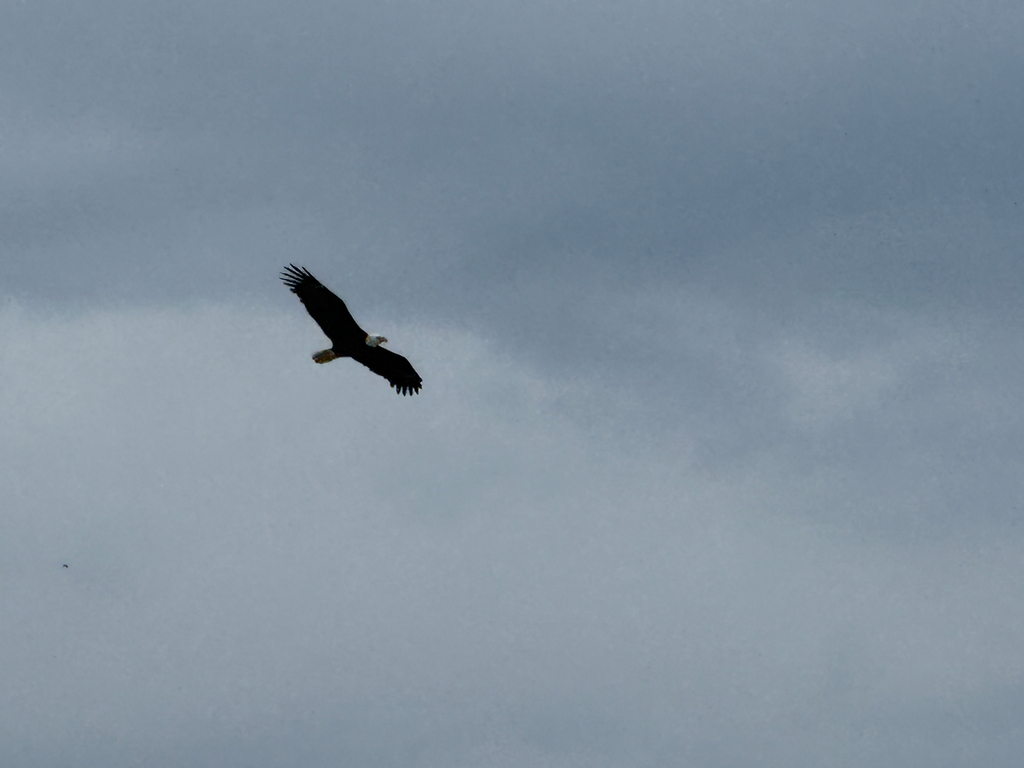
© Jared Lincenberg · iNaturalist · CC BY 4.0
Scientific Classification & Quick Facts
Classification
At a Glance
The American Bald Eagle is one of North America’s most iconic predators, instantly recognizable by its distinctive white head and neck contrasting sharply with a dark brown body and powerful hooked beak. This large raptor commands the skies across two countries and has become a symbol of wilderness and freedom throughout its range. Once hunted to the brink of extinction, the species has made a remarkable recovery and now appears on the IUCN Red List as Least Concern, marking one of conservation’s genuine success stories.
What makes this species particularly fascinating is not merely its visual drama or numerical recovery, but the ecological role it plays as an apex predator in freshwater and coastal ecosystems. With massive talons capable of exerting crushing force and eyesight eight times sharper than human vision, the bald eagle demonstrates the refinement of millions of years of predatory evolution. Understanding this species provides insight into how large raptors interact with their environment and how conservation efforts can reverse even severe population declines.
Identification and Appearance
The American Bald Eagle is a large raptor with a distinctive appearance that makes it unmistakable in the field. Adults display dark brown plumage across the body, wings, and back, contrasting sharply with a pure white head and tail. The tail is moderately long and slightly wedge-shaped, providing excellent maneuverability during high-speed flight. The beak is large and hooked, adapted for tearing flesh, and together with the feet and irises, it is bright yellow. The legs are unfeathered, and the toes are short and powerful, equipped with large curved talons—the hind toe’s talon is particularly developed and used to pierce vital areas of prey while the front toes immobilize the catch.
Sexual Dimorphism
Males and females are identical in plumage coloration, but females are approximately 25% larger than males, making this one of the most pronounced size differences in North American raptors. Female bald eagles can reach up to 5.35 kg in weight, whereas males are noticeably smaller. This size difference does not affect the visual field marks—both sexes share the same distinctive white head and dark brown body—but it becomes apparent when birds are observed together or when comparing individuals of known sex.
The legs are notably long and stout, with no feathering below the thigh joint—an adaptation that keeps them dry during frequent water contact. The bright yellow coloration of the beak, feet, and irises intensifies with age, becoming particularly vivid in mature adults. This combination of white head, dark body, powerful talons, and yellow facial features creates one of North America’s most recognizable bird silhouettes.
Distribution and Habitat
The American Bald Eagle is endemic to North America, with its range confined to the United States and Canada. GBIF records indicate 245 occurrences documented in the US and 55 in Canada, reflecting the species’ strong association with continental North America. The bird’s distribution spans from the Atlantic to the Pacific coast, though sightings concentrate heavily in regions with suitable aquatic habitats.
Seasonal presence shows a striking winter concentration, with peak activity recorded in January based on available occurrence data. This pattern reflects the species’ migratory behavior: many populations move southward in autumn and return northward in spring, with January representing the height of winter staging and overwintering across much of the range. The absence of records in warmer months suggests either breeding dispersal to less-surveyed northern territories or reduced observer activity during summer seasons.
While elevation data is not available for this species, American Bald Eagles show strong fidelity to aquatic environments across their range—large lakes, rivers, coastal zones, and reservoirs where fish populations sustain them. Breeding birds establish territories in forested areas adjacent to open water, whereas wintering populations concentrate wherever ice-free water provides reliable hunting grounds. Population recovery over the past four decades has expanded the species’ range and local abundance, particularly in northern regions historically abandoned following persecution.
Biology
Behavior
American Bald Eagles are highly skilled hunters and solitary or paired birds outside the breeding season. They spend much of their day scanning waterways and open terrain from prominent perches, waiting for prey to appear. These raptors are most active during daylight hours and often hunt from dawn through mid-morning. They exhibit remarkable aerial agility, diving from heights of 30 metres or more to snatch fish from water surfaces with their powerful talons.
During the non-breeding season, eagles typically defend individual hunting territories, though they may gather in loose aggregations at productive feeding sites like rivers with open water in winter. Pair bonds are strong and long-lasting; mated eagles often perform elaborate courtship displays involving cartwheeling through the air and talon-grappling mid-flight. Social hierarchies exist at communal roosts, with dominant individuals claiming the best perching spots.
Diet
Fish form the primary diet of American Bald Eagles, comprising up to 90 percent of their annual food intake. They hunt live fish in open water, targeting species 0.5 to 2.5 kilograms in weight, though they can capture larger prey. Eagles also take waterfowl including ducks and geese, particularly during winter when open water becomes scarce. They hunt small mammals such as muskrats and rabbits opportunistically, and will scavenge carrion, especially roadkilled deer, when live prey is unavailable.
Hunting success varies with habitat quality and season. Eagles in regions with abundant open water fish year-round maintain stable territories, while those in areas that freeze seasonally may migrate to productive feeding grounds or rely more heavily on scavenging. A single eagle requires roughly 0.5 kilograms of food daily, though consumption varies with activity level and season.
Reproduction
Bald Eagles breed from December through July, with egg-laying peaking in January and February across most of North America. Mated pairs construct massive stick nests in tall trees or on cliff ledges, often reusing and adding to the same nest for decades until it may exceed 2 metres in diameter and weigh over 900 kilograms. The female lays two to three eggs, typically at three-day intervals, and begins incubation immediately after the first egg arrives.
Both parents incubate the clutch for approximately 35 days. Chicks hatch asynchronously, creating age and size hierarchies that influence survival. The young remain in the nest for 10 to 14 weeks, fully dependent on their parents for food and protection. During this period, parents make dozens of hunting trips daily to meet the voracious appetite of growing eaglets. Fledglings leave the nest at 12 weeks but remain dependent on their parents for several additional months, learning to hunt through trial and error. Pair bonds persist across years, and many eagles first breed at 4 to 5 years of age, after acquiring their distinctive white head and tail plumage.
Conservation and Threats
Haliaeetus leucocephalus, the American Bald Eagle, holds a Least Concern status on the IUCN Red List, reflecting its recovery from near extinction and current stable population across North America. This classification indicates that the species faces no immediate threat of extinction at a global scale, though regional monitoring remains important for long-term persistence.
Threats and Historical Pressures
While the species is no longer facing the acute threats of the mid-20th century, historical pressures shaped its conservation trajectory. DDT pesticide accumulation caused eggshell thinning and reproductive failure—a threat that became largely historical following the pesticide’s ban in the United States in 1972. Lead ammunition in prey remains an ongoing concern, as eagles that consume animals shot with lead bullets accumulate toxic residues that can impair neurological function and survival. Habitat loss, particularly the destruction of mature riparian forests and coastal wetlands used for nesting and foraging, continues to affect local populations in some regions. Vehicle collisions, electrocution on power lines, and illegal shooting still claim individuals in small numbers.
Conservation Efforts and Legal Protections
The Bald and Golden Eagle Protection Act of 1940, strengthened through subsequent amendments, provides federal protection against hunting, killing, or harassment. The species was removed from the U.S. Endangered Species List in 2007 after decades of recovery, though it remains protected under this legislation and similar statutes in Canada. Recovery programmes have emphasized restoring breeding habitat, protecting nesting sites, and monitoring population health across North America. State and provincial wildlife agencies continue surveillance to detect emerging threats and support local populations.
Cultural Significance
Role in Native American culture
The bald eagle holds profound spiritual significance across many North American Indigenous cultures. The bird is regarded as sacred, with its feathers central to religious and spiritual customs. Many Indigenous traditions recognize the eagle as a spiritual messenger between gods and humans, elevating it beyond a mere animal to a bridge between the physical and divine realms. Among the Navajo, an eagle feather represents protection, and medicine men traditionally use the leg and wing bones to craft ceremonial whistles. The Lakota people confer eagle feathers as symbols of honor upon individuals who achieve noteworthy accomplishments, reflecting the bird’s association with excellence and distinction.
Eagle feathers and talons feature prominently in ceremonial regalia and traditional dress. Powwow dancers incorporate eagle claws into their regalia, while the feathers themselves are woven into fans, bustles, headdresses, and other ceremonial garments worn during sacred gatherings and spiritual practices. These uses underscore the eagle’s elevated status within Indigenous material culture and ritual life.
Popular culture and national symbolism
The bald eagle’s prominence in popular culture stems from its dual role as the emblem of the United States and as an apex predator commanding human imagination. Its use as a national symbol has cemented its place in American artistic representation, design, and collective identity across diverse media.
Fun Facts
- Bald eagles do not develop their iconic white head and neck feathers until they are 4–5 years old; younger birds are entirely brown and were once mistaken for a separate species.
- An adult bald eagle’s grip strength reaches approximately 500 pounds per square inch—roughly ten times stronger than a human hand—allowing them to snatch fish weighing up to 15 pounds from the water at high speed.
- Despite their majestic appearance, bald eagles produce a surprisingly weak, high-pitched chirping call rather than the deep screech heard in films; Hollywood typically uses the call of a red-tailed hawk instead.
- Bald eagles can see fish in water from a height of 1.6 kilometres, thanks to eyes that are roughly eight times more powerful than human vision and contain four types of color receptors compared to our three.
- A bald eagle’s nest, called an eyrie, grows larger every year as the pair adds new sticks—some nasts reach 2 metres wide and 3 metres deep, weighing as much as a small car.
- These raptors engage in a dramatic aerial courtship ritual called a cartweel dive, where two eagles lock talons mid-air and spiral downward together, releasing just before hitting the ground.
- Bald eagles were removed from the U.S. Endangered Species List in 2007 after their population rebounded from fewer than 500 breeding pairs in the 1970s to more than 70,000 birds today—one of conservation’s greatest successes.
Ecology
Habitats
Diet
Behavior
Conservation Status
LC (Least Concern) · NT · VU · EN · CR · EW · EX
Photo Gallery
Jared Lincenberg · CC BY 4.0
Related Species
Was this profile helpful?