
Squamata
Common Basilisk
Basiliscus basiliscus
Least ConcernAlso known as: Jesus Christ lizard
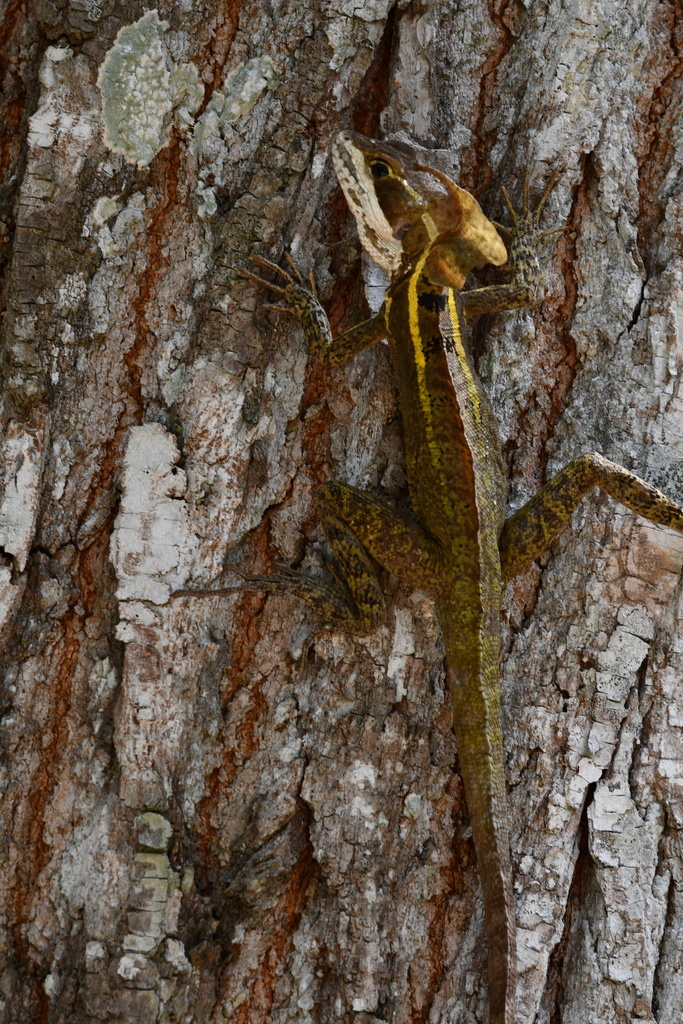
© josebarrientos · iNaturalist · CC BY 4.0
Scientific Classification & Quick Facts
Classification
At a Glance
The common basilisk is a lizard of striking contrasts: a creature equally at home sprinting across forest floors and skittering across water surfaces with astonishing agility. Found across Central and South America, this species inhabits three countries and maintains a stable population status classified as Least Concern by the IUCN. Its range spans humid tropical regions where rainforest and riverside habitats provide the moisture and vegetation it depends on.
Among the Corytophanidae family, Basiliscus basiliscus has earned its place as one of the neotropics’ most recognizable reptiles, known for its dramatic crest, cryptic coloration, and the remarkable capacity to flee predators by literally fleeing across water—an adaptation that sets it apart from most terrestrial lizards and makes it a compelling subject for understanding how evolution shapes escape behavior in confined, wet environments.
Identification and Appearance
The Common Basilisk is a large lizard with a distinctive body structure and prominent cranial ornamentation. This species is characterized by its moderately stout build and rectangular cross-section, giving it a robust appearance compared to many other lizards. Most notably, males possess a prominent sail-like crest along the spine and a crest on the head, which is less developed or entirely absent in females. The dorsal coloration is typically brown to olive-green, often with darker crossbands or mottling along the body that provides effective camouflage in its natural forest habitat.
Size and Sexual Dimorphism
The Common Basilisk exhibits pronounced sexual dimorphism, with males typically larger and more ornately crested than females. Males develop the characteristic head and dorsal crests used in territorial displays and species recognition. Females are generally smaller and lack the prominent crests, though they retain the fundamental body shape and coloration patterns of the species. Sexual maturity in females is reached at a minimum length of 100 centimetres and a weight of 700 grams.
Distinctive Features
The most striking feature of this species is the presence of a prominent lateral crest running from the head to the tail in males, which can be erected during threat displays or social interactions. The head is relatively broad, and the eyes are positioned laterally, providing good lateral vision crucial for detecting movement in dense vegetation. The tail is long and compressed laterally, aiding in swimming and balance. Coloration patterns vary individually but generally include browns, olives, and greys, sometimes with lighter spotting or banding that aids in concealment among leaf litter and undergrowth.
Distribution and Habitat
Basiliscus basiliscus is restricted to Central America, with its range concentrated in three countries: Costa Rica, Panama, and Colombia. Costa Rica holds the overwhelming majority of recorded occurrences, with 236 documented locations, making it the species’ core stronghold. Panama and Colombia support much smaller populations, with 37 and 27 records respectively, indicating that the species is far more abundant in the western portions of its range.
The species shows a pronounced seasonal pattern in observational records, with a marked concentration in the early months of the year. February represents the peak period for sightings, recording 166 occurrences, followed by January with 134 records. This early-year activity likely reflects increased visibility during the dry season when vegetation is less dense, though the absence of records from March onward suggests either genuine seasonal retreat or reduced observer effort during the remainder of the calendar year.
Specific elevation and habitat preference data are not available from current records. The species’ distribution across Central American lowlands and foothills suggests an adaptation to tropical environments typical of the region, though precise microhabitat requirements and elevation boundaries remain undocumented in this dataset.
Biology
Behavior
The Common Basilisk is a diurnal lizard, most active during daylight hours in the warm, humid environment of tropical rainforests. It is primarily a ground-dweller that spends much of its time on branches overhanging water or on the forest floor. When threatened, this species exhibits a remarkable escape behavior: it runs on its hind legs in a bipedal gait, a posture that allows it to move rapidly across the ground or, most famously, across the surface of water. This ability to sprint across water—sometimes for distances of several meters—has earned it the colloquial name “Jesus Christ lizard” in parts of Central and South America.
The basilisk is generally solitary and territorial, particularly males, which display dominance through head-bobbing, body flattening, and crest-raising behaviors. Males are noticeably larger and more elaborately crested than females. When confronted, the lizard may flatten its body laterally to appear larger and more threatening, or it may simply flee to the water. Territorial disputes between males can be intense, involving physical combat with bites and tail-lashing.
Diet
The Common Basilisk is strictly carnivorous, feeding primarily on insects, small vertebrates, and arthropods. Its diet includes grasshoppers, crickets, beetles, spiders, small snakes, and other lizards. Young individuals tend to focus more heavily on smaller invertebrates, while larger adults are capable of consuming larger prey items including small rodents and birds. Foraging is opportunistic; the lizard actively hunts from perches or on the ground, using its keen eyesight to locate prey before striking with speed and precision.
Reproduction
The Common Basilisk breeds seasonally, with mating occurring during the wet season in most of its range. Males compete for access to females through displays and combat. After successful mating, females lay eggs in shallow burrows dug in sandy or loose soil near water. A typical clutch contains 4 to 18 elongated, flexible-shelled eggs, which are left unattended after burial. Incubation lasts approximately 60 to 90 days, depending on soil temperature and humidity conditions.
Hatchlings emerge during the rainy season when moisture levels are high and food availability peaks. Juvenile basilisks are fully independent from the moment of hatching, receiving no parental care. Sexual maturity is reached within 2 to 3 years, at which point males develop their characteristic large dorsal and nuchal crests. Females retain smaller crests throughout life.
Conservation and Threats
Basiliscus basiliscus is classified as Least Concern on the IUCN Red List, indicating that the species does not currently face an imminent risk of extinction. However, this assessment does not reflect full stability: populations across its range show a decreasing trend, which suggests mounting pressure on wild populations that warrants continued monitoring and preventative conservation action.
Threats and Population Decline
While specific quantified threats are not formally documented in current IUCN assessments, the decreasing population trend points to habitat loss and human land-use change across Central and South America as primary drivers of decline. The species depends on riparian forests and wetland margins near rivers and streams; conversion of these habitats to agriculture, urban development, and infrastructure projects directly reduces available breeding and foraging grounds. Pollution of freshwater systems and alterations to natural water flow regimes also degrade habitat quality for this aquatic and semi-aquatic reptile.
The pet trade historically captured individuals for the exotic reptile market, though the extent of current collection pressure is unclear. Local hunting and predation by introduced species in altered ecosystems further compound population losses in fragmented landscapes.
Conservation Efforts and Legal Protections
The Common Basilisk benefits from protection within several national parks and protected areas throughout its range in Central America and northwestern South America, particularly in countries with established forest reserves. Many range countries have national wildlife regulations that prohibit or restrict collection for trade, though enforcement remains variable. The species’ presence across multiple protected areas and its adaptability to some human-modified habitats provide a buffer against rapid extinction.
Cultural Significance
The common basilisk carries a name steeped in ancient mythology and European folklore. Basiliscus derives from the Greek word meaning “little king,” a reference to the legendary creature of the same name that featured prominently in medieval bestiaries and lore. According to tradition, this mythological serpent possessed a lethal gaze—the mere act of looking into its eyes brought instant death to those unfortunate enough to meet its stare. This fearsome reputation extended to its exhalations, which were said to be equally toxic and deadly.
Beyond its mythological associations, the basilisk holds symbolic significance in European heraldry and civic identity. The real reptile became the guardian creature and traditional symbol of Basel, Switzerland, representing power and authority—though in some Christian contexts, it was also associated with infernal forces. This dual symbolism reflects the creature’s ambiguous place in human culture: feared and reviled as a harbinger of death in legend, yet adopted as a protective emblem by cities seeking to project strength. The basilisk myth continues to influence contemporary culture, appearing in literature, art, and popular media as an archetypal symbol of danger and supernatural power.
Fun Facts
- 1.The common basilisk can run across water surfaces on its hind legs for distances up to 1.5 metres before sinking, using its fringe-toed feet and rapid acceleration to generate lift. This remarkable ability has earned it the nickname “the Jesus Christ lizard” across Central and South America.
- 2.When threatened, a basilisk raises a prominent crest along its head and back—a display that makes the animal appear much larger than its actual body size of 60–90 centimetres. Males develop notably larger crests than females, particularly during the breeding season.
- 3.Basilisks are obligate carnivores that hunt small prey including insects, spiders, crustaceans, and other small vertebrates, catching most food while perched in low vegetation or along riverbanks. They are ambush predators that rely on speed and precision rather than active pursuit.
- 4.The species is highly arboreal and spends much of its life in trees and shrubs overhanging water, where it can escape predators by dropping into the stream below and either swimming or running across the surface.
- 5.Common basilisks are oviparous, laying eggs in moist soil or leaf litter near water. Females typically deposit 4–10 elongated eggs, which hatch after an incubation period influenced by temperature and humidity.
- 6.The basilisk’s eye structure includes a movable eyelid and excellent colour vision adapted to forested light conditions, allowing it to detect prey movement and predators with precision in dappled tropical shade.
- 7.These lizards are primarily diurnal and thermoregulate by basking on exposed branches early in the morning, then retreating to cooler, shaded areas during the hottest part of the day.
Ecology
Habitats
Diet
Behavior
Conservation Status
LC (Least Concern) · NT · VU · EN · CR · EW · EX
Photo Gallery
josebarrientos · CC BY 4.0
Related Species
Was this profile helpful?