
Insecta · Coleoptera
Common Goliath Beetle
Goliathus goliatus
Also known as: Goliath Beetle
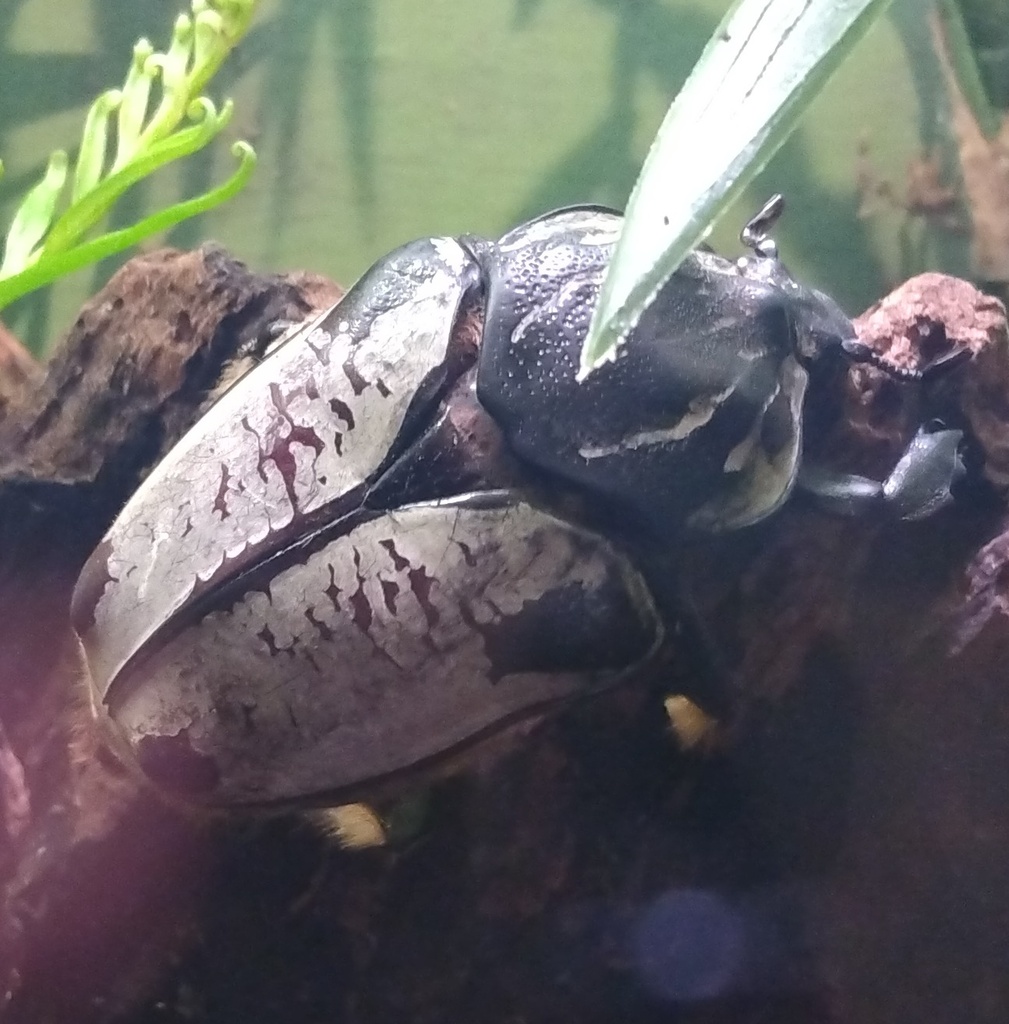
© Rob Schnautz · iNaturalist
Scientific Classification & Quick Facts
Classification
At a Glance
Data not available.
The Goliathus goliatus, or Common Goliath Beetle, ranks among the largest and heaviest insects on Earth. Members of the scarab family (Scarabaeidae), these magnificent beetles are found across ten countries in central and west Africa, where they inhabit tropical forests and woodland regions. Their conservation status remains unknown, yet their sheer size and ecological role make them a subject of scientific interest and cultural significance across their range.
What distinguishes this species is not merely its impressive proportions but also the remarkable transformation required to achieve them. Larvae develop in the soil, feeding voraciously on organic matter over months, before pupating and emerging as fully formed adults. The combination of extreme growth, powerful mandibles, and striking iridescent coloration makes Goliathus goliatus a distinctive representative of Africa’s invertebrate fauna and a window into the extraordinary diversity of scarab beetles worldwide.
Identification and Appearance
Goliathus goliatus ranks among the largest beetles in the world. Males measure 50–110 mm in body length, while females are slightly smaller at 54–80 mm. This substantial size makes the species immediately recognizable among African insects, though exact mass data remains unpublished in standard references.
Coloration and Markings
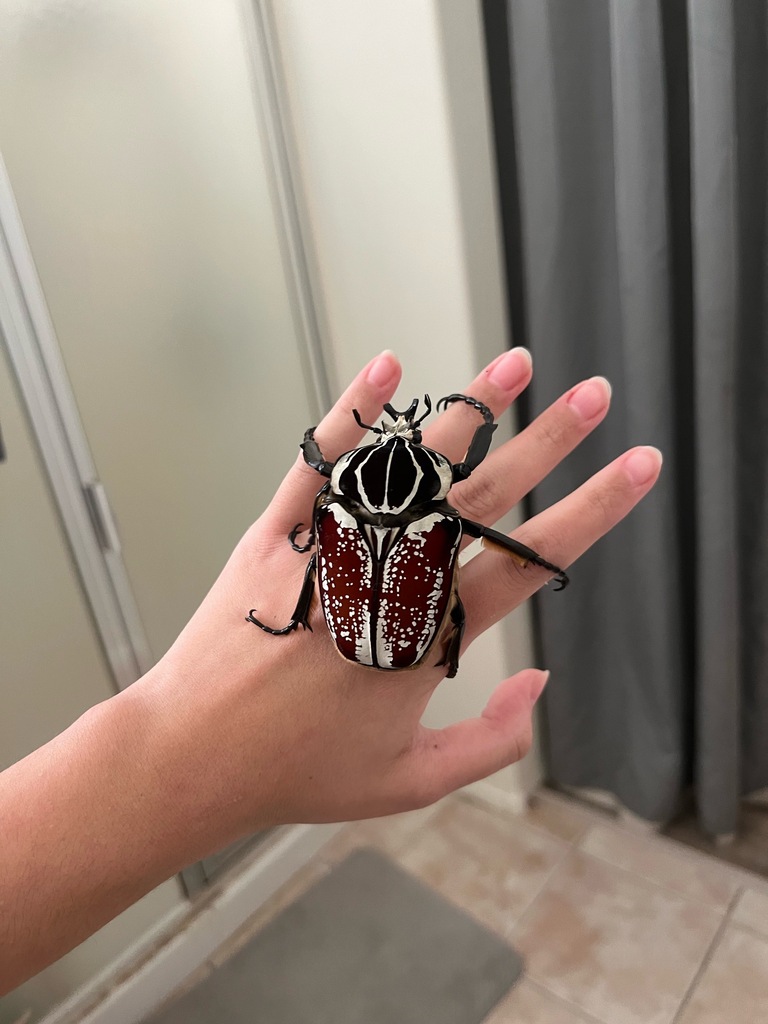
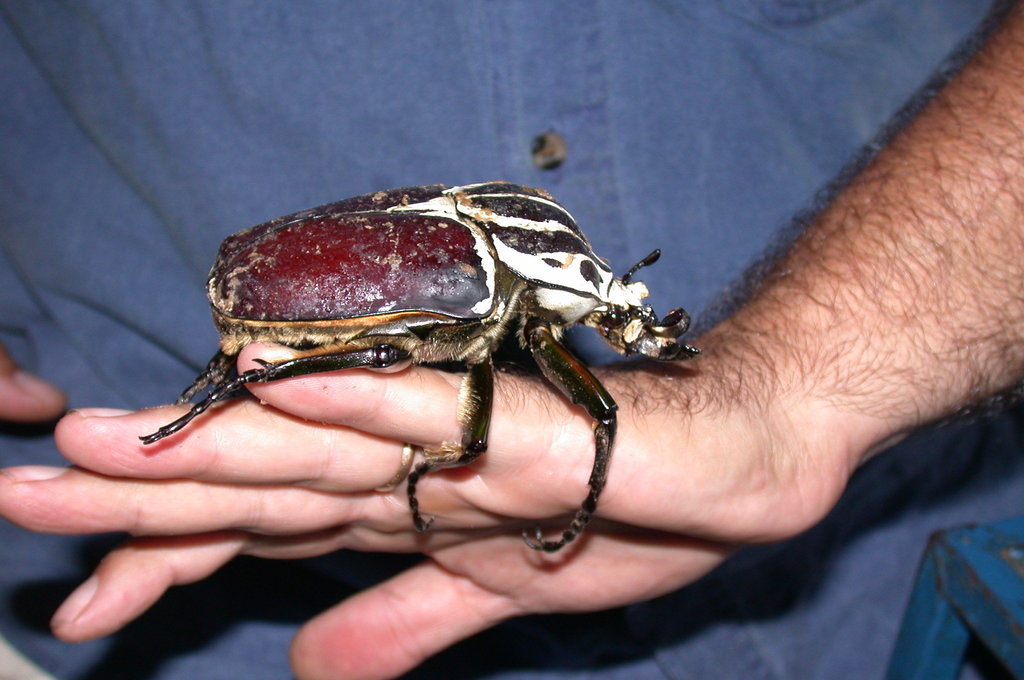
The pronotum (thoracic shield) is predominantly black with distinctive whitish longitudinal stripes running across its surface. The elytra (wing covers) typically display dark brown coloration in the standard form, but considerable variation exists across different populations and individuals. Several named forms occur sympatrically, each with distinct elytra patterns: the “quadrimaculatus” form features mostly white elytra, while intermediate forms designated “albatus,” “apicalis,” “conspersus,” “hieroglyphicus,” and “undulatus” display varying proportions and arrangements of brown, white, and black markings. This color polymorphism reflects natural population diversity rather than distinct subspecies.
Sexual Dimorphism
Females are generally shorter than males, with body lengths typically ranging from 54–80 mm compared to males’ 50–110 mm range. The upper size limit for females rarely approaches that of the largest males, creating a noticeable size difference that is often the first indication of sex in field observations.
Distribution and Habitat
Goliathus goliatus is found across West and Central Africa, with records concentrated in ten countries. Benin holds the largest number of documented observations, followed by Cameroon, the Democratic Republic of the Congo, and Equatorial Guinea. Smaller populations have been recorded in Uganda, the Central African Republic, Republic of the Congo, Nigeria, Gabon, and Kenya, indicating a broad but discontinuous distribution across the continent.
The species occurs at elevations between 322 and 1,219 metres, with an average elevation of around 920 metres. This mid-altitude range suggests a preference for upland forest habitats typical of transitional zones between lowland rainforests and higher-altitude woodland. The beetles are most active during April, when sighting frequency peaks sharply; activity remains moderate throughout the rest of the year but drops to zero in November, reflecting seasonal variation in beetle emergence or observer effort in tropical regions.
Distribution records are heavily skewed toward West African populations, particularly in Benin and Cameroon, which together account for the majority of confirmed sightings. Central African populations appear more scattered, with Kenya representing the easternmost confirmed occurrence. This pattern suggests that G. goliatus thrives in the humid forest belts of the Gulf of Guinea region and adjacent Congo Basin woodlands, though the exact habitat requirements remain incompletely documented.
Biology
Behavior
The Common Goliath Beetle is primarily nocturnal, spending daylight hours concealed beneath leaf litter, rotting wood, or loose bark in the forest floor. At dusk, these beetles become active, using their powerful legs to navigate through dense vegetation and their membranous wings to fly between feeding sites. Despite their massive size and weight, they are surprisingly capable fliers, though their flight is labored and noisy.
Adult beetles are solitary and territorial, with males competing aggressively for access to females during the breeding season. Males possess deep notches on their front legs and characteristic horns on their heads, which they use as weapons during combat with rivals. These confrontations can be intense, with beetles attempting to flip or dislodge one another from their perches.
Diet
Adult Goliath Beetles are herbivorous, feeding primarily on the sap and fruit of trees. They show a particular preference for rotten or fermenting plant material, accessing these food sources by chewing into decaying wood and bark. Their strong mandibles allow them to process tough plant matter efficiently, and they may consume large quantities to fuel their considerable body mass.
Larvae develop within rotting logs and soil, feeding on decomposing plant material and humus. This larval diet, rich in nutrients from decaying organic matter, enables their rapid growth into some of the world’s largest beetles. The larvae can spend 2–3 years developing underground before pupating.
Reproduction
Breeding occurs during the wet season in their Central African habitat, when moisture levels in the soil are optimal for larval development. Females lay eggs directly into moist soil or rotting wood, typically in clusters. After hatching, larvae burrow deeper into the substrate, where they feed and grow through several instars over an extended period.
Pupation occurs within a hardened pupal chamber constructed in the soil. The development from egg to adult beetle spans several years, making the Common Goliath Beetle a long-lived insect relative to smaller beetle species. Once adults emerge, they may live for several months to over a year in the wild.
Conservation and Threats
Goliathus goliatus, the Common Goliath Beetle, has not been formally assessed by the International Union for Conservation of Nature (IUCN) and therefore lacks an official Red List status. This absence of assessment reflects the limited systematic monitoring of this species across its African range, making it difficult to establish reliable population estimates or long-term trend data. Without comprehensive baseline information, the true conservation status of this iconic beetle remains unclear.
Given the beetle’s restricted distribution in Central African rainforests, habitat loss poses a significant threat to its survival. Deforestation for logging, agriculture, and urban expansion continues to fragment and reduce the forest ecosystems on which larval development depends. The species’ long larval development period—which can span several years in rotting wood—means that populations recover slowly from disturbance. Additionally, wild-caught beetles are collected for the international pet trade and insect collections, adding localized collection pressure in accessible populations.
Conservation Efforts
No major international conservation programmes specifically target Goliathus goliatus at present. However, the species benefits indirectly from general rainforest protection efforts in Central Africa, particularly in national parks and protected areas within its range. Some countries regulate or restrict the export of wild-caught specimens through CITES listings or national wildlife laws, though enforcement varies widely. Captive breeding initiatives exist in private collections and some research institutions, which may eventually reduce pressure on wild populations if breeding stock becomes established.
The most critical conservation need for this species is improved monitoring and baseline research. Systematic surveys across its Central African range would clarify population status and identify priority areas for protection. Local engagement with forest-dependent communities could also reduce unsustainable collection and ensure that habitat conservation aligns with human livelihoods.
Cultural Significance
The Common Goliath Beetle derives its name from Goliath, the legendary Philistine warrior of the Bible. According to the Book of Samuel, Goliath challenged the Israelites to single combat, a confrontation most famously resolved by the young David, who would later become King of Israel. The beetle’s enormous size and formidable appearance evoke the giant warrior’s reputation for strength and intimidation, making the name a fitting descriptor for one of Africa’s most impressive insects.
In West African cultures, Goliath beetles hold symbolic significance as representations of strength and endurance. Their striking red backs and robust exoskeletons have made them prized specimens for collection and display in museums and private collections worldwide. These impressive insects appeal to those seeking tangible connections to tropical biodiversity and the natural world’s capacity to produce creatures of remarkable proportions. However, unlike many other beetles, the species lacks major roles in regional mythology or traditional narratives beyond these general associations with power and resilience.
Fun Facts
- Adult Goliathus goliatus beetles can weigh up to 100 grams and reach lengths of 11 centimetres, making them among the heaviest insects on Earth, yet they remain agile fliers despite their enormous bulk.
- The larvae spend up to two years in the soil feeding on decaying wood and plant matter, gaining the mass needed to support their final adult form—a transformation that produces one of nature’s most impressive metamorphoses.
- Male Goliath beetles engage in dramatic pushing contests using their prominent frontal horns, much like rhinoceroses, to compete for mates and establish dominance in their rainforest habitat.
- The beetle’s iridescent exoskeleton shifts between white, green, and gold depending on viewing angle, a phenomenon caused by microscopic structures in the cuticle rather than pigmentation.
- Despite their size and strength, adult Goliath beetles live only a few months and do not feed—they rely entirely on energy reserves accumulated during their lengthy larval stage.
- These beetles are primarily nocturnal and are attracted to fermented fruit and tree sap, which they locate using highly sensitive chemoreceptors on their antennae.
- The larvae produce distinctive clicking sounds when disturbed, a defensive warning that alerts predators to their presence in the leaf litter and rotting wood where they develop.
Ecology
Diet
Behavior
Photo Gallery
Rob Schnautz ·
Related Species

Was this profile helpful?