
Agaricomycetes · Phallales
Devil’s Fingers
Clathrus archeri
EndangeredAlso known as: Devils Fingers, Octopus Stinkhorn, Seastar Stinkhorn, devil's-fingers
© jsimons · iNaturalist · CC BY 4.0
Scientific Classification & Quick Facts
Classification
Known For
Detailed measurements for this species are still being verified.
Clathrus archeri, commonly known as Devil’s Fingers, is a striking fungus that emerges from the forest floor as a bundle of blood-red, finger-like arms reaching skyward. This species belongs to the Phallaceae family, a group renowned for their bizarre morphologies and pungent odours designed to attract carrion-feeding insects. Found across eight countries, Devil’s Fingers remains relatively obscure in scientific literature, with its conservation status currently unknown to formal assessment bodies.
What makes Devil’s Fingers especially notable is its bold appearance and the unusual reproductive strategy of its family. Rather than producing gills or pores like typical mushrooms, this fungus develops a latticed or chambered structure that ruptures to reveal its spore-bearing surface. Its global presence across multiple continents, combined with its dramatic fruiting bodies, makes it a captivating example of fungal diversity and adaptation in temperate and subtropical ecosystems.
Identification and Appearance
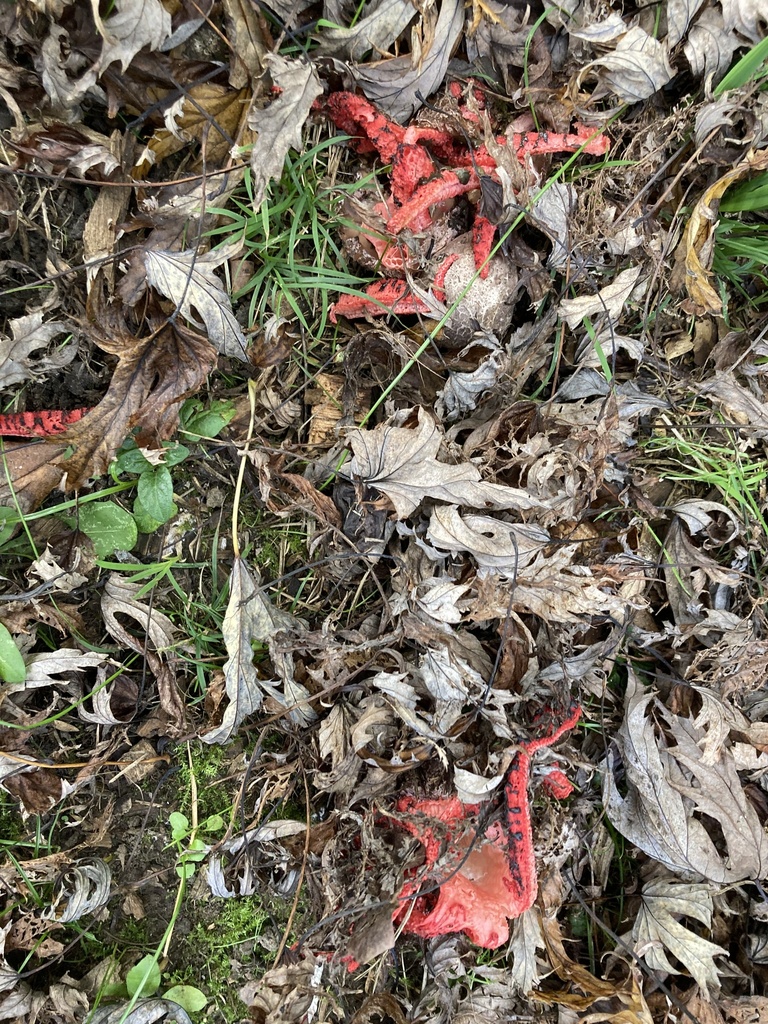
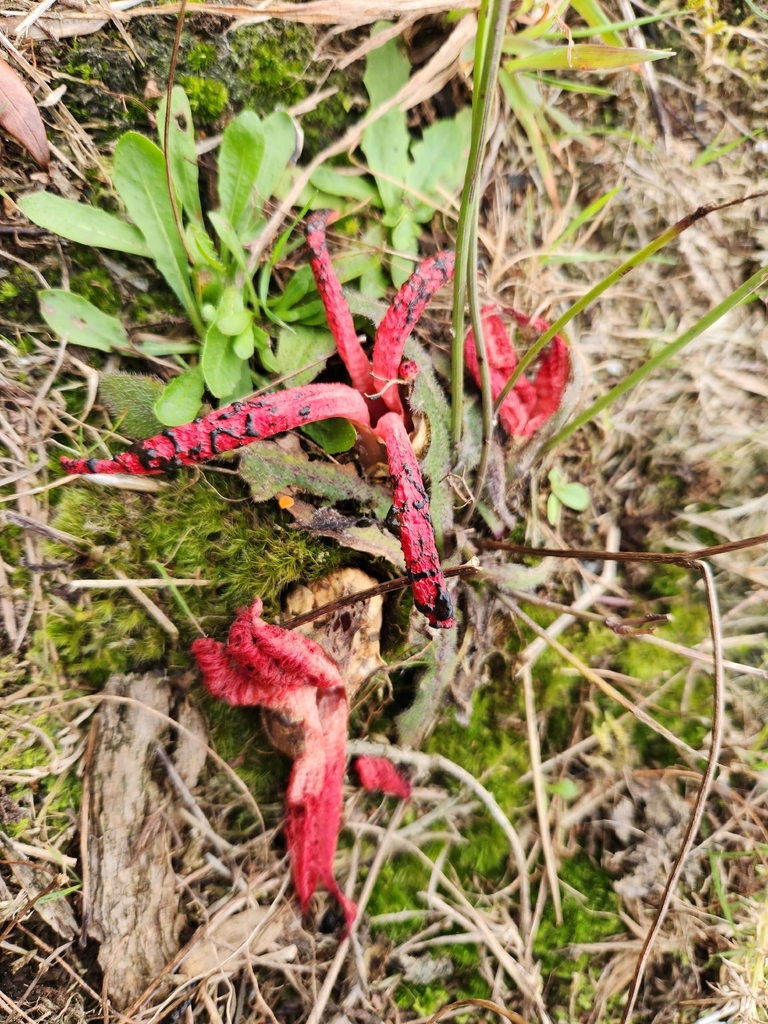
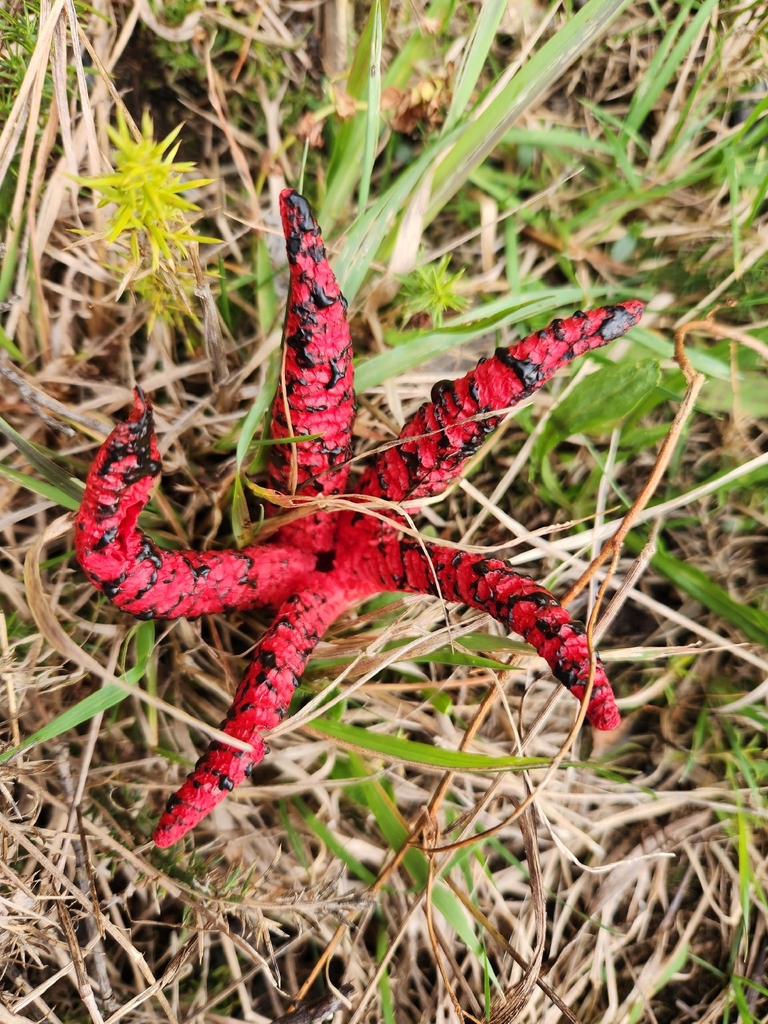
Clathrus archeri is a distinctive stinkhorn fungus that develops through two striking morphological stages. The fruiting body emerges from a whitish, egg-like structure roughly 2–3 centimetres in diameter, which sits partially embedded in soil or leaf litter. Once mature, the fungus unfolds into a starfish or octopus-like form with 4–6 arms on average, though specimens with up to 8 arms have been documented.
Fruiting Body Structure
The arms extend upward and outward, each reaching up to 10 centimetres in length. The upper surfaces are coated with gleba, a slimy, spore-bearing tissue that gives the fruiting body its distinctive appearance and contributes to its pungent odour. The overall colour ranges from bright red-orange to deeper red, a pigmentation produced by carotenoid compounds that develop as the fungus matures. This vivid colouration, combined with the angular arm structure, creates the appearance that inspired the common name Devil’s Fingers.
Spore Characteristics
The spores are microscopic, smooth, and oblong in shape, measuring 3.5–6 micrometres by 1.5–2 micrometres. This fine-scale morphology is consistent across populations and aids in confirming identification under magnification. The fungus produces no sexual dimorphism; all fruiting bodies are functionally equivalent and capable of spore production.
Distribution and Habitat
Clathrus archeri, commonly known as Devil’s Fingers, has established a scattered but significant presence across eight countries on multiple continents. New Zealand dominates the distribution record with 183 documented observations, making it by far the primary stronghold for this species. South Africa follows with 40 records, while Australia, Colombia, and the United States each contribute 23–24 observations. Ecuador and Spain are represented by three records each, and a single record exists from Great Britain.
The species exhibits a marked seasonal pattern, with fruiting activity concentrated between January and May in the Southern Hemisphere. April represents the peak month, recording 103 observations—nearly double the count from surrounding months. February and March also show elevated activity, with 55 and 74 records respectively, while January records 45. From June onward through December, observations drop to zero or near-zero levels, indicating that the fungus fruits almost exclusively during autumn and early winter in temperate regions south of the equator.
Specific elevation data is not available from current records, and detailed habitat preferences remain undocumented in the observational dataset. This absence of structured habitat classification likely reflects the opportunistic nature of occurrence records, which often capture sightings without comprehensive ecological metadata. The broad geographic scatter across temperate and subtropical regions suggests the species tolerates varied environmental conditions, from Mediterranean-influenced zones in Spain to the temperate forests and grasslands of New Zealand and southern Africa.
Ecology and Lifecycle
Lifecycle
Clathrus archeri begins its life as vegetative mycelium colonizing decomposing organic matter in soil and leaf litter. The fungus remains in this hidden state until environmental conditions—moisture, temperature, and nutrient availability—trigger fruiting. When conditions align, the fungus produces its distinctive fruiting body: a latticed, finger-like structure that emerges rapidly from the soil or mulch. This fruiting body is not the fungus itself, but rather a specialized spore-bearing organ designed for a specific dispersal strategy.
Spore release relies entirely on carrion-feeding flies. The fungus produces a pungent odor mimicking decomposing animal flesh, which attracts insects seeking a breeding site or food source. As flies land on and crawl through the latticed fruiting body, they inadvertently collect spores on their bodies and legs. These insects then transport spores to new locations—often at considerable distances—where they deposit them in fresh sites rich in decaying vegetation. Once spores land in suitable habitat, germination occurs and the mycelial cycle begins anew.
Ecological Role
Clathrus archeri functions as a saprotroph, breaking down dead organic material and recycling nutrients back into the soil ecosystem. The fungus secretes oxalic acid as a primary metabolic byproduct; this acid binds to metal cations and increases the bioavailability of minerals for neighboring plants. Beyond simple decomposition, the fungus influences soil chemistry through mycelial calcium pooling, which alters soil pH and affects phosphorus availability for surrounding vegetation. In this way, the fungus acts as a silent ecosystem engineer, reshaping the chemical conditions of its immediate environment.
The relationship between Clathrus archeri and carrion flies represents a form of mutualistic deception: the fungus gains dispersal, while the insect gains nothing but is merely exploited. This system demonstrates how fungi have evolved sophisticated chemical signaling to manipulate animal behavior for their own reproductive success. The fungus fits within broader detrital food webs, serving decomposer roles alongside bacteria, other fungi, and invertebrates that collectively recycle nutrients in woodland soils and gardens.
Uses
There are no established culinary, medicinal, or traditional human uses for Clathrus archeri. The fungus is neither harvested nor processed for food or pharmaceutical purposes. Its edibility and toxicity status remain undocumented in the scientific literature, making it unsafe to assume it is either edible or poisonous without rigorous testing. The species is primarily of interest to mycologists and ecologists studying fungal biology, spore dispersal mechanisms, and decomposer ecology.
The fungus does have minor significance in horticulture and gardening contexts. Its presence in mulch beds and around decomposing wood is generally benign, though the distinctive fruiting bodies—with their red, finger-like appearance—can startle gardeners unfamiliar with fungal diversity. Clathrus archeri poses no direct threat to plants, and its role in nutrient cycling may even benefit soil health and plant nutrition in the long term.
Conservation and Threats
Clathrus archeri, commonly known as Devil’s Fingers, currently lacks an official IUCN Red List assessment. This means the species has not been formally evaluated against the organization’s standardized criteria for extinction risk. Without this classification, the conservation status and global population trends remain poorly documented, making it difficult to determine whether the species faces immediate threats or maintains stable populations across its range.
Threats and Conservation Efforts
The specific threats facing Devil’s Fingers are not well documented in current scientific literature. As a fungal species with a wide distribution, it may be affected by habitat degradation, climate change, or land-use conversion in areas where it occurs, but targeted research identifying key risk factors is lacking. The absence of detailed threat assessments underscores a broader gap in conservation knowledge for many fungal species worldwide.
No formal conservation programmes or legal protections for Clathrus archeri have been established. The species would benefit from increased monitoring and ecological study to determine whether population trends are stable, increasing, or declining, and to identify any region-specific conservation priorities.
Cultural Significance
Clathrus archeri, commonly known as Devil’s Fingers, carries significant conservation importance in Eastern Europe, particularly in Ukraine where its cultural and ecological standing has prompted formal protection. The species was designated as endangered with a disjunctive range and included in the Red Data Book of Ukraine (3rd edition, 2009), recognizing both its rarity and the fragmented nature of its distribution across the landscape.
The vernacular name “Devil’s Fingers” itself reflects a broader human tendency to interpret the fungus’s distinctive morphology through folklore and symbolic language. The common name captures the unsettling appearance that has likely shaped local perceptions and narratives surrounding this unusual fungus. In Scandinavian regions, the species attracted sufficient attention to warrant inclusion in conservation lists, including the Danish Red List of Fungi compiled by the Danish Mycological Society, indicating that its rarity and unusual form have made it a subject of scientific and cultural interest across Northern and Eastern Europe.
Fun Facts
- Devil’s fingers erupts from a buried egg-like structure called a universal veil, which splits open to reveal four to seven elongated arms that initially stand upright and are fused together at their tips.
- The fungus was formally described to science only in 1980, making it one of the more recently documented stinkhorn species, with the original specimen collected in Tasmania.
- When the arms unfold and mature, they expose a pinkish-red inner surface covered with a dark-olive, slimy substance called gleba—this layer contains the fungus’s microscopic spores.
- At full maturity, Clathrus archeri releases a powerful stench resembling rotting flesh, a smell designed to attract carrion-feeding insects that unwittingly disperse its spores.
- Despite being first discovered in Australia, this species has spread to a global distribution, making it a striking example of how fungi can establish themselves far beyond their native range.
- The common name “octopus stinkhorn” refers to its arm-like tentacles, while “devil’s fingers” captures the slightly sinister appearance of its upright, claw-like structure bursting from the soil.
- The striking contrast between the fungus’s fleshy pinkish-red exterior and dark-olive spore-bearing interior makes it unmistakable in the field, despite its alien and somewhat unsettling appearance.
Conservation Status
LC · NT · VU · EN (Endangered) · CR · EW · EX
Photo Gallery
jsimons · CC BY 4.0
Related Species
Was this profile helpful?