
Magnoliopsida · Piperales
Milkbush Jackalskos
Hydnora africana
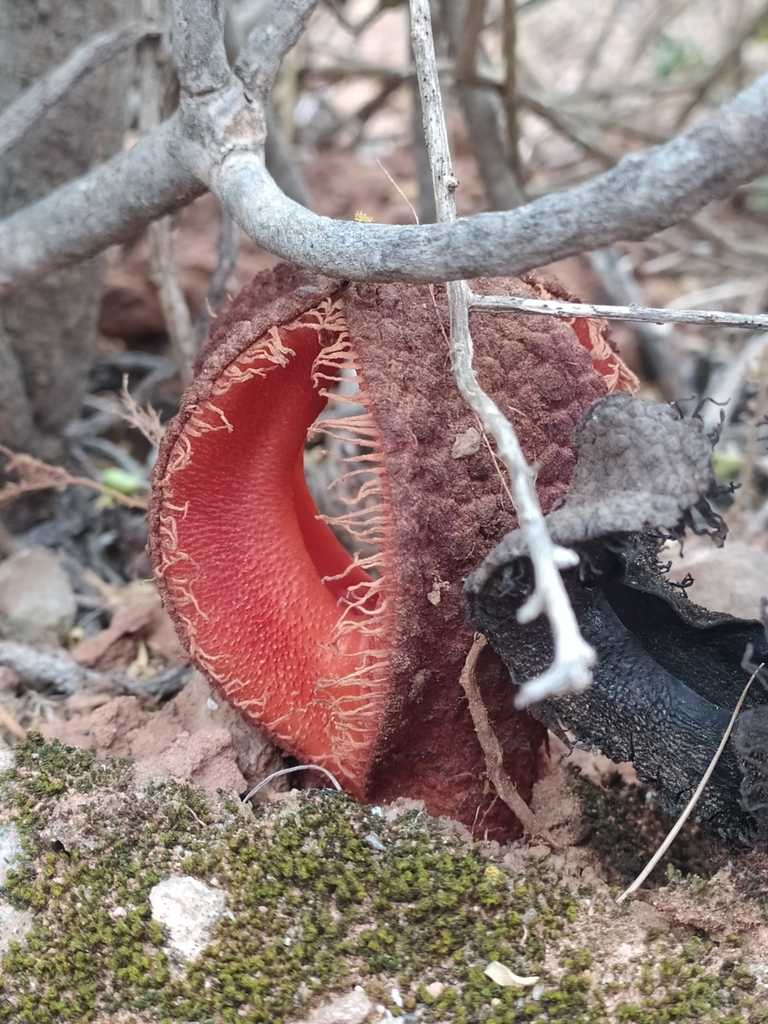
© Kim Gordon · iNaturalist · CC BY 4.0
Scientific Classification & Quick Facts
Classification
Known For
Detailed measurements for this species are still being verified.
Hydnora africana, commonly known as the Milkbush Jackalskos, is a peculiar flowering plant from the family Hydnoraceae, an obscure lineage that has adapted to some of Africa’s harshest environments. Found across three countries in southern Africa, this species occupies an unusual ecological niche, thriving in arid and semi-arid regions where few other plants can establish themselves.
The species remains poorly studied in scientific literature, with its conservation status currently listed as unknown. Its rarity in botanical collections and limited distribution across a small number of African countries suggest it may face pressures from habitat loss and changing climatic conditions, though detailed population surveys are lacking. The Milkbush Jackalskos exemplifies the hidden diversity of parasitic plants, organisms that challenge our conventional understanding of how plants obtain energy and water in dryland ecosystems.
Identification and Appearance
Hydnora africana, commonly known as the Milkbush Jackalskos, is a parasitic flowering plant that defies conventional botanical form. Unlike most plants, it lacks visible leaves, stems, and chlorophyll, existing instead as a subterranean network of fleshy tissues that attach directly to the roots of host plants.
Above-Ground Structures
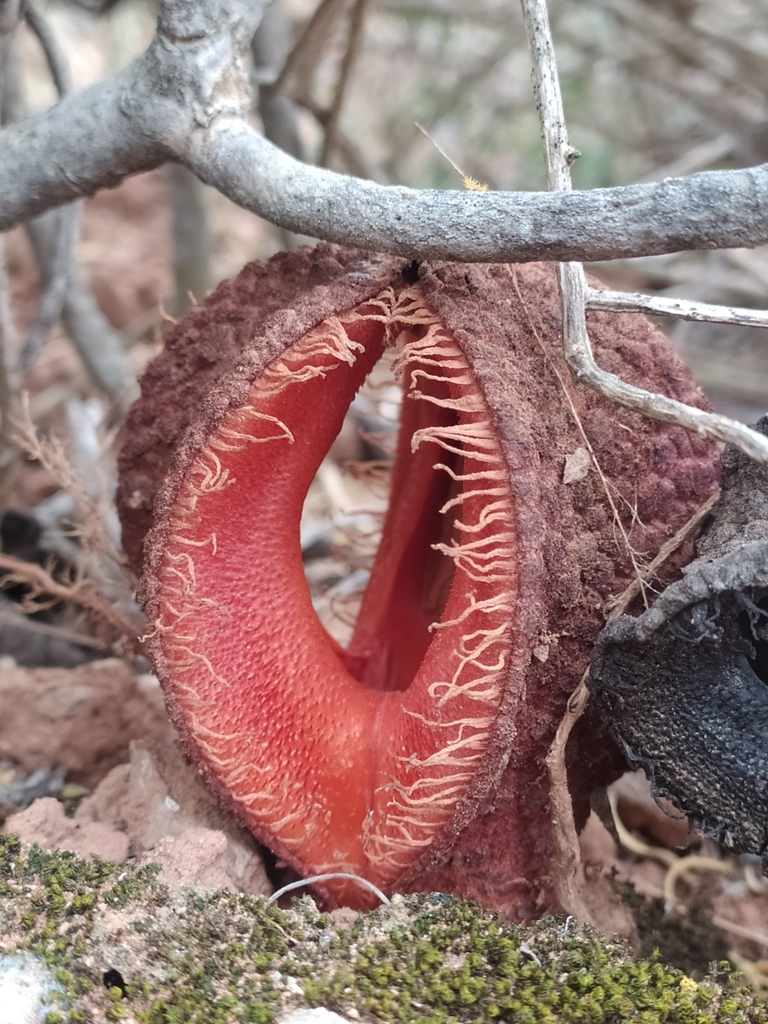
The only visible portions of Hydnora africana emerge from the soil as distinctive flowering structures. The plant produces large, carnivorous-looking flowers that range from deep burgundy to dark purple, often with fleshy, reflexed petals that create an urn-like or tulip-like appearance. Individual flowers can reach substantial size relative to other parasitic plants, making them locally conspicuous despite the species’ cryptic lifestyle. The flowers emit a strong, unpleasant odour—often described as faecal or fetid—which attracts the flies and beetles that serve as pollinators. After flowering, the plant develops fleshy, berry-like fruits that split open at maturity to release numerous small seeds.
Underground Morphology
Beneath the soil surface lies the plant’s true body: a tuber-like mass of pale, succulent tissue that penetrates the roots of host plants, typically members of the Euphorbiaceae family. This subterranean portion absorbs water and nutrients entirely through parasitic connections, requiring no photosynthesis or independent resource acquisition. The species typically occurs at elevations around 617 metres in its native southern African habitat, where seasonal moisture fluctuations trigger the emergence and flowering of its remarkable aerial organs.
Distribution and Habitat
Hydnora africana, known as the Milkbush Jackalskos, is confined to southern Africa. The species occurs across three countries, with South Africa serving as its primary stronghold. Occurrence records show 196 observations from South Africa, compared to 7 from Namibia and a single record from Angola, indicating that the species’ core range lies within South Africa’s borders.
The species maintains a narrow elevational range, occurring consistently at approximately 617 metres above sea level across its distribution. This consistent elevation suggests a preference for specific environmental conditions typical of lowland to mid-elevation regions in southern Africa.
Seasonal patterns
Activity records reveal a pronounced seasonal peak in September, when 66 observations were recorded—substantially higher than other months. A secondary peak occurs in October with 30 records. Summer months (July through October) collectively account for the majority of documented sightings, with August contributing 27 records. Winter months show reduced observation frequency, though the species remains present year-round in its range.
Biology
Growth
Hydnora africana, commonly known as Milkbush Jackalskos, is a highly specialized parasitic plant with an unusual growth habit that sets it apart from conventional herbs and shrubs. Unlike typical plants, this species produces no chlorophyll and remains largely subterranean, embedding itself within the roots of its host plants. The visible above-ground portions emerge only during the flowering season, making it difficult to observe the plant’s true form and extent throughout much of the year.
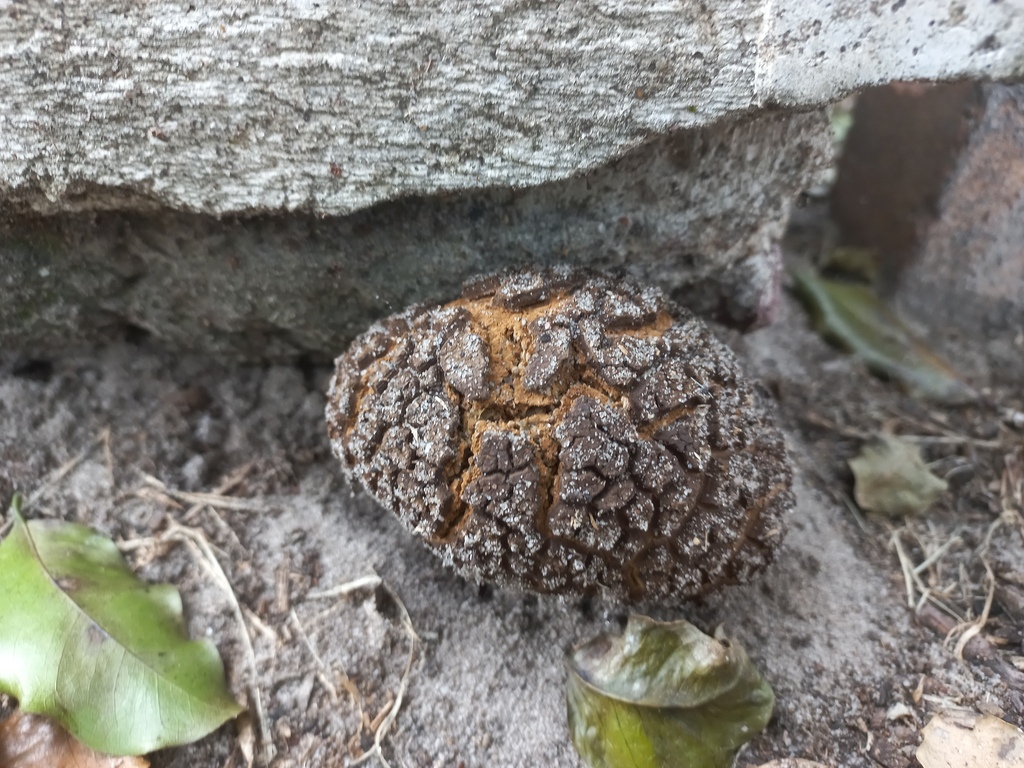
The plant’s growth is entirely dependent on its parasitic relationship with host species, which constrains its development patterns and size. Mature specimens produce fleshy, fungus-like structures that emerge from the soil but rarely exceed modest proportions. The subterranean architecture forms a network of absorptive tissues that draw nutrients directly from host roots, eliminating the need for independent root systems or photosynthetic tissue.
Flowering
The flowering of Hydnora africana represents one of the plant’s most distinctive biological features. The flowers are highly modified, fleshy, and often malodorous, emitting scents that attract specific pollinators, particularly carrion-feeding insects. These blooms emerge directly from the soil surface and display the characteristic fungal or rotting-meat appearance typical of many parasitic flowering plants.
Fruiting occurs following successful pollination, producing fleshy fruits that contain seeds adapted for dispersal by animals. The reproductive cycle is tied entirely to the availability and health of host plants, making flowering frequency and seed production variable and unpredictable across seasons and locations.
Cultivation
Cultivation of Hydnora africana is extremely challenging and rarely attempted outside of botanical research settings. The species’ obligate parasitic nature means it cannot survive independently or be propagated in conventional horticultural conditions. Gardeners and cultivators lack the necessary host species identification and symbiotic techniques to establish this plant in controlled environments.
No standardized cultivation requirements exist for soil pH, hardiness zones, light conditions, or water regimens, as the plant’s needs are determined entirely by its host and the ecological context of its natural range. The species remains essentially impossible to cultivate intentionally, and any conservation or study efforts must focus on protecting its wild populations and their associated host plants.
Conservation and Threats
Hydnora africana has not been formally assessed by the IUCN Red List, meaning its global conservation status remains officially undocumented. Without a designated threat classification, the species’ vulnerability to extinction is unknown to most conservation frameworks. This absence of formal assessment does not indicate the species is safe—rather, it reflects gaps in global monitoring of rare or poorly studied organisms.
Threats
Climate change poses a significant risk to Hydnora africana‘s reproductive capacity. As a holoparasitic plant dependent on its obligate host species for survival, the species is doubly vulnerable: shifts in temperature and precipitation patterns can disrupt the sexual reproduction of both the parasite and its host. If either partner fails to reproduce successfully, the ecological relationship collapses entirely. This interdependence makes Hydnora africana far less resilient to rapid environmental change than free-living plants.
Beyond climate impacts, habitat loss and degradation likely threaten populations across its African range. Land conversion for agriculture, urbanization, and resource extraction reduce the availability of suitable habitat and host plants. However, quantitative data on population size, population trend, and specific regional threats remain scarce, hindering targeted conservation responses.
Conservation Efforts
No formal conservation programmes or legal protections specific to Hydnora africana are currently documented. The absence of an IUCN assessment means the species does not feature in most international conservation priority lists. Addressing this gap requires baseline research on distribution, abundance, ecology, and host-plant relationships across the species’ range.
Cultural Significance
Hydnora africana holds a distinctive place in the cultural and culinary traditions of southern Africa. The fruit is documented as a traditional food of the Khoisan people of South Africa, representing one of the few known human uses of this extraordinary parasitic plant. Its acceptance as sustenance reflects the deep ecological knowledge of indigenous communities, who recognized value in a organism that appears, at first glance, utterly foreign to conventional plant life.
The plant’s unusual morphology captured European scientific imagination in the nineteenth century. When Swedish botanist Carl Peter Thunberg first encountered Hydnora africana near Calvinia in South Africa’s Hantam district, he mistook it for a fungus—a reaction that shaped its scientific nomenclature. He named the genus Hydnus after fungal groups, a designation later refined to Hydnora. This moment of misidentification underscores how radically different the species appears from typical flowering plants, lacking stems and leaves entirely.
Traditional medicine systems across Africa have incorporated Hydnora species into healing practices, though these uses remain poorly documented in formal literature. Reported biological activities of H. africana and its close relative H. abyssinica include antibacterial, antiproliferative, antioxidant, antidiarrheal, and antifungal properties. Despite these folkloric applications and demonstrated pharmacological potential, systematic research into the plant’s medicinal value has lagged significantly behind its traditional use in communities where it grows.
Fun Facts
- 1.Hydnora africana is a parasitic plant that feeds on the roots of other plants rather than producing its own food through photosynthesis. It lacks true leaves and relies entirely on its host plant for nutrients and water.
- 2.The plant produces a distinctive carcase-like odor to attract carrion beetles and flies as pollinators. This foul smell, which intensifies at night, mimics the scent of rotting flesh to lure insects to its flowers.
- 3.Its flowers are among the most unusual in the plant kingdom, emerging directly from the soil with a trap-like structure that closes around visiting insects. The flower can remain underground until conditions are right for pollination.
- 4.Hydnora africana has an extremely limited above-ground presence, with only its flower occasionally visible above soil. Most of the plant exists as a network of tubers and feeding structures buried deep underground.
- 5.The species produces fleshy, tubercle-like fruits that are dispersed by rodents and other small mammals attracted to their nutrient-rich flesh. These fruits can remain viable in the soil for extended periods before germinating.
- 6.Despite its parasitic nature, Hydnora africana does not typically harm its host plants severely. The relationship is often described as hemiparasitic, as the host plant typically survives the infestation, though its vigor may be reduced.
- 7.The plant is found exclusively in arid and semi-arid regions of southern Africa, thriving in harsh environments where few other flowering plants can establish themselves as effective parasites.
Sources and References
- Global Biodiversity Information Facility (GBIF)View source
- iNaturalistView source
- WikidataView source
- WikipediaView source
- Encyclopedia of Life (EOL)View source
- Plants of the World Online (POWO)View source
Ecology
Growing Conditions
Edibility
Photo Gallery
Kim Gordon · CC BY 4.0
Related Species
Was this profile helpful?