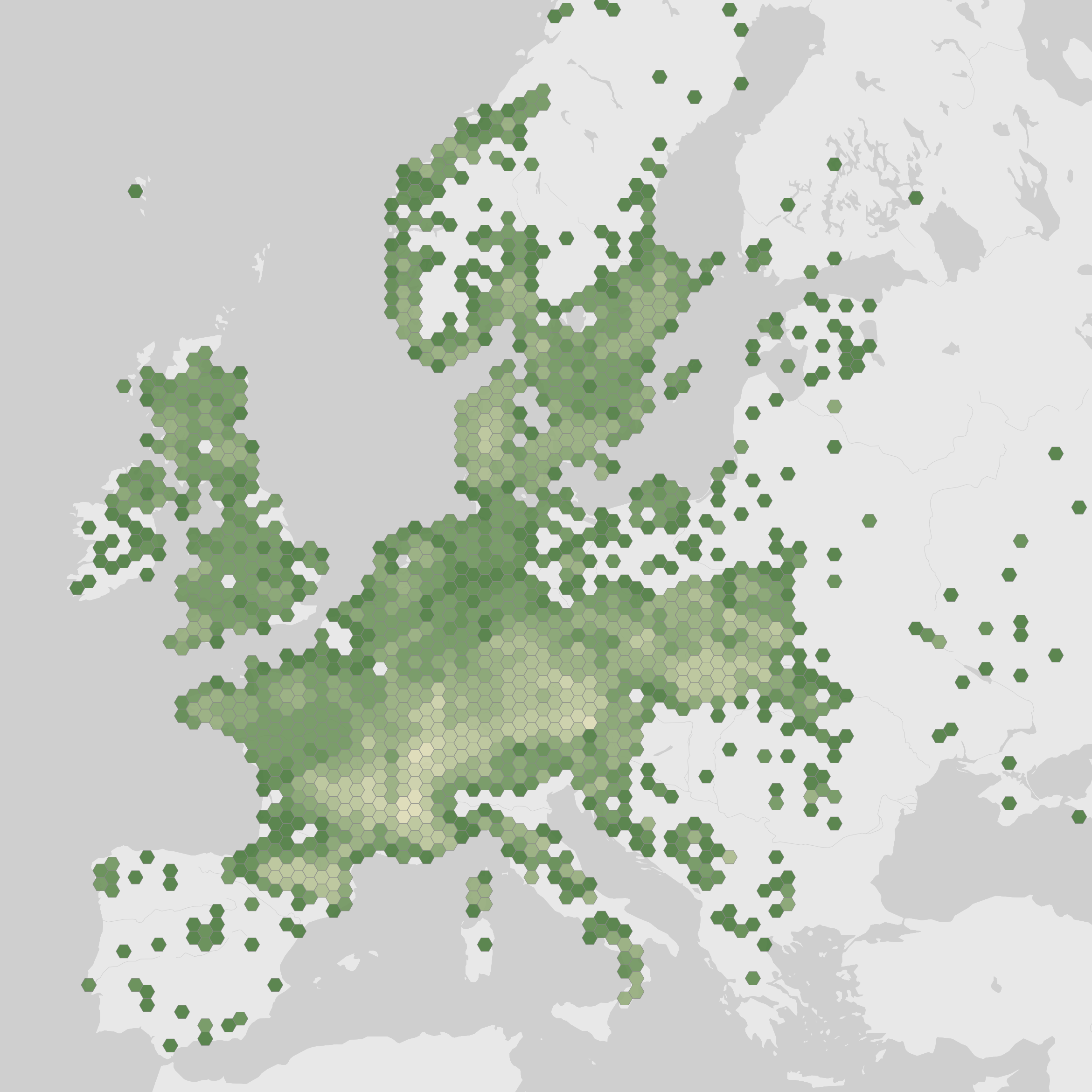
Abies alba's native range stretches from the Pyrenees in France and Spain north to Normandy, then east through the Alps and Carpathians into the Balkans, reaching Slovenia, Croatia, Bosnia and Herzegovina, Montenegro, Serbia, Bulgaria, Kosovo, Albania, and northern Greece before dipping south into Italy.
Known as the European silver fir, this species belongs to the pine family, Pinaceae, within the order Pinales and class Pinopsida. The IUCN lists it as Least Concern, a reflection of its wide distribution across European mountain forests.
What makes the silver fir worth a closer look is not just its scale but its long entanglement with people, from Roman wine casks to the origins of the modern Christmas tree.
Identification and Appearance
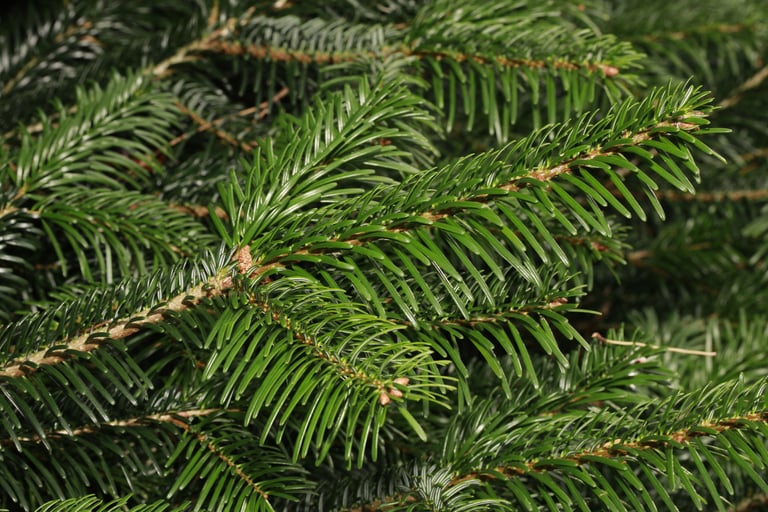
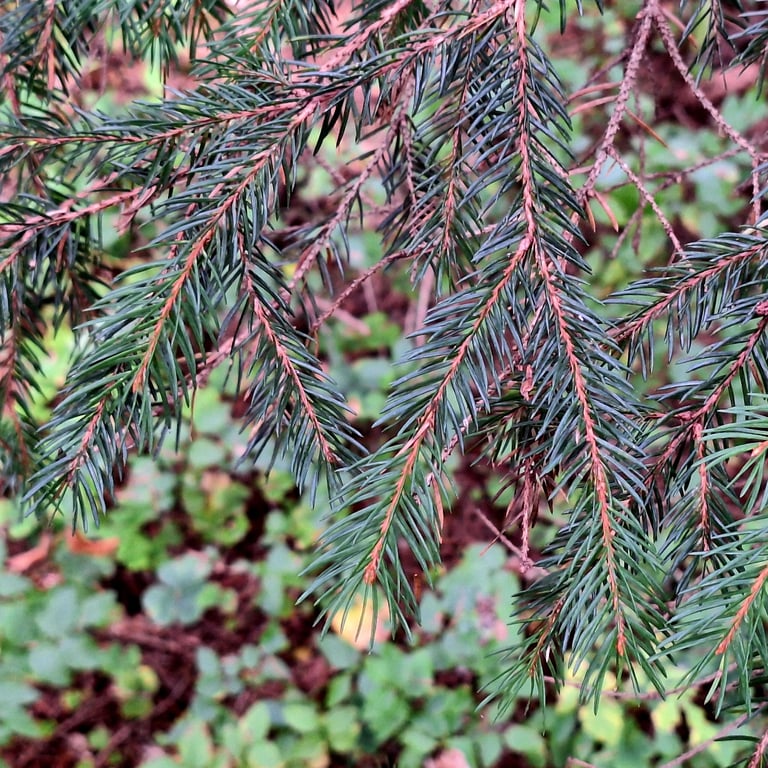
The most reliable field mark is the needle: flattened, 1.8 to 3.0 centimeters long, glossy dark green above, with two pale greenish-white bands of stomata on the underside and a tip that is usually slightly notched. Unlike many related firs, the needles spread out to either side of the shoot rather than covering it, so the shoot itself stays visible when viewed from above.
This is a large tree, typically reaching 40 to 50 meters in height with a trunk up to 1.5 meters in diameter. The largest recorded individual measured 60 meters tall with a trunk 3.8 meters across, an exceptional size for a European conifer.
Cones are cylindrical, 9 to 17 centimeters long and 3 to 4 centimeters wide, made up of roughly 150 to 200 scales, each bearing an exserted bract and two winged seeds. Rather than falling intact, the cones disintegrate on the tree as they mature to release their seeds. The wood is pale white, the source of the species name alba.
Abies alba is closely related to Bulgarian fir (Abies borisii-regis), Spanish fir (Abies pinsapo), and Sicilian fir (Abies nebrodensis), and some botanists treat the latter two as varieties of it. It differs from these relatives in its sparser foliage and the way its needles leave the shoot exposed, a useful check when the species overlaps with close kin.
Distribution and Habitat
Monthly observation records show a sharp seasonal pattern rather than a steady presence throughout the year. Counts climb from 22,131 in May to a peak of 42,781 in July, stay elevated through August at 34,859, then fall steeply to under 6,000 by December and January.
This swing almost certainly reflects when people are out recording trees in the mountains rather than any real change in where the species grows, since these are presence-only observations and not a measure of abundance or population size. The low counts in winter months likely trace to reduced observer activity in high-elevation terrain rather than the tree's absence.
Ecology and Relationships
In the western Balkan Peninsula, silver fir is a defining species of the dinaric calcareous block fir forest, a distinct montane forest type. In Italy it plays a similar structural role in the mixed broadleaved-coniferous forests of the Apennines, especially in the northern range, where it favors cold, humid conditions on north-facing slopes with rainfall exceeding 1,500 millimeters a year.
In the eastern Alps, silver fir grows alongside Norway spruce, European beech, and other trees, forming layered mixed stands rather than pure fir forest. These associations shape much of the tree's realized range within its broader mountain distribution.
The species also supports specialized insects: caterpillars of the tortrix moth Cydia illutana feed on its cone scales, while a related moth, Cydia duplicana, feeds on bark around wounds and cankers on the trunk.
Uses and Human Relationships
In Roman times, silver fir wood was made into casks for storing and transporting wine and other goods, casks that were often later recycled into writing tablets. The tree also yields a resinous essential oil, pine-scented and used in perfumes, bath products, and aerosol inhalants, while its branches, bark, and wood have historically gone into spruce beer.
The timber itself is strong, lightweight, pale, fine-grained, and long-fibred, qualities that make it suitable for construction, furniture, plywood, pulpwood, and paper manufacture.
Silver fir holds a particular place in Christmas tree history as the first species used for the purpose, before being largely displaced by Nordmann fir and Norway spruce, which offer denser foliage or cheaper cultivation. It is still grown on Christmas tree plantations both within its native range and in northeastern North America, from New England to Canada's Maritime Provinces. Separately, honeydew produced by aphids feeding on silver fir is collected by honey bees and sold as "fir honey."
Fun Facts
- The tree's native range spans well over a dozen countries, stretching roughly 3,000 kilometers from the Pyrenees in the west to the Carpathian and Balkan mountains in the east.
- Its common name, European silver fir, points to the pale, almost white wood inside the trunk, the same trait that gives the species its scientific name, alba.
Conservation status
- LC
- NT
- VU
- EN
- CR
Least Concern
Ecology
Habitat
- Forest
- Mountain
Growth habit
- Tree