Individuals of the Great Basin bristlecone pine can live up to 4,000 years. Pinus longaeva is a conifer in the family Pinaceae, found in the higher mountains of California, Nevada, and Utah, and it is rated Least Concern by the IUCN.
The tree is best known for its extreme age and its gnarled, weathered form. In 1987, it was designated one of Nevada's state trees, a recognition of how closely it is tied to the state's high mountains.
Identification and Appearance
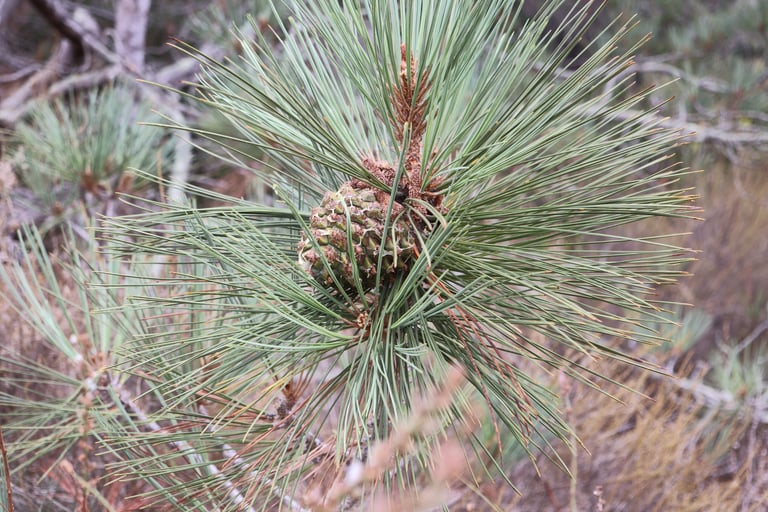
The needles give the best clue to identity. They grow in bundles of five, are stout and 2.5 to 4 cm long, and are deep green to blue-green on the outer face. The inner surfaces carry a bright white band of stomata, and some needles stay green for 45 years.
Mature trees reach 5 to 15 m tall, with trunks up to 2.5 to 3.6 m across. The bark is bright orange-yellow and thin, and it turns scaly at the base of the trunk. On older trunks it becomes reddish-brown with deep fissures.
Cones are ovoid-cylindrical, 5 to 10 cm long, and green or purple at first. They ripen to orange-buff by 16 months, and each thin, fragile scale ends in a bristle 2 to 5 mm long. Trees at high altitudes often look stunted and twisted, and their green needles give the branches a bottle-brush look.
The Great Basin bristlecone pine differs from the Rocky Mountain bristlecone pine because its needles always have two uninterrupted resin canals, so they lack the small white resin flecks of that species. It differs from the foxtail pine because its cone bristles are over 2 mm long and its cone base is rounded rather than conic.
Distribution and Habitat
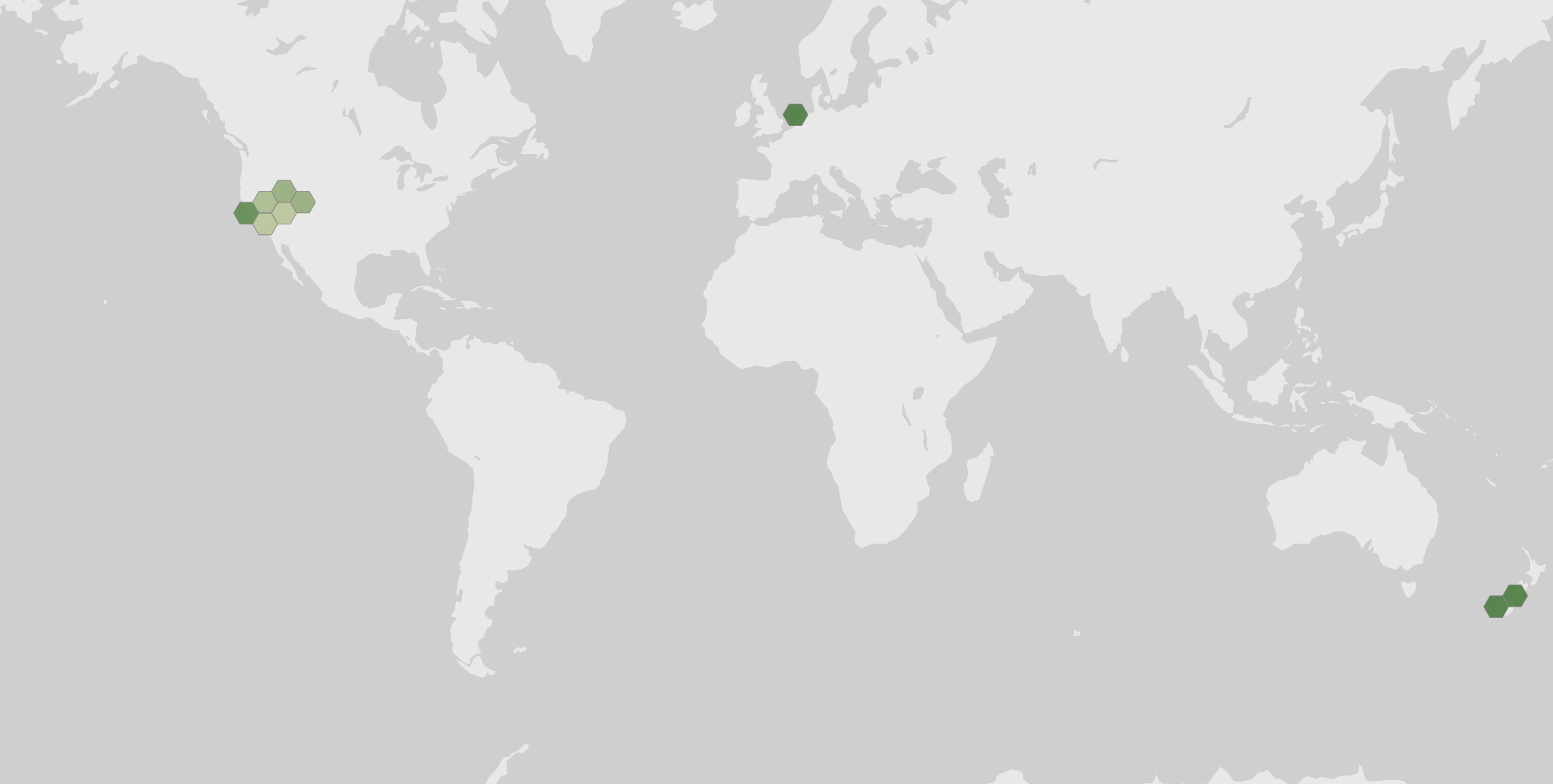
The species occurs in Utah, Nevada, and eastern California. In California it is restricted to the White Mountains, the Inyo Mountains, and the Panamint Range. In Nevada it grows in most of the higher ranges of the Basin and Range, from the Spring Mountains near Las Vegas north to the Ruby Mountains, and in Utah it reaches northeast to South Tent in the Wasatch Range.
It grows from 7,200 to 12,000 feet (2,200 to 3,700 m) in California, and overall it occupies subalpine and alpine zones between about 1,700 and 3,400 m. It favors very dry, exposed slopes and ridges, usually steep, with south and west aspects. Gale-force winds are common on these sites.
The soils are thin and rocky, most often derived from limestone or dolomite. In the White Mountains, stands grow on dolomite soils with 50 percent or more rock content, where few other plants can compete.
In most places the trees form large, open stands, with canopy cover of only 15 to 50 percent. Limber pine, Engelmann spruce, subalpine fir, and quaking aspen are common neighbors, and sagebrush and salt-desert shrublands surround the stands at lower elevations.
Ecology and Relationships
The tree is highly vulnerable to fire. Its resinous bark ignites quickly, and a crown fire will almost certainly kill it, even low-intensity burns can damage it. Populations are resilient, though, because the species is a primary succession pioneer that quickly grows on new open ground, so stands are expected to reestablish after a fire. Large fires are uncommon where it grows, and they are not a major factor in its long-term survival.
Seeds are mostly dispersed by the wind, carried by wings 12 to 22 mm long. Clark's nutcrackers also spread the seeds. The birds cache conifer seeds in the ground, and some caches are never retrieved and sprout into new trees, which explains the multi-trunk growth form common where the nutcrackers live.
The species is a poor competitor on good soils, so it does best in harsh terrain. It often dominates high-elevation dolomite soils, where most plants cannot survive. An introduced fungal disease, white pine blister rust, is believed to affect some individuals.
Uses and Human Relationships
The Great Basin bristlecone pine is considered a sacred tree by some tribes, and its presence is often tied to spiritual and cultural meaning. Pines in general have long been part of many cultures' folklore, where they are associated with immortality, steadiness, and resilience, qualities linked to their ability to survive harsh environments.
The species has seen limited horticultural use. The dwarf cultivar 'Cherry Lady' was discovered as a witches' broom by Franz Etzelstorfer and Jörg Kohout during a 2006 trip to the United States. The bristlecone has become an uncommonly popular tree in modern culture.
Bristlecone pines are protected in federally owned areas such as the Ancient Bristlecone Pine Forest in the White Mountains of California and Great Basin National Park in Nevada. These areas prohibit the cutting or gathering of wood.
Fun Facts
- In 2011 a population survey found the species stable, with no known subpopulations decreasing, and it was moved from Vulnerable, its 1998 listing, to Least Concern.
- In ancient Greek tradition, the pine was a symbol of royalty and was linked to the goddess Pitthea, and it was also a fertility symbol tied to the Dionysus and Bacchus mythology.
Photos
Photographs from by Indio Brown via iNaturalist, licensed under CC BY 4.0., by Adam Kamal via iNaturalist, licensed under CC BY 4.0., by Andrew Dudley via iNaturalist, licensed under CC BY 4.0., by Nelson Balcar via iNaturalist, licensed under CC BY 4.0., by Trevor Van Loon via iNaturalist, licensed under CC BY 4.0., by Brooke Smith via iNaturalist, licensed under CC BY 4.0., by Kenzie Anderson-Bell via iNaturalist, licensed under CC BY 4.0., by Parker James Lloyd via iNaturalist, licensed under CC BY 4.0., by Jennifer Styrsky via iNaturalist, licensed under CC BY 4.0., by Zach Earl via iNaturalist, licensed under CC BY 4.0., by Dee Shea Himes via iNaturalist, licensed under CC BY 4.0., by Melanie J. Davis via iNaturalist, licensed under CC BY 4.0., and by Sam Eberhard via iNaturalist, licensed under CC BY 4.0., credited on each photo.
Ecology and classification
Classification
- Phylum
- Tracheophyta
- Class
- Pinopsida
- Order
- Pinales
- Family
- Pinaceae
- Genus
- Pinus
- Species
- Pinus longaeva
Sources
- GBIF Species names and classification
- iNaturalist Photos
- Wikidata Common names and conservation status
- Wikipedia Summary extract
- Encyclopedia of Life Habitat, diet and behavior traits