With individual trees in Lapland recorded at over 760 years old, Pinus sylvestris ranks among the longest-lived trees in Europe. It is a conifer in the pine family, Pinaceae, native across Eurasia from Western Europe to Eastern Siberia, and is widely known as the Scots pine (or Scotch pine in the United States). Its conservation status is Least Concern, reflecting its enormous natural range and adaptability.
What makes the tree worth a closer look is its sheer range of tolerance: it grows from sea level in the Arctic to over 2,600 meters in Mediterranean mountains, surviving temperatures as low as -64°C in Siberia while also enduring hot, dry summers farther south. Few conifers span such extremes of climate and geography.
Identification and Appearance
The clearest field mark is the combination of orange-red bark and short, blue-green needles carried in pairs. On young trees and the upper trunk of mature specimens, the bark is thick, flaky, and distinctly orange-red; with age it turns scaly and gray-brown, though the reddish upper bark often persists, giving older trees a two-toned trunk.
Mature trees typically reach 35 meters in height and up to 1 meter in trunk diameter, though exceptional individuals on productive sites exceed 45 meters and 1.7 meters in diameter. The tallest tree on record, growing in Estonia, stands 46.6 meters tall. The growth habit is distinctive: a long, bare, straight trunk topped by a rounded or flat crown of foliage, with light brown shoots arranged in a spiral, scale-like pattern.
The needles are glaucous blue-green, sometimes darker or yellow-green in winter, measuring 2.5 to 5 centimeters long and 1 to 2 millimeters wide, borne in fascicles of two with a persistent gray basal sheath 5 to 10 millimeters long. Vigorous young trees can produce needles twice as long, occasionally in fascicles of three or four. Needle persistence ranges from two to four years in warmer climates up to nine years in subarctic regions, while seedlings under one year old bear single, flattened, serrated juvenile leaves rather than paired adult needles.
The cones offer a further check: pointed ovoid-conic, 3 to 7.5 centimeters long, red at pollination, turning pale brown in their first year, then green and finally gray-green to yellow-brown at maturity. Each cone scale has a flat to pyramidal apophysis with a small central prickle, and the blackish seeds, 3 to 5 millimeters long, carry a pale brown wing 12 to 20 millimeters long.
Distribution and Habitat
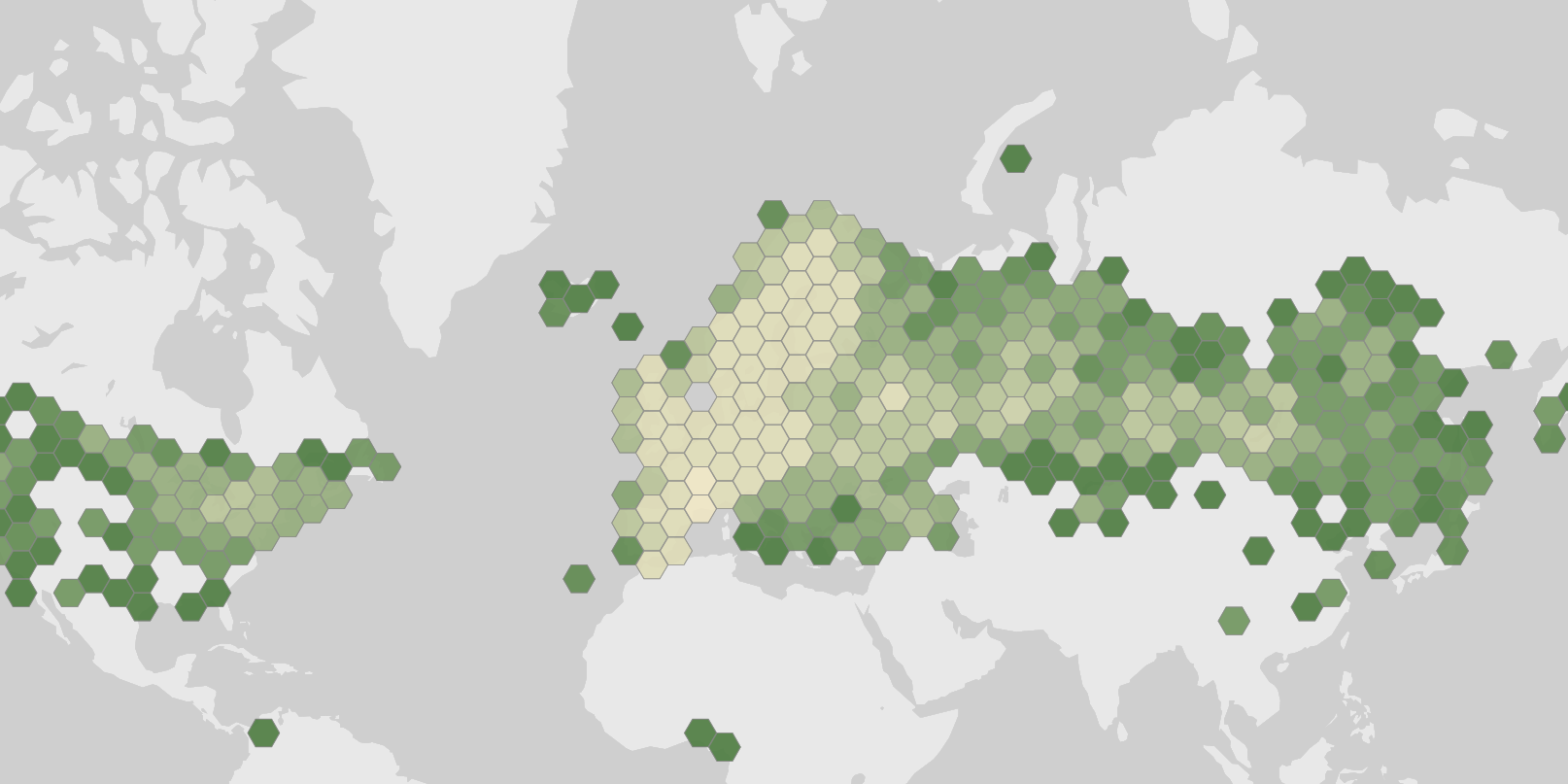
Scots pine is the only pine native to northern Europe, ranging from Western Europe across to Eastern Siberia, south to the Caucasus and Anatolia, and north well inside the Arctic Circle in Fennoscandia. In the north of its range it grows from sea level to 1,000 meters, while in the south it becomes a mountain tree found between 1,200 and 2,600 meters altitude.
The species favors poorer, sandy soils, rocky outcrops, peat bogs, and sites near the forest limit, where it faces less competition; on richer soils it is typically outcompeted by spruce or broad-leaved trees. It tolerates soils with pH from 4.0 to 7.0 but grows best between 4.5 and 6.0, and it can persist even where the subsoil is permanently frozen. Monthly observation counts peak sharply from June through August, which likely reflects greater field survey activity and visibility during the growing season rather than a true seasonal change in the tree's presence, since as a conifer it does not migrate or die back.
In Britain and Ireland, pollen records show pine reaching southern England roughly 9,000 years ago and Scotland between 8,000 and 8,500 years ago, likely via an independent refuge, Scandinavia through Doggerland, or Ireland. As climate warmed, it vanished from most of Britain and Ireland around 5,500 years ago, surviving only in Scotland, Kielder in England, and The Burren in County Clare, Ireland; Irish populations eventually went extinct between 2,000 and 1,000 years ago. Today it occurs naturally in Britain only in Scotland, where it once formed much of the Caledonian Forest.
Overcutting, fire, overgrazing by sheep and deer, and deliberate clearance to deter wolves have all reduced the Caledonian Forest to roughly 17,000 hectares, just over 1% of its estimated original 1.5 million hectares, with the main remnants at Abernethy Forest, Glen Affric, Rothiemurchus Forest, and the Black Wood of Rannoch.
Ecology and Relationships
Scots pine rarely stands alone ecologically; across Europe and Asia it forms boreal forest together with Norway spruce, and it mixes with common juniper, silver birch, European rowan, and Eurasian aspen. Farther south it grows alongside European black pine, mountain pine, Macedonian pine, and Swiss pine, while in the eastern part of its range it associates with Siberian pine.
The tree's ecological success on poor sites comes partly from an efficient nutrient-extraction strategy: studies of foliage across several seed sources found significant differences in the ability to accumulate nitrogen, phosphorus, sodium, magnesium, and boron, with magnesium especially important to nutrition, and faster-growing seed sources accumulating higher foliar magnesium levels even on infertile sand and gravel soils.
The species is not without pressures from other organisms. Its range overlaps with the pine shoot beetle Tomicus piniperda, a primary pest, and in 2020 black spot needle blight, caused by the fungus Heterotruncatella spartii, was documented on hundreds of Pinus sylvestris var. mongolica trees across four forest farms in northeastern China, starting as light black spots on needles before they withered and died.
Uses and Human Relationships
Timber and resin products dominate the human use of Scots pine. Commercial plantation rotations run between 50 and 120 years, with longer cycles in slower-growing northeastern regions, and the pale brown to red-brown wood is used for pulp, sawn timber, and general construction, with a dry density around 470 kg/m³. In Scandinavia the species was historically tapped for tar production in the preindustrial era, a few tar producers still operate, and the tree has also supplied rosin, turpentine, and a hemp-like textile fiber known as vegetable flannel.
Beyond forestry, Scots pine carries deep cultural weight. Celtic Druids associated it with the sun's return after winter and burned it in seasonal rituals, while in Greek mythology it was linked to the goddess Artemis, with its cones read as symbols of fertility. It has long served as a Yuletide log and winter solstice fire, symbolizing rebirth and the hope of spring. Practically, it was once used to fortify coal-mining tunnels in Flanders, prized because the wood would crack audibly when it needed replacing. It is the national tree of Scotland and the plant badge of Clan Gregor and Clan Farquharson.
Introduced to North America around 1600, Scots pine became one of the most popular Christmas trees from the 1950s through the 1980s, though it has since been eclipsed by species such as Fraser fir and Douglas-fir. It is now considered invasive in parts of Ontario and Michigan, yet it often grows poorly there, developing a twisted, haphazard form outside cultivation and remaining vulnerable to pine wilt disease, caused by the pine wood nematode, which can kill infected trees within weeks. Several ornamental cultivars, including 'Aurea', 'Beuvronensis', 'Frensham', and 'Gold Coin', have received the Royal Horticultural Society's Award of Garden Merit.
Fun Facts
- A fossil seed cone attributed to Pinus montana fossilis, related to Scots pine, has been dated to the late Pliocene epoch, roughly 2.6 million years ago.
- The oldest known living Scots pines, found in Lapland, Northern Finland, exceed 760 years of age, far beyond the typical 150 to 300 year lifespan.
- Celtic Druids linked the tree to the sun's return after the dark winter months, burning it in seasonal rituals.
- In Greek mythology the pine was connected to the goddess Artemis, and its cones were read as symbols of fertility.
Conservation status
- LC
- NT
- VU
- EN
- CR
Least Concern
Ecology
Habitat
- Wetland
- Forest
- Mountain
- Tundra
Growth habit
- Tree